Meta-Practice, Research

words on social practice and creativity

Christoph Büchel’s Piccadilly Community Centre: an exciting example of social practice.

J.J. Charlesworth’s “Hidden Intentions,” (Art Review, December 2011) introduced me to this brilliant intervention transforming the tony Central London Hauser & Wirth location (formerly a bank) into a working social centre, and not just for in-the-know art students, but for the public—senior citizens, yoga practitioners and so on. Piccadilly Circus is a popular tourist’s nexus like Times Square, where simply winding through crowds, dodging street salesmen, and finding a restroom can be exhausting. So Büchel’s gesture of turning an exclusive, expensive, private space into a rambunctious, free, public one is quite satisfying. I was also intrigued to read that

much was made of whether Büchel’s project was a comment on David Cameron’s ‘Big Society’

I find Büchel’s responsiveness commendable.

On irony, and bridging the divide between art and life

“Hidden Intentions” is not an exhibition review, but a speculative essay. Charlesworth also examines Matthew Darbyshire’s faux loft ads at Herald Street, writing that it

is interesting because, like Büchel’s community centre, it points backwards to interrogate the capacity of the viewer to recognise the gesture as ironic. Because irony always implies a ‘double’ audience—those who accept the gesture at face value and those who realise the gesture is simulated intentionally—it also implies a form of superiority, which is often couched in terms of criticism of another….

This is art that writes itself into the fabric of everyday life with only the fading trace of the artist as proof of its reality as a sort of ironic gesture, and in which the work’s audience is made complicity with the artist’s manipulation of the world of others…. Of course, it still needs the institutional frame of the artworld to allow it to happen, but in doing so, it takes to an extreme the postmedium scope of current artistic possibility, where in the end, the only thing that is distinguishable is the discursive setup of the artworld itself.

Conflict aids creativity?

So argues Jonah Lehrer in “Group Think: The Brainstorming Myth” (The New Yorker, January 20, 2o12). He presents evidence contrary to the widely-accepted prohibition against criticism in brainstorming:

According to [psychology professor Charlan] Nemeth, … “…debate… will always be more productive. True creativity requires some trade-offs.”

To Lehrer and Nemeth, I’d respond with a constructively critical, “Yes, but…”

Positive Sign #1, 2011, glitter and fluorescent pen with holographic foil print on gridded vellum, 8.5 × 11 in / 21.5 × 28 cm

Consider Mihaly Csikszentmihalyi‘s five stages of the creative process: preparation, incubation, insight, evaluation, and elaboration. I would think that debate is productive in some stages (such as evaluation and elaboration) and not others (such as preparation, incubation, and insight).

Perhaps more even-handed: sociologist Brian Uzzi analyzed musicals to find correspondences between social intimacy among creators and box office and critical success.

“The best Broadway teams, by far, were those with a mix of relationships,” Uzzi says. “These teams had some old friends, but they also had newbies. This mixture meant that artists could interact efficiently—they had a familiar structure to fall back on—but they also managed to incorporate some new ideas. They were comfortable, but not too comfortable.”

For artists considering creative and professional collaborators, choose carefully.

Lehrer also makes an exemplar of the MIT “rad lab”—where a disused building became home to divergent departments, creating spillover, and presumably, lending interdisciplinary gusto to the work of Chompsky, Bose, and other paradigm shifters. Lehrer concludes

The lesson of Building 20 is that when the composition is right—enough people with different perspectives running into on another in unpredictable ways—the group dynamic will take care of itself…. The most creative spaces are those which hurl us together.

I cringed when I read that last sentence, after my experiences in open-plan studios in graduate school. Unwanted intrusions can make focusing attention seem like a Herculean task. Being hurled together say, when you’re reading or trying to resolve an artwork, with someone taking a phone call or playing music, is not creative, but torturous. Psychologist Jonathan Haidt points out that humans can adapt to many things, but we never adapt to intermittent noise:

Research shows that people who must adapt to new and chronic sources of noise … never fully adapt, and even studies find some adaptation still find evidence of impairment on cognitive tasks. Noise, especially noise that is variable or intermittent, interferes with concentration and increases stress. It’s worth striving to remove sources of noise in your life.

Jonathan Haidt, The Happiness Hypothesis, New York: Basic Books (2006) 92.
Standard
Meta-Practice, Projects, Research

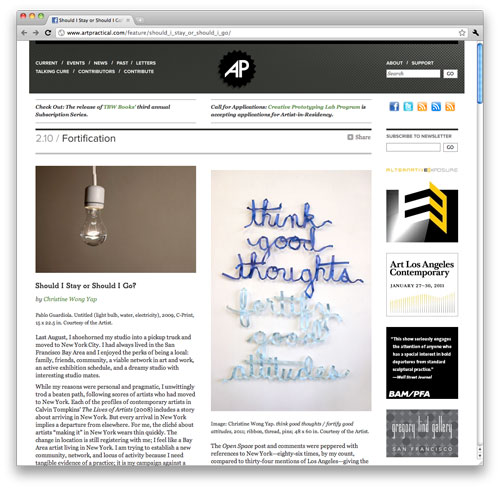
Should I Stay or Should I Go? on Art Practical

Art Practical, Should I Stay or Should I Go? Christine Wong Yap

My feature on artists staying or leaving the Bay Area is finally out in the current issue of Art Practical. Thanks to the interviewed artists—Michael Arcega, Pablo Guardiola, Stephanie Syjuco, Emma Spertus, and Jenifer Wofford—for their time and insight. And a deep bow to Editor-in-Chief Patricia Maloney, Copy Editor Victoria Gannon and the rest of the Art Practical team for their support and guidance!

“Should I Stay or Should I Go?”
Feature story published on
Art Practical, Issue 2.10

Standard
Meta-Practice

Adventures in archiving

As a book-end to photos of my workbench and pegboard glory when I first moved into my West Oakland studio, I’ll share some pictures of the crates that will characterize my move out…

Crates!

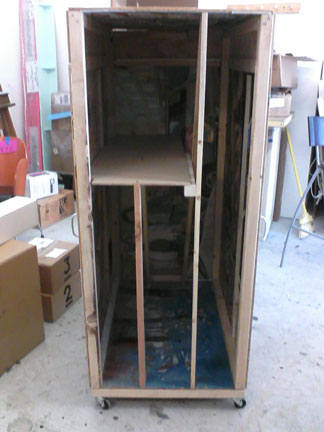
As I’ve been decommissioning art materials and deciding which artwork to store or bring to New York, I’ve also been building and modifying crates as needed.

My painting rack (made of old paintings on plywood that I couldn’t bear to part with) will make a great crate. I can fit boxes in there too, now that I’ve added a shelf. It’s now a split-level bobber:

This guy will be great in storage. It’s not air- or water-tight by any means, but I’ve got poly and tape. Otherwise, it’s got a small footprint, casters and storage space on top.

For the move, I’ll put all my tools, materials and artworks into one large crate. That will be my studio in a box! Only the essentials are coming with me: very recent and pertinent art works, major tools like the miter saw and sewing machine, my first and only screen (just the hinges, no baseboard), my Alumi-cut and Alvin mats, my 24″ level-ruler combo. Gloves, goggies and a mask. Only two framed artworks, with the glass swapped out with acrylic.

I’m re-purposing the design for an old crate for my new studio-in-a-box crate. Huge time-savers were finding the original schematic and shopping list in an old notebook, and cutting diagrams of the sheet goods on an archived CD. (Between my compact car and temperamental hand-me-down circular saw, I often have the lumber yard cut the full sheets. Presenting a schematic with dimensions, as well as with the work pieces and remnants labeled, seems to help garner accurate cuts.)

Inventory software!

In the past, I kept records of artwork in two places: my website (copy and pasting to develop image lists) and my head (remembering what is where for the most part). Now that my inventory is undergoing a bi-coastal mitosis, I realized having some kind of tracking software will help.

This ArtBizBlog post was insightful:

The software below was designed specifically for artists’ special needs. Unfortunately, I can’t recommend one of these over the others….

The blogger also noted

Amazingly, most of these are unattractive.

[That’s an ongoing gripe of mine; acute reactions to user experiences are the burden of being married to an interactive designer.]

Since the price was right ($30) and the interface straightforward and functional, I thought I’d try Flick, a Filemaker adaptation created by a software developer in Australia. Having some familiarity with Filemaker helped me jump right in—even though I last used it in the early 2000s.

So far, I think it’ll work for me. It’s pretty basic. Not very powerful, and can be a bit slow when you’re scrolling through multiple records. It’s also short on shortcut keys, but for the price it works fine.

I wish I knew more about accession numbers, especially one that suits my idiosyncratic output. I can already see that my naming convention—[year]--[series]-[number]—could use improvement. It probably should have been [year]-[series]--[number]. This is where being able to do some batch processing would be nice. Luckily, I’ll have some in-house systems management know-how in New York.

Standard
Meta-Practice, Research

Cultivating inefficiencies

As S. Barich pointed out to me, Jerry Saltz recently wrote:

“Like most people in the art world, I’m basically making this up as I go. The art world is about trying to invent new definitions of skill.” (Jerry Saltz, “Work of Art Season Premiere: Judge Jerry Saltz Recaps,” NYMag.com, June 10, 2010)

One of my skills, if I could call it that, is procurement. Even after all these years, I’m surprised at how much time and energy I spend sourcing materials.

Since I respond to the materials that I work with, I often can’t start a project until I have them in hand. Yet identifying and getting the right materials can take weeks. Beyond brushes, paint, paper, frames and the usual, Dick Blick and Aaron Bros aren’t much help. Besides, I’m too self-conscious a consumer; I know their target audiences are Sunday painters and scrapbook keepers. One must get creative.

As an artist, I’m constantly negotiating how to materialize my ideas. The frustrating thing is reaching limits persistently and pervasively — a recipe for pessimism, according to Martin E. P. Seligman in Learned Optimism.

For example, recently I envisioned producing a multiple: a circular, printed on newsprint in full color, of about 100 copies, at the size of a standard advertising insert, roughly 11×12 inches folded or 22×12 flat. This, it turns out, is not feasible. I’ve become a customer service nightmare, making ridiculous requests.

Digital printers don’t want to run newsprint (which is lightweight, only 16-18#s) in their machines; the lowest weight they’ll accept for double-sided full color jobs is 60-70#. Further, they’ll resist anything but standard sizes: 11×17, 13×19, 12.25×18.25. These sizes are efficiencies that work across multiple industries — paper mills, presses, reprographics — but not me, not now. What I need to use, like what I need to produce, are inefficiencies in the system.

Circulars are typically printed on offset web presses, the massive kind that fill warehouses. These presses take too long to set up to produce my piddly quantity. I could do it if I had to make like 5,000 copies, or had about $5k to spend.

Newspaper Club in the UK produces bespoke short-run newspapers. Too bad they don’t ship internationally. An article on Time reveals that Newspaper Club prints on large newspapers’ presses during their inactive times. I contacted some small, local papers to see if they’d bang out an odd job for me, and they courteously but firmly denied my request.

When I produced Sorted, a gilt badge, I contacted many vendors, who would only take on jobs with minimums of 200-250 pcs, way out of my budget. I finally found a vendor that specializes in badges for schools (such as “hall monitor”) that would make smaller quantities of custom badges at reasonable prices. So I took the same tack and looked up school newspaper printers. (I remember buying indie newspapers at Epicenter about home schooling; which couldn’t have had a large circulation.) But times sure have changed. It turns out the young whippersnappers today produce online school newspapers. Of course!

So maybe I have to do this myself. I could make a relief, intaglio or screen print. But that would mean four color separations and a week to produce the edition. The result would be Fine Art. Bummer. I’m just not interested in making a crispy-clean print to mat and frame for this project. I want to make a circular — a big, glossy, tacky, cheap, off-gassing circular. Viewers would handle it with bare hands. Gasp!

Now I’m thinking about freedom and familiarity, and how once again, even the most mundane materials are irrevocably tied with a feeling of constriction. That what I can imagine must be shoved through the machinations of capitalism and global manufacture, and it risks being extruded in unrecognizable form.

To make objects is to direct form-making. I don’t think twice about 8.5×11 inch Letter-sized sheets most days, but today, it seems oppressively inescapable.

The process of de-materialization is ongoing. I’m thinking more about making less. Returning to examples like Chu Yun and Jeremy Deller.

To be optimistic is to take a selective perspective. I’m refusing to let these vendors’ limitations become my own. This project will materialize with the right materials, or not at all. Time to get creative.

Standard
Meta-Practice, Research, Values

Enthusiasms Unbounded, Mentality, Reviews

My Art Practice as Enthusiasms Unbounded

“Enthusiams unbounded” is neither grammatically correct nor concise, but it’s the best linguistic capsule for my sentiment: that many aspects of being an artist can be seen as exercises in honoring curiosity.

I love my life in art because I’m constantly learning new things; I made a decision to cultivate areas of knowledge and skill, and they’re accumulating more or less every day. When I look at it this way, art practice is even more satisfying.

I’m starting to think that being an artist means studio work, as well as enacting one’s enthusiasms at will, anytime and anywhere. To borrow examples from my own recent past, this manifests via browsing exhibition catalogs about shopping, learning how to use a nail gun (powered with air: brilliant!), getting over my fear of hand-held circular saws, and savoring donut shop typefaces. My enthusiasms fuel my art practice, so as an artist, it’s my job to follow them.

An Observation on Mentality

My friend Stephanie pointed out that longevity in art can often be attributed to sheer determination. In other words, success in art is partially a war of attrition (especially for women, as my friend Jenifer would add). Stephanie vowed to make art, no matter what. I want art in my life, but I need happiness too. And I think there’s a way to cultivate both:

I suspect that another secret to longevity in the arts is good morale, which requires (at least) two skills:

1. The ability to welcome and accept all forms of validation. I think it’s along the lines of being a connoisseur, not an addict, of the tangible evidence of success. That means blocking out mithering resentments or bitterness in light of any successes, and not letting hang-ups limit the extent of one’s satisfaction.

2. A high tolerance, or the quick ability to recover. May the stings of rejection fade quickly. May the forgettable exhibitions be soon forgotten. May petty resentments pass, along with all the reasons to be jaded about the art world.

The goal, it seems, is to make optimism and happiness “sticky,” and to let all the rest roll off your shoulder. Duckin’ and weavin’. Stick and move.

Enthusiasms, specifically

A cursory look-see of downtown galleries less than stunning, with two major exceptions:

Kim Anno at Patricia Sweetow Gallery

Kim Anno’s paintings on metal are pretty and formal — two things I’m not usually that wowed by. But I felt that feeling of worship that I think overcomes many art lovers when I looked at her paintings — my God, the light! The works are pure abstraction, with large expanses of white paint nestled by wisps of translucent color; they “read” quite simple and gestural and yet there are passages upon passages of textures, patterns, marks and contrasting surfaces. The whites revealed themselves to be rich in color as well. They’re works that continue to reward the act of looking. Expertly executed.

Bruce Connor at Gallery Paule Anglim

I first saw one of Bruce Connor’s miraculous black-and-white inkblot pattern drawings in Lawrence Rinder’s Galaxy at Berkeley Art Museum a few weeks ago, so it’s a treat to see more of them so soon. I absolutely adore them. There are several tiny ones on view, as well as a generous series of leaf-shaped inkblots and a few fuddy-duddy assemblages. The inkblots, though, are sublime. Completely abstract, moments of recognition appear and fade away, with a variety of textures, media and mark-making devices that result in an surprising magnitude of visual experiences — some lent the sensation of solarized photographic prints, others are clearly tactile acrylic, still others suggested small infinities. They strike a balance between meticulous compulsion and the fine art of knowing when to stop.

Standard