My op-ed, “Release Ai WeiWei: An Overseas Chinese Perspective” appears on New America Media today.
—
Photos from the NYC 1001 Chairs demonstration:
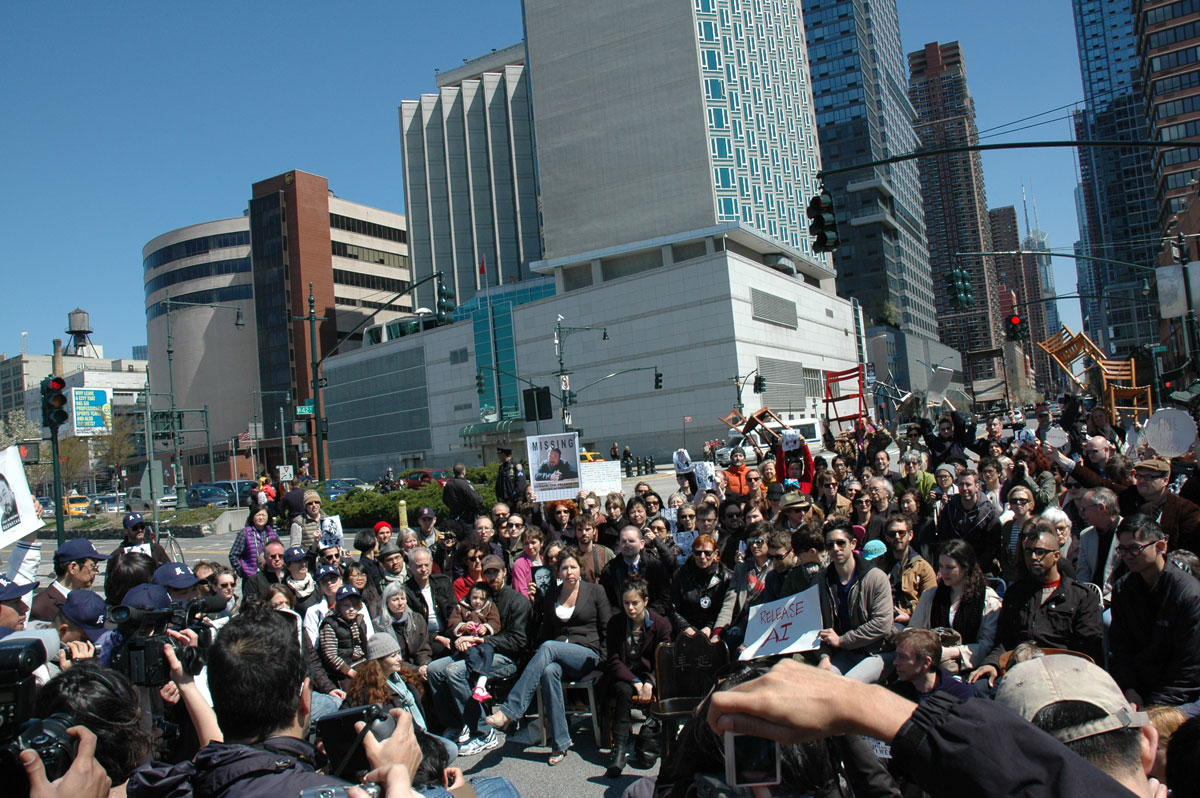
1001 Chairs for Ai Weiwei at the Chinese Consulate in New York City, April 17, 2011
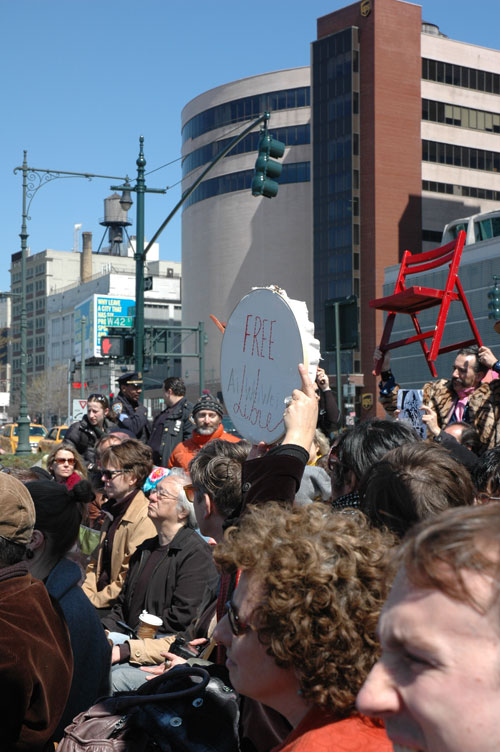
Crafters represent.

Ann Pasternak, Director of Creative Time, addressing the crowd. I was wondering who'd play the role of police negotiator, and Pasternak did. I love seeing art administrators do on-the-ground community organizing.

My op-ed is about Chinese Americans/Overseas Chinese taking a stand; I was delighted to see a large contingent show up too. They totally side-busted the peaceful, poetic 1,001 Chairs for Ai Weiwei with street protest tactics: bullhorns, chants, raised fits (though suit jackets and matching ball caps is pretty Chinese). It's funny because the stereotype is that Chinese people are quiet, but today it was the Chinese contingent that wanted to be heard.
—
Accounts from 1001 Chairs in San Francisco:
Glen Helfand, “Empty Chairs,” Open Space (April 17, 2011) (I’m a fellow contributor.)
Christian L. Frock, “1001 Chairs for Ai Weiwei,” KQED Arts Blog, (April 18, 2011) (Frock mentions the posters I designed.)
—
Updates: FreeAiWeiWei.org
Further Readings:
“The arrest of Ai Weiwei reflects a new escalation in the current and already severe crackdown,” said Sophie Richardson, Asia advocacy director at Human Rights Watch. “Only sustained international pressure can help Ai Weiwei now.”… Since mid-February, the Chinese government has arrested, detained, disappeared, put under house arrest, summoned for interrogation, or threatened with arrest over two hundred people for dissent or peaceful social activism. Six of the country’s most prominent human rights lawyers – Teng Biao, Tang Jitian, Jiang Tianyong, Liu Shihui, Tang Jingling, and Li Tiantian – have been “disappeared” by the police and remain at serious risk of torture and ill-treatment.
—Statement from Human Rights Watch
Great context, and this beautiful quote about Ai’s father’s advice to his son:
“This is your country,” his father told him as he was dying. “Don’t be polite.”
—Austin Ramzy, “The Activist Artist of China,”Time Magazine (April 16, 2011)
Why the allegations, however suspect, are irrelevant to the core issue of justice and citizen’s rights:
Without fair legal proceedings, there is no fairness for the legal entity, any results from such circumstances cannot be deemed credible. As Ai Weiwei’s Studio colleges, his family members and volunteers, we all urge the … authorities to … follow the procedures proscribed by law, and to protect the public’s rights.”
—From the open letter from Ai Weiwei’s family and studio members on his and his associates’ detainment/disappearances, in English and Chinese, on Scribd.
Something historically obscene is happening here. It is as if different times exist simultaneously. In one time-stream, democracy is in global demand and artists including Ai Weiwei are revealing the richness of China’s culture to the world. Yet in the sinister second stream it is 1950, and dissidents can be blackguarded and bullied with total impunity by a system that takes Orwell’s 1984 as a handbook.
—Jonathan Jones, “Ai Weiwei isn’t on trial: China is,” The Guardian (April 14, 2011)
A beautiful call to action by someone who knows a thing or two about the power of art to provoke strong reactions:
Art can be dangerous. Very often artistic fame has proved dangerous to artists themselves…. We can perhaps bet on art to win over tyrants. It is the world’s artists, particularly those courageous enough to stand up against authoritarianism, for whom we need to be concerned, and for whose safety we must fight. …outside the free world, where criticism of power is at best difficult and at worst all but impossible, creative figures like Mr. Ai and his colleagues are often the only ones with the courage to speak truth against the lies of tyrants.
—Salman Rushdie, “Dangerous Arts,” New York Times (April 19, 2011).

Love the Future via ArtInfo via CDT
“‘Love the Future’ Becomes Coded Rallying Cry for Ai Weiwei,” ArtInfo (April 16, 2011)
What you can do:
Sign the petitions!
Guggenheim Foundation’s petition on Change.org (Bloomberg reports that Change.org suffered denial-of-service attacks by Chinese hackers)
Bianca Jagger Foundation for Human Rights
Call the Chinese Embassy (See the Facebook event for contact info for embassies in Stockholm, Athens, Paris, Sofia, the Netherlands, Washington DC, and San Francisco)
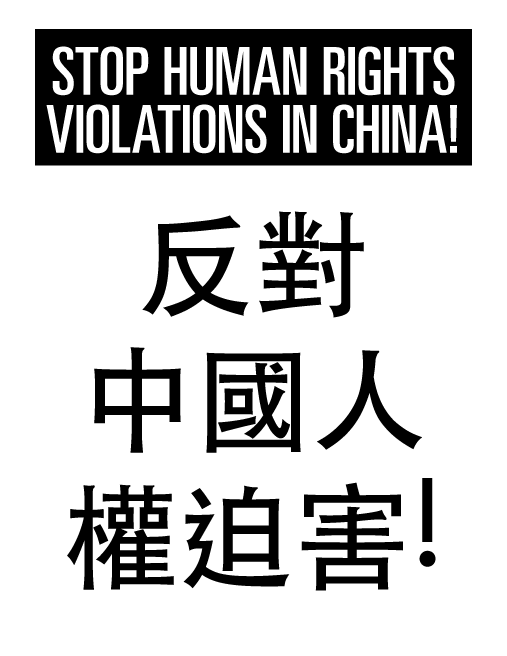
Download the Missing poster by Berlin-based Platoon.
In advance of their April 27-28 meeting with China, tell the US State Department to call for the immediate release of Ai Weiwei, his associates and the other dissidents who have been unlawfully detained!




 R+D
R+D 