Are you an artist? Is someone asking you to work for free? Are you unsure how to decline? This sample letter is for you.
I received an invitation from a start-up to present my work in a 30-minute presentation on a volunteer basis. I am paid on a regular basis to present my work similarly by universities, conferences, foundations, non-profits, etc. Here is how I responded.
Thank you for your interest in my work, and for this invitation. I am not accepting requests from start-ups to present my work without compensation. As for volunteering, I focus my efforts on worthy causes that support under-resourced communities.
When you are able to offer adequate compensation, please reach out. A great resource for learning about artist fees and artistic labor is wageforwork.com.
Reflections on talking and thinking about art as a visiting artist and human
Welcome sign
Lagoon at dusk
Lagoon-side artist-talk
Hot shop: Yashu and Lucy blowing glass
My perfectly imperfect tumbler
Last month, I was a visiting artist at Ox-Bow School of Art in Saugatuck, Michigan.
Ox-Bow is like a summer camp for artists. It’s set alongside an idyllic lagoon, very close to beach access on Lake Michigan and the Kalamazoo River. There are cabins and studios for painting, printmaking/digital media, ceramics, metal, and hot glass.
Visiting artists usually stay a week. Due to some scheduling conflicts, I arrived on Monday evening and left on Saturday morning. My visit was too short, yet it was also just perfect. I fit a lot into a short amount of time.
Over the course of a week, my responsibilities were to conduct an artist’s talk and 12 studio visits. The artist talk was held under a tent with open sides next to the lagoon at sunset. I crammed 5 projects from the past 2 years into a whirlwind talk. I realized that my images convey only about 10% of the story of my projects, so I have to convey the other 90% verbally.
I decided to frame my talk with a focus on accessibility, and the ways I was able to increase accessibility in each project. For example, some projects were bilingual or trilingual. My most recent project includes Braille and tactile graphics.
There were plentiful questions during the Q&A—a fantastic sign of engagement and a healthy learning environment. Many students asked questions about accessibility or positive psychology. I heard from some faculty that some of the ideas in the talk and Q&A reverberated in more conversations among the students.
Artists’ talks are necessarily synopses of art practices. They elide how artists arrive at their practice—the uphill battles, dips and turns in the journey of artistic development. Some people asked about how I arrived at my interest in social practice, or my use of flags. I can respond by mentioning influences I know about, influences that make for a good story, and influences in incubation, percolating under the surface of consciousness.
Presenting my work the day after arriving did two things. First, introducing my work helped me feel welcome and make connections in a community that had already been in formation for two weeks. (The post-talk reception/after party also helped!) Second, students were invited to sign up for studio visits with me after my talk. Then students had more to respond to, speak to our commonalities, and ask additional questions.
Someone in a studio visit pointed out the myth of the artist as a tortured genius, and how mental distress is romanticized as a source of creativity. They said they found it refreshing that my practice associated artists and art with mental wellbeing.
I try to be open, transparent, and honest about my interests in psychology, and how there’s still so much I don’t know. I think this factored into having unstructured conversations around campus which touched upon emotional intimacy, vulnerability, and feelings around life transitions. In some studio visits, we talked about artistic practice and development. In other studio visits and conversations, we talked about life and personal histories and experiences. A lot of art practice is about finding your artistic direction and voice. Yet we’re all developing our capabilities as humans; our emotional maturity; and our abilities to relate to others, care for others, and care for ourselves. We’re all learning how to navigate everything that life throws at us.
Ox-Bow’s culture is queer- and trans-centering. This is made colorfully visible in part by 26-year Ox-Bow veteran, Buildings and Grounds Manager John Rossi. Queer nightlife culture is integrated into camp culture with flags, party lights, costumes, and over-the-top performances. (I missed the Dungeons and Drag Queens themed closing party.) I’ve been thinking about the curb cut effect: when wheelchair users advocated for improved sidewalk accessibility, an unintended consequence was improved accessibility for others, such as anyone using a stroller, walker, or cart, or people with other types of mobility. When queer and trans people show up as who they are, especially in critical mass, there’s probably a net effect on everyone in terms of authenticity, vulnerability, non-judgment, or open-mindedness.
I think that there’s a zeitgeist at Ox-Bow this session, some combination of it being a space for artistic experimentation, an LGBTQ-positive culture, and positive dynamics within this specific group of people, that made it possible for people to be more authentic and whole-hearted. That’s something I want to think more about: whole-heartedness as it relates to being a human and being an artist—how one’s life experiences influence what you make and want to share through your art, and how a person can grow as a human and an artist in parallel.
After a year of isolation and social distancing, it was really intense to go to an art camp, to live among 60 strangers and eat all three (delicious!) meals with them (if you desire) every day. I was lucky I had a cabin with my own room. As an introvert, insomniac, and artist with a looming deadline, I definitely needed some down time to myself to rest, recharge, and work.
This year, due to the pandemic, there was a smaller number of people on campus. In typical years, there’s 100 or so people during the summers. I was very grateful to be in this smaller, more intimate group, to work out the rust from my social muscles.
I haven’t worked with students or been in a school setting in years. Prior to this, my studio visit experiences have been on the receiving end, where I share my work with curators, or in a peer setting where I’m sharing work with other artists in a cohort. I haven’t been in this situation of being the visiting artist, who is positioned to offer critical feedback, advice, or references. This of course replicates the hierarchical “bank” model of education, in which a teacher deposits knowledge to the student. I tried to acknowledge what I don’t know, such as feeling out of my depth when it comes to the discipline-specific discourses, as in painting. But gradually, as I did more studio visits, some of the brain fog dissipated, and I got back into the hang of looking at, reflecting upon, and talking about art and art practices not my own. I was very gratified when references to artists, exhibitions, articles, books, or podcasts that I suggested resonated with the students, or when I was able to frame or reframe an idea in a way that I sparked something generative.
One thing that is really cool about Ox-bow is that students and staff could sign up for studio visits. I did 13 studio visits: mostly students and fellows (graduate students who take classes but also have more self-directed studio time), as well as with two staff. If I had more time, I would have done more visits with more people, and to follow up as more responses came to me. So many people on campus are artists with interesting practices which are not secondary to their roles at Ox-Bow. I’ve worked in a kitchen as a prep cook and dishwasher, and I could imagine how frustrating it would be to be an artist in an art-centric setting where you’re not acknowledged to be an artist (one of many reasons that art handlers become jaded). Many people at Ox-Bow are from Chicago, which I haven’t had the chance to learn much about. I have so much to learn about artists, their practices, interests and communities, and I feel like I just scratched the surface.
If that wasn’t enough, at Ox-Bow, I had the chance to be a practitioner for a few hours and access a studio I never usually have access to. I got to blow glass for the first time since undergrad, which is over 20 years ago. I’ve been wanting to blow glass for years, especially the past few years as I’ve gotten more connected with glass artists and institutions. But the opportunity to blow glass never presented itself. Finally, I worked up the nerve to mention my interest to staff, and glass studio head Nick Clayton very generously devoted a morning to a private tutorial. Many aspects and movements came back to me, but many things did not. It was humbling, hilarious, and tons of fun! Blowing glass was a peak experience in a week full of peak experiences. I’m so grateful to Nick and to Ox-Bow. Many art studios are not set up for an individual not enrolled in a class to be able to handle molten glass and red-hot metals. But at Ox-Bow there’s an extraordinary willingness to trust artists, and to take risks as part of generosity in support of fellow artists.
An important aspect of Ox-Bow is its setting on a peaceful lagoon home to birds, fish, turtles, and muskrats. The quality of light is stunning. Due to a fluke in scheduling, I sandwiched this trip to Ox-Bow inside a trip to NYC. It was a 180º in mindset to go from being all-in on project details to sitting on a rope swing next to a lagoon. This was only possible with the support of Times Square Arts, whose staff and fabricators were working hard to realize my project after I’d put many pieces in motion, and to Ox-Bow, where the culture recognizes the importance of play, rest, connections, conversation, and experimentation.
When I read Grit: The Power of Passion and Perseverance by psychologist Angela Duckworth, it helped me connect the dots behind what I do as an artist and why I do it, and seeing it in the context of my greater purpose in life. I kept this info to myself or friends until recently. When younger artists ask me about motivations, I’ve started suggesting that they think big—not in terms of ambition, but in terms of connecting your art practice to a higher purpose.
For this reason, I really picked up on the clarity with which LeVar Burton (in “LeVar Burton’s Quest to Succeed Alex Trebek” by David Marchese, NYT, June 25, 2021) speaks about his goals and purpose, and the emotional intelligence, wisdom, and reframing that he practices.
“…my goal is to be authentic to myself as well as have a real relationship with those that I come in contact with through storytelling.”
Amazing: Having a clear sense of your goal, who you are, and how your goal connects you with others.
“That’s the nature of who I am. We love to make each other feel good, and feeling good is one of the privileges of being human, as is feeling at all. I gravitate toward thegood vibe.”
Yes! The ability to feel is so easily taken for granted.
“I spent a lot of time and energy discovering, defining, divining who I am and how I want to live my life.”
It takes time and attention to develop self-knowledge and core beliefs. These are fundamental to belonging to yourself.
On rejection:
“What does it mean that I got this [opportunity]? What does it mean that I didn’t get that? The what-does-it-mean game is one that I had to get over if I was ever going to achieve equanimity in my life. The real truth that I have come to recognize is that everything that is supposed to be for me comes to me. If it doesn’t come my way, it wasn’t meant for me. It’s all perfect in its design and execution. I mean, the idea that I’m still here 45 years after “Roots”? I’m not only still here but I’m still making a contribution. Those times in the past when I felt like I wasn’t getting my due, out of jealousy or ego — that’s natural, but it’s self-destructive. I learned how to minimize my response to those feelings to the point where I rarely have them anymore. When I didn’t get certain acting jobs, it forced me to develop other skill sets, and that was obviously part of the plan because now I’m able to do what I do as an actor, writer, producer, director, podcaster, storyteller, public speaker. It all happened perfectly because here I am. I feel like this life is a gift. I used to wonder what it was that I did in previous lifetimes to deserve it. How did my soul get here? This is hard to put into words, David: There are times when I experience my life as having been for a specific purpose. I look at Kunta. I look at Geordi. I’ve been able to express humanity as enslaved in the past and as free in the future and do it as a completely liberated Black man. It’s kind of mind-blowing.”
Events that happen to us are separate and distinct from the story we tell ourselves. We can reframe and tell that story multiple ways. Being able to reframe and see things in the perspective that gives you equanimity is a superpower.
There was the time that I found out that the producers of “Glory” wanted me for the role that Denzel Washington ended up playing, and “Star Trek” would not agree to let me go. When the movie came out and then Denzel won an Academy Award, I thought, Hmm. [Laughs.] But it wasn’t for me, and I’ve made peace with that. That which is mine, no one can take away. That which is not meant for me, no amount of wishing or stamping my feet will make it so.
The idea that “That which is mine, no one can take away” is wisdom echoed from Victor Frankl.
DM: When you say your life has been for a specific purpose, can you articulate what that purpose is?
LB: Healing through storytelling. Bringing joy through storytelling. Bringing information, education, enlightenment through storytelling. That’s why I’m here.
Again, being able to articulate your purpose in life is so helpful and wise.
“…Fred [Rogers]’s example is about being able to be OK with who we are wherever we find ourselves. It’s easy to forget how important that is: simply being fine with who we are at any given moment.”
I’m thinking maybe at the heart of self-actualization (depicted at the top of a pyramid by Maslow) is idea of self-acceptance (which feels to me more circular than unidirectional). And, of course, self-acceptance is another key ingredient in belonging to yourself.
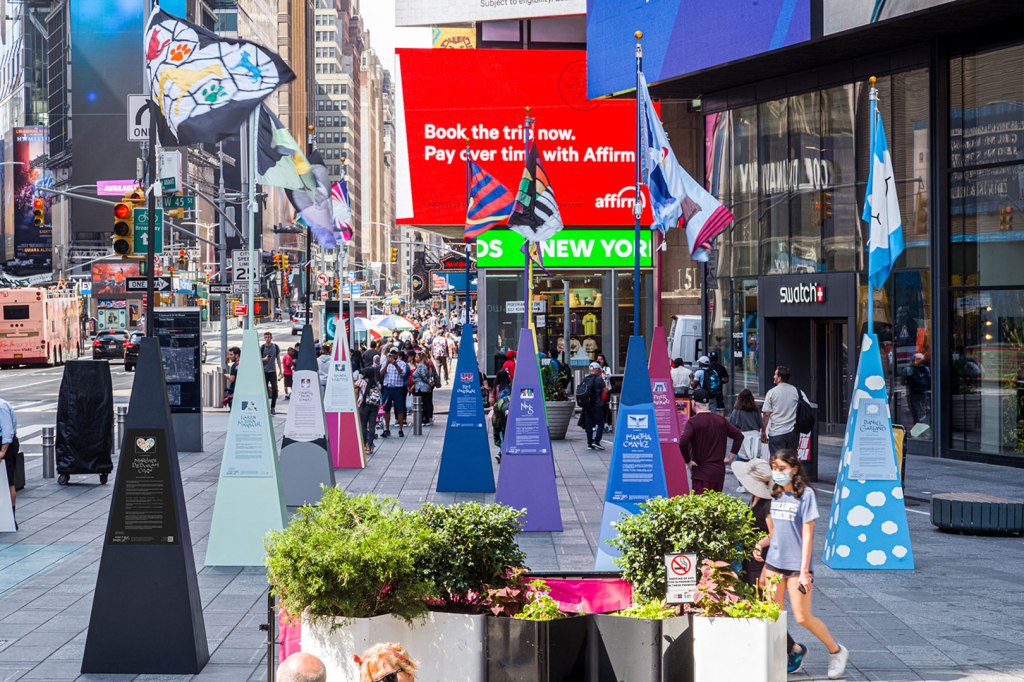
Christine Wong Yap with Encore Community Services, How I Keep Looking Up, 2021, social practice, flags, flagpoles, signs, dimensions variable. Photo: Mike Vitelli for Times Square Arts. The public artwork is on view in the pedestrian plaza on Broadway between 45th and 46th Streets through August 9, 2021.
In my art practice, I think a lot about psychology, resilience and belonging, and how art is accessible or not accessible. When art is shown in a museum, it is only seen by people who self-select to go into the museum. Some of those people feel that museums are built for people like them, but not everyone feels that way.
It means so much to me that this project is free and ultra-accessible. Anyone can come see it 24/7 for the next 8 weeks. Here, people from all walks of life—from all over New York City, the region, and the world—come to Times Square. Hundreds of people will pass through this installation every hour; thousands and tens of thousands will see it every day.*
Times Square is a public space used by a multitude of publics. People come here to find delight, excitement, wonder, inspiration, connection, and celebration. Everyday New Yorkers work here contributing to arts and culture, hospitality, and ingenuity and spectacle. It’s a place where families and friends come to make memories. For all these reasons, it is the perfect place to show a collaborative artwork featuring 11 New Yorker’s resilience. Coming out of a year of isolation, I’m proud that this artwork and these stories occupy these crossroads where people connect with each other.
*I underestimated this… by a lot. “Nearly 195,000 pedestrians strolled through Times Square on June 13, more than twice the typical number in the bleak winter days when the coronavirus was raging. That’s a long way from the 365,000 who passed through daily before the pandemic, but the totals are edging higher, according to Tom Harris, president of the Times Square Alliance, a nonprofit group that promotes local businesses and the neighborhood.” —By Nelson D. Schwartz, Patrick McGeehan and Nicole Hong, “New York Faces Lasting Economic Toll Even as Pandemic Passes,” NY Times, June 20, 2021.
Learning a new psychological concept, over year into the pandemic.
I related to this article so much! I thought getting my vaccine shot would change everything. The pandemic is still dampening many aspects of life, and I’m still stuck in my own head, for better or worse. Learning to name this feeling of languishing—and see that it is a normal, common reaction—is helpful. It’s also great to be reminded of the importance of flow, a concept I learned about and wanted to share via my Positive Signs drawings from about 10 years ago.
“Languishing is a sense of stagnation and emptiness….
…[as] the pandemic has dragged on, and the acute state of anguish has given way to a chronic condition of languish….
…In psychology, we think about mental health on a spectrum from depression to flourishing. Flourishing is the peak of well-being: You have a strong sense of meaning, mastery and mattering to others. Depression is the valley of ill-being: You feel despondent, drained and worthless. Languishing is … the void between depression and flourishing — the absence of well-being….
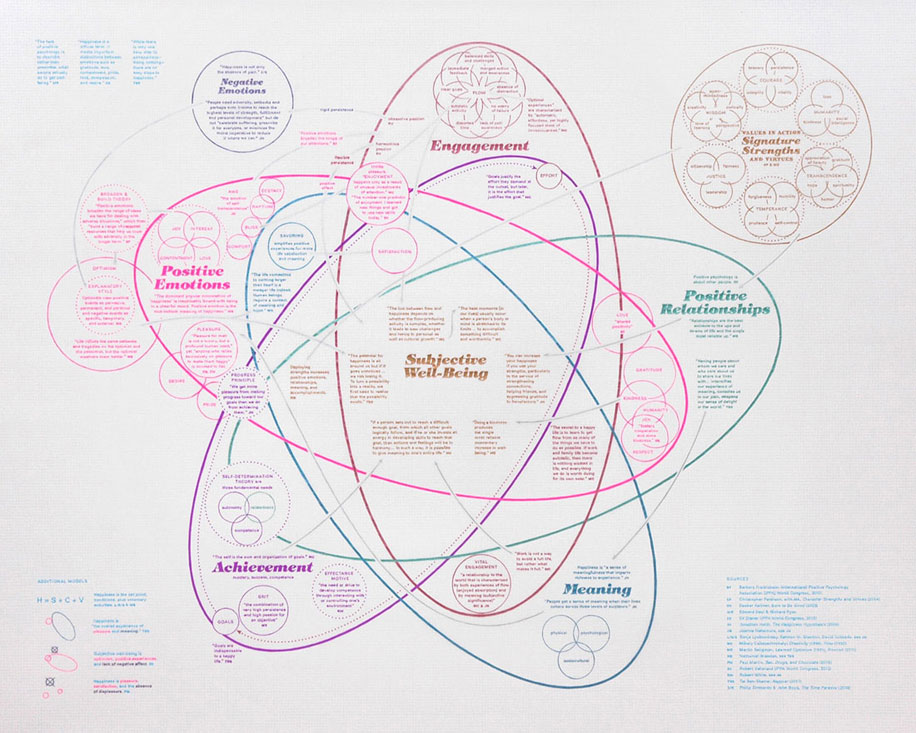
I am guilty of thinking in this duality between anxiety/depression and flourishing. This is a 5-part Venn diagram I made inspired by Martin Seligman’s PERMA theory of flourishing.
Positive Signs: United Theories, 2012, gel pen on vellum, 32 x 40 inches unframed / 35.5 x 43.5 x 1.5 inches framed / 81.2 x 101.6 cm unframed / 90 x 110.5 x 3.8 cm framed. Supported by Lucas Artists Program at the Montalvo Arts Center.
…when you’re languishing, you might not notice the dulling of delight or the dwindling of drive….
So much of my artwork inspired by positive psychology is about noticing your feelings!
Christine Wong Yap, take charge of your happiness, 2011, ~83 × 24 × 1 in / 211 × 61 × 2.5 cm.
Not to mention my work that aspires to delight.
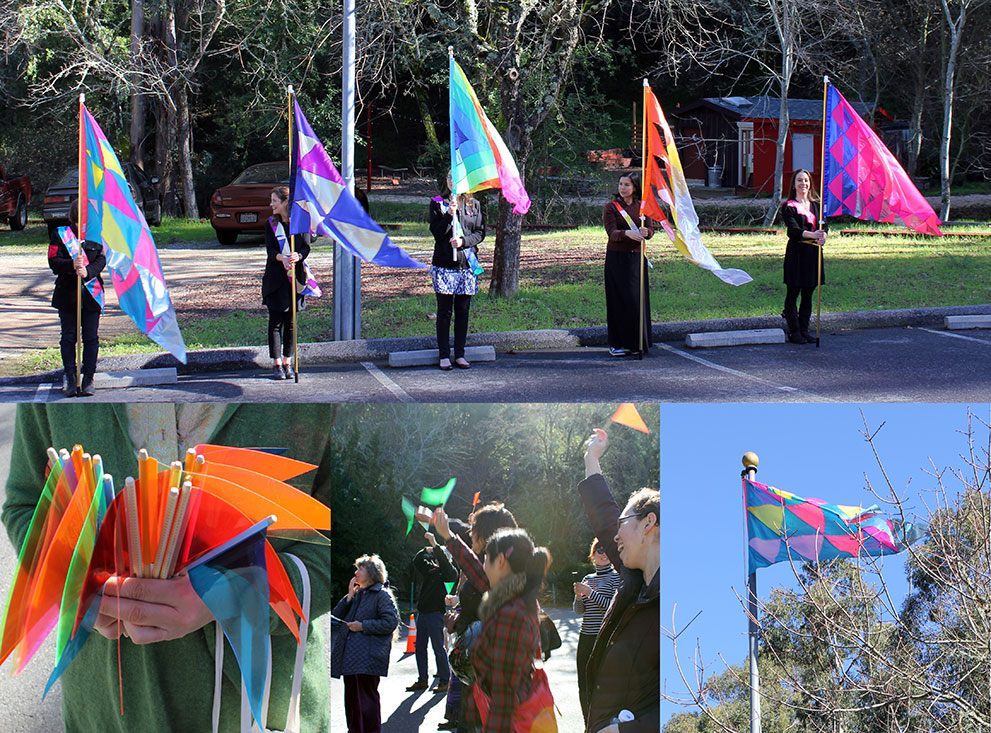
Irrational Exuberance Flags, 2012–13, five flags and five sashes; flagpoles, bases; participation; flags: 48 x 48 up to 48 x 80 inches each, poles: 8 to 30 feet each. Supported by Lucas Artists Program at the Montalvo Arts Center. Photos: Susan O’Malley.
…When you can’t see your own suffering, you don’t seek help or even do much to help yourself….
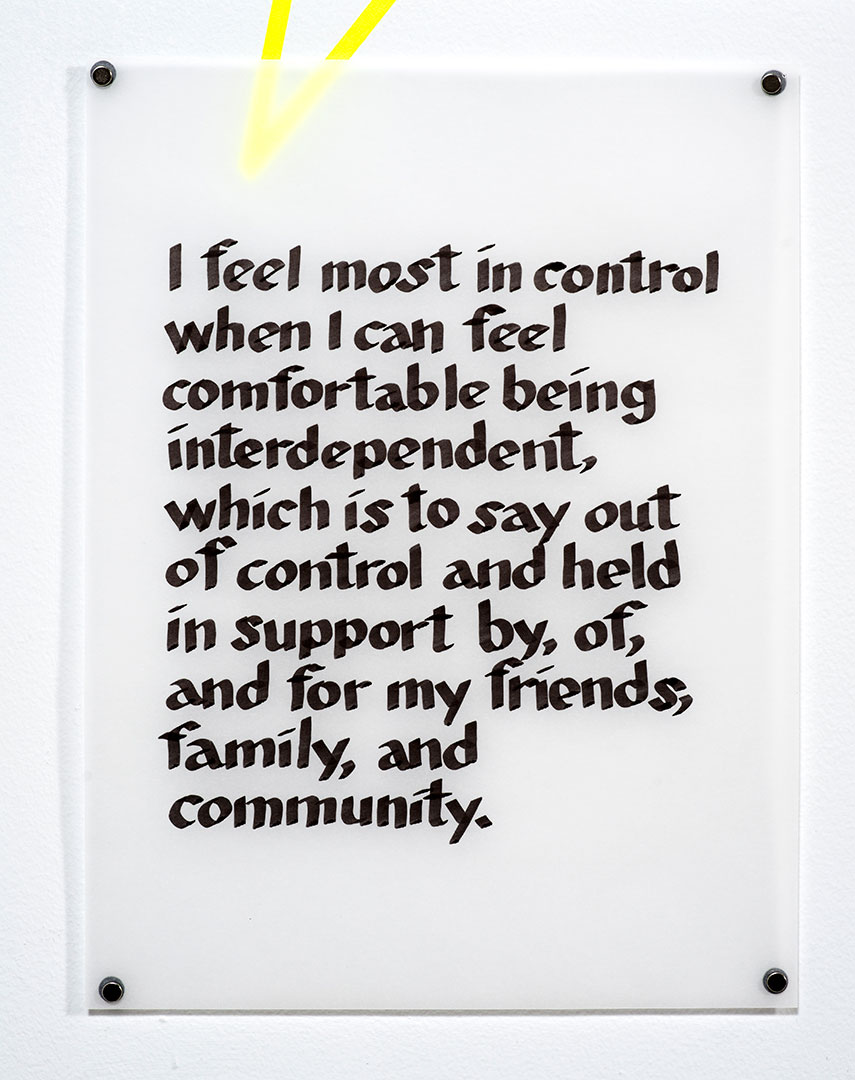
I just remarked how hard it is to ask for help—to allow yourself be held in support by others.
Detail from an installation of drawings on interdependence and my artists’ personal impacts survey, 2015, ink on vellum, 12 × 9 inches / 30.5 × 22.8 cm.
It’s really neat to see how the answer may be in finding flow.
…“flow” may be an antidote to languishing. Flow is that elusive state of absorption in a meaningful challenge or a momentary bond, where your sense of time, place and self melts away. During the early days of the pandemic, the best predictor of well-being wasn’t optimism or mindfulness — it was flow….
Fragmented attention is an enemy of engagement and excellence….
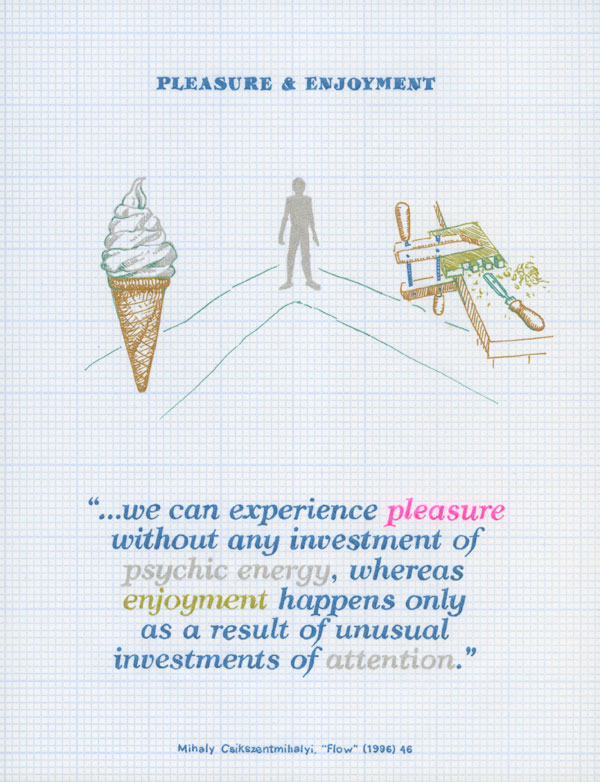
This really resonates with my takeaways from Mihaly Csikszentmihalyi’s Flow.
Positive Signs #49, 2011, glitter and fluorescent pen on gridded vellum, 8.5 × 11 in / 21.5 × 28 cm.
We now know that the most important factor in daily joy and motivation is a sense of progress….
This is a revelation to me. I sometimes think I’m addicted to work. Often, when I write in my journal about what went well in my day, it’s often a list of accomplishments. I try to fight this urge to overvalue productivity. But it is very satisfying to know that you’re making progress.
…treat uninterrupted blocks of time as treasures to guard.
I know, during work from home and remote learning, having uninterrupted time is a huge privilege. I try not to take it for granted. I try to schedule my work day bearing in mind that I’m my most focused and creative in the mornings. Learning how to single-task, rather than multitask, is an ongoing challenge.
One of the clearest paths to flow is a just-manageable difficulty: a challenge that stretches your skills and heightens your resolve. That means carving out daily time to focus on a challenge that matters to you — an interesting project, a worthwhile goal, a meaningful conversation.
I think it’s so wonderful that a “meaningful conversation” is included here. Having deeper conversations is always important, but may be more so than ever, for combating isolation and pandemic-fatigue.
We still live in a world that normalizes physical health challenges but stigmatizes mental health challenges.
May is mental health awareness month. In a time of so much disruption and upheaval, it’s so important to normalize mental health as part of our everyday experience, and de-stigmatize caring for one’s own mental wellbeing.



 R+D
R+D 