Art & Development, Travelogue

Travelogue Entry No. 1: Cumbria, England

Visuals will be uploaded in mid-October, but here is an interim post. 

-Participating in the FRED festival looks like:

–Hanging out in Brougham Hall, the fortified castle that dates back 1600 years ago to the Roman days. It’s currently undergoing private reconstruction under the leadership of Mr Christopher Terry, a delightful Englishman, world traveller and architect. Mr Terry took me to see the Lake District, past the beautiful lakes Ullswater and Brotherswater, and over the Hardknotts Pass, where we could see 20 miles to the Irish Sea.

–Meeting a few other artists involved with FRED, such as Sally Barker, who has made sculptures of poo and set them out along a beautiful creek and waterfall outside of Sticklebarn(?) Tavern in Great Langdale, Kate Gilman Brundrett, who developed the Ministry of Creative Parking for the parking-starved town of Penrith, and Tony Charles, who makes his own pigments out of steel rust and created a marvelous floor pattern in the art college, which is housed in a former steel mill. And I also enjoyed painting rocks to assist Kate Raggett with her piece, which involved hauling 5,000 stones up the side of a hill behind a mining museum into sheep grazing territory, and arranging it into a design that can be seen from miles away, such as at the Castlerigg Stone Circle.

–Staying at the Keeper’s Cottage B&B, which was actually the gamekeeper’s cottage during Lord Brougham’s time. Pam and James Wright maintain it now as a beautiful, homey cottage, and the little touches in the decor are adorable. The view outside my window is picture perfect: a farm with sheep and what looks to my city-slicker eyes as Shetland ponies, walls of slate cutting up the green fields. The breakfasts of Cumberland sausage and bacon (what we Yanks call ham) and eggs and toast with homemade marmelade are fantastic…

Standard
Activist Imagination, Citizenship

The Fall of the I-Hotel, Revisited

I went to the screening of Curtis Choy’s film, The Fall of the I-Hotel (2005, 58 minutes) at the Oakland Museum of California last night with a sense of obligation to my research for the Activist Imagination project. I left with reverance and lots of food for thought.

Some impressions:

• I sort of thought that by default, early APA graphics would borrow heavily from established visual languages of resistance (such as Chicano graphic arts or social realism). Surprisingly, the mural on the outside of the I-Hotel was very cartoonish. More Vaughn Bodé than Diego Rivera.

• The film also included a beat-infused poem by Al Robles. Which maybe means that Robles was at least equally influenced by San Francisco’s literary history than other essentially activist or APA forms. Which leads me to a new line of thinking: of course APA art can look or sound any way. Does this seem was more so in the old days than now (when everything seems so hybridized and postmodern)?

• Shots of the original Kearny Street Workshop storefront inspired me to think, If I could go back in time and check it out, one thing I’d want to know is what Cooper Black (the typeface of KSW’s original signage) conveyed in the 1970s. Today, it’s so retro, goofy and playful (and judging from the pop culture references on the Wikipedia entry for Cooper Black, “budget”), it’s hard to imagine what it signified in the context of the I-Hotel.

The struggle to save the I-Hotel could signify the birth of APA activism, but the gestation of a movement of this magnitude went far beyond this one building. The I-Hotel happened to be the right time and place (a pretty great congruence of ‘Asian’ and ‘Pacific’ in Asian and Pacific American, right?), following over a decade of displacement — those manongs were the last 50 of the 10,000 Fil-Ams displaced from Manilatown (as Al Robles explained) — and of course, the historical moment.

There wouldn’t have been an I-Hotel struggle without the post-1965 immigration wave and the 1960s youth movement, which in turn wouldn’t have emerged without the 1950s civil rights movement and the collapse of old-world-style colonialism around the world.

I think some people view activism today with a sense of futility, and the 1960s and 1970s seem like a golden era when change was possible. But we have to keep in mind how political change evolves over time.

In the 1990s, I thought the times were similar to the 1950s: obsessed with technology and consumerism, revolution seemed distant, if not impossible. I was wrong. The picture-perfect nuclear family was only middle-class white (male) America’s narrative. The 1950s marches and boycotts were certainly more consequential, but the 1990s were not without their acts of mass resistance in LA and Seattle. (So instead of, How do we create a revolution now, a better question would be, How do we continue and amplify the struggle for racial, gender, and class justice in addition to facing emergent issues — immigration status, the global “north-south” divide, environmental justice — with a united front? What does this mean for APA activists?)

• One last note about history… I know the impact of the 1965 immigration act is far-reaching, but had to be reminded that it made possible the birth of the APA movement. And working backwards: Yes, as I wrote in “The Stone Age,” the history of APA art is short — as so, the history of Asian Pacific America as we know it now. (Next year, Kearny Street Workshop celebrates its 35th anniversary — and to all of us immigrants and decendants of immigrants, let’s also celebrate the 43rd year anniversary of the Immigration and Nationality Act of 1965.)

The screening was followed by a panel with Emil deGuzman, Curtis Choy, Al Robles, and Dr. Estella Habal. I would have liked to ask them:

Why was art so important in this particular struggle? Clearly a screening on the 30th anniversary of the I-Hotel demonstrates the importance of media, and the organizers in the film evidenced rigorous organizing tactics. So why was it important to have murals and screenprints?

[ Judging by a response to a different question, the answer probably would be something like, “Self-expression is an act of defiance. We were asserting our oun human-ness in a time where we were being told that we didn’t count.” Having seen and sat on numerous panels where the “why does art matter” question was asked, invariably by people who already believe it matters, this answer’s fine. Still, I wouldn’t mind being surprised by some new insight here. ]

My second question would have been:

For future APA activists, what are key issues and how must our tactics change?

I can surmise on possible responses, but as usual, I’d rather leave the strategizing to the strategizers.

Watching The Fall of the I-Hotel was a contradictory experience for me. On one hand, the shots of the final evictions made the event more real — the brutality of the police department was terrifying, the spirit of resistance electrifying. On another hand, the historic footage matched my pre-exisiting “memory” of the event. Even though I was born in 1977, the same year as the evictions, I must have seen clips of the film or photographs from other sources. So the film is important and worth watching, but it also cannonizes this event… And I imagine that it has a similar effect for everyone else of my generation.

This brings up a host of issues for me as a visual artist: How do we tell what’s real? How we assimilate visual images into memory, and who do we tell them apart? How do we contend with the limits of representation while continuing to struggle to control our means of self-representation?

[There’s some really interesting film theory that relates the cinematic apparatus to our psyche… For more, check out the essays in The Dream of the Audience, catalogue for the Teresa Cha exhibition at the Berkeley Art Museum.]

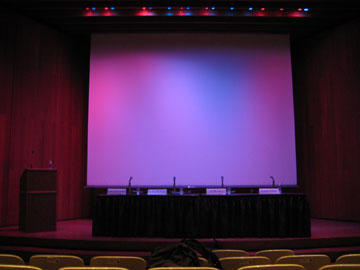
So here are some photographic impressions. I snapped these from my seat in the theater.

blank theater screen
Setting. My poor woman’s Hiroshi Sugimoto.

movie title

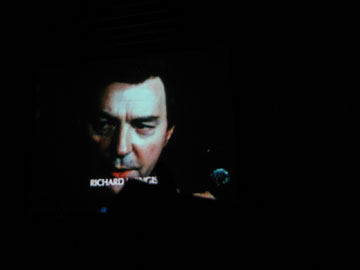
Richard Hongisto
Richard Hongisto, sheriff. He spent 5 days in jail for contempt for resisting eviction orders, and later reluctantly oversaw the evictions.

hotel signage

police action
While so much of the film was so distinctly 1970s — the cars, the activist’s facial hair and clothing styles — riot cops look relatively the same.

crowd shot

Standard
Art & Development, Travelogue

Autonomy

This year, I’m lucky enough to travel abroad twice. In a few days, I’ll be off to the UK. It’s my first time across “the” pond. I’m going to be an artist in FRED, the annual art invasion of Cumbria. Then I’m going to see as much art in Manchester and London as possible.

I feel lucky to be an artist who makes a living as a self-employed graphic designer. Still, having tasted the life of a full-time artist during my trip with Galleon Trade, I want more. And that’s another reason why being an Affiliate Artist at the Headlands is so great — sure, there’s the studio, the awesome environment, the community, but I’ve also been savoring the osmotic zone of artists-in-residence. The AIRs are there to have time and space to experiment and develop, and appear to be happily spending their days and nights thinking about, talking about and making art. I find myself wondering, What would it be like to wake up in a secluded place, and in the quiet of the morning, wander over to the studio and see where the day takes me?

I’m starting to think of these opportunities for international travel as Temporary Autonomous Zones (TAZs) as an artist. A while ago, I worked with Underground Railroad, a collective of cultural workers who theorized that, while we lived in a country that lacks physical TAZs (Not counting Burning Man — I mean those accessible to young urban POCs), cultural events could be transient TAZs. The vision was that a taste of being free would lead towards expansions in duration, until soon enough the TAZ would be round-the-clock and migrate beyond its four walls.

I love this idea’s elegance — its sense of natural momentum. It’s not about the fear of failure driving one to a necessary optimism. Rather, the potential is just too good to pass up.

Standard
Activist Imagination, Research

The Stone Age

“We’re in the Stone Age of environmental consciousness.”

That’s what I thought the other day when I saw a recent print advertisement for Chevrolet’s new hybrid vehicles. In the full-spread photo, a mean-looking concept car with oversized rims sits on a grassy meadow surrounded by rolling, tree-covered hills.

car ad

The ad rings false for me because American car manufacturers have been slow to release hybrid vehicles and adopt alternative technologies. The big 3 automakers are, as many others have pointed out, dinosaurs of the Industrial age, who ruled by the might of mass production. The sweet irony is that one can ‘buy American’ — and purchase a Toyota made in Fremont, CA. Dinosaurs, after all, are slow on the uptake of the ‘adapt or perish’ idea.

And so with the art direction here. Every element of this ad is a cliché. The message — “Chevy’s gone ‘green'” — has been clunkily literalized: Take a Chevy. Put it in a leafy locale.

What’s missing is a critical visual and conceptual analysis.

First, to point out the obvious: parking a car on a meadow isn’t environmentally friendly. Most meadows function as natural water filters for underground streams, so oil leaks are bad news blues. And driving on critters’ homes can’t be fair play.

Second, the grass’s cut tips give away that it’s not a meadow, but a lawn that was recently mowed. Since manicured lawns suck up water and pesticides, they don’t make good symbols for ecological health, either.

What makes it necessary to convey environmental soundness so literally? The car’s engine may be green, but that’s not reflected in its design. Outwards, it’s conventionally stylish. The bullish front-end and low-slung cab references the gas-guzzling muscle cars of yesteryear. In fact, for a futuristic prototype, it looks a lot like today’s Dodge Charger. Oversized rims and minimized tires give away Chevy’s conceit to style over function. I thought green meant you take only what you need, and you don’t need huge alloy rims.

The problem is that the fear of crunchy-granola designs has overshadowed the imaginative possibilities for what a green car could look like. And imagining change is the first step in making change, as Angela Davis recently discussed at Los Angeles’ Museum of Contemporary Arts (check out a podcast of Angela Davis’ lecture on contributions to feminism from theorists of color). Green can, and should, look different. I’m sure that environmental concerns will force the tide of mass opinion to turn towards an attitude that desires green inside and out. We won’t have a choice: either we choose green, or Mother Nature will choose it for us.

Of course, the ad itself is printed on paper, which is gloss-coated and therefore probably not recyclable. Worse, the ad appeared in a special supplement, of which this reader received two unsolicited copies. By extraction, I’d guess that thousands, if not tens of thousands, of these ad-revenue-driven publications have entered the waste stream, courtesy of a giant publishing house.

This ad reminds me of old advertisements with laughable premises — like the young actor Ronald Reagan endorsing smoking as healthful. I’m looking forward to the day when green visual literacy is so prevalent that corporations can no longer pass off half-hearted attempts at consciousness.

. . . . .

Similarly, I sometimes feel like we’re in the Stone Age when it comes to identity and art. The critique of formulaic Identity Art is that it operates on a one-plus-one equation, like the ad above:
green + car = green car

Its corrolary, so to speak:
identity + art = Identity Art

such as,
asian design motifs + painting
Or
migration story + photo-collage

Thankfully, postcolonial theorists provide a critique of essentialism, the idea that certain groups carry innate characteristics, implying the inability to transcend one’s traits. In art, essentialism is when artists “get put in a box” or marginalized, and it feels like, well, being stuck in the Stone Age. There’s some validity to this feeling, considering that women and people of color have had a relatively short history of participating in “high” art discourses in the US (and we are still struggling for control over the modes of our self-representation). So in the US we are in an early era of art that can emcompass the voices of women, people of color, the working classes, immigrants, etc. I think the first task is to debunk the perception that art by certain groups should look a certain way. I was reminded of this earlier today.

In To Hedonopolis, From Melancolony, curator Rico Reyes explores the emergence of two thematic strains in art works by Filipino and Fil-Am contemporary artists. So the show brings light to two distinct perspectives. The works are in diverse styles and media, but the artists are uniformly confident and adept. Some, but not all, of the content transparently corresponds to aspects of Filipino identity.

I was admiring an abstract painting by Reanne Estrada, when an agitated stranger next to me asked aloud, “How is this Filipino?”

I wish I could say that I helped the young viewer critically engage with Reanne’s work (afterall, he’s an APA, I’m an APA, he’s a student, we were on a university campus), but I’d be lying. Instead, I was flabbergasted that an APA would suggest that art that isn’t overtly Filipino isn’t Filipino enough.

When I was in Manila, the question of “What is Filipino?” followed us Galleon Traders around like white on rice. I didn’t learn an answer so much as gain a comfort with the standing question (not unsimilar to an ‘intersectional’ position advanced by feminist theorists of color, described in Davis’ lecture). To leave the question unanswered acknowledged the Philippines’ complex history of colonization and its people’s ongoing perserverance and shifting identities. To attempt to answer it, and make “capital-F” Filipino art (i.e., as Carlos Celdran joked, nailing a bangus to a wall), would be to ascribe to an essentialist point of view.

Which relates to ideas I’m thinking about now for Activist Imagination. I think it’s time to start reimagining the blanket term “APA” (Asian Pacific American) for the future: APA can, and should, look different. But how?

And how will this change the function of an APA arts organization?
Standard
Citizenship

Large Donations to the Arts

In NYTimes.com’s “Big Gifts, Tax Breaks and a Debate on Charity,” Stephanie Strom writes about philanthrophic ins and outs in this era of Bush’s tax cuts for the wealthy.

Check out the NYTimes.com info-graphic. Attractive (Tufte readers: Yum!) and informative about the sad state, relatively, of large individual donations to the arts.

The super-wealthy have super-accountants, who take advantage of the numerous and legal means to make giving profitable. As explained by a professor, museum donors can actually make money by purchasing of significant art works and donating them incrementally over several years. Since the work appreciates as part of an esteemed museum collection, the tax write-offs increase year-to-year, eventually exceeding initial outlay.

While I am for incentives for charitable giving (for example, artists should be able to write off the sale price of works donated to non-profit orgs, not just the cost of materials used), Strom’s article correctly points out that it’s high time to re-evaluate the tax codes for charitable giving among the super rich.

Standard
Community

Fall Arts Previews

I love summer, but I’m excited about this fall. Here’s why:

Duration TBA
Artists InSight: The Big Ideas Project—Three Views: Jenifer K. Wofford, Derrick Ion, Ali Dadgar

Opening reception: Thursday, September 6, 6:30 pm
“Through a proposal process, local artists were invited to create original interpretations of the 07-08 Big Ideas using the concept of Tibetan Buddhist Thangka paintings as inspiration. We are proud to present three interactive contemplative installations by artists Ali Dadgar, Derick Ion and Jenifer K. Wofford.”
Yerba Buena Center for the Arts‘s Room for Big Ideas
FREE

August 20 to October 19, 2007
To Hedonopolis, From Melancolony: Current Topography of Filipino Visual arts
Curated by Rico Reyes
Terry Acebo Davis, Yason Banal, Genara Banzon, Leo Bersamina, Emily Caisip, Crisanta de Guzman, Cirilo Domine, Reanne Estrada, John Yoyogi Fortes, Vince Golveo, Maryrose Cobarrubias Mendoza, Johanna Poethig, Charles Valoroso, Carlos Villa, and Jenifer Wofford
Artist Talk: Thursday, September 6, 3 pm to 4 pm in the Maraschi Room, Fromm Hall
Opening Reception: Thursday, September 6, 4 pm to 6 pm, Thacher Gallery
University of San Francisco
Work by Galleon Traders and friends Jenifer Wofford, Reanne Estrada and Johanna Poethig are included, as well as work by Yason Banal, an artist the Traders met in the Philippines!

October 6, 2007–January 20, 2008
Michael Arcega: Homing Pidgin
De Young press room page: “Contemporary artist Michael Arcega reinterprets the Oceanic collections at the de Young Museum for this exhibition. Arcega is known for sculpture and installations that revolve around language, a subject he dealt with early in his life when his family emigrated from the Philippines to California. At the de Young, he will show common Oceanic objects that have become altered after frequent interactions with Western culture. He compares this phenomenon to the pidgin languages (dialects that blend Western and Oceanic words) spoken throughout Oceania. He calls the works pidgin objects. “In the same way pidgin languages get ideas across, these cultural residues of pidgin objects act as bridges toward understanding the artifacts within the glass cases,” Arcega says.”
De Young Museum

September 19, 2007 – December 23, 2007
One Way or Another: Asian American Art Now

Michael Arcega, Xavier Cha, Patty Chang, Binh Danh, Mari Eastman, Ala Ebtekar, Chitra Ganesh, Glenn Kaino, Geraldine Lau, Jiha Moon, Laurel Nakadate, Kaz Oshiro, Anna Sew Hoy, Jean Shin, Indigo Som, Mika Tajima, Saira Wasim
Berkeley Art Museum
I was delighted when I found out this NY-based Asia Society show was coming to the Bay Area. It’s a museum-quality survey of mostly young, contemporary Asian American artists. What’s not to love? Keep an eye out for work by Galleon Trader Michael Arcega Berkeley-based Indigo Som. The Bay Area also represents with Binh Danh and Ala Ebtekar. And I always look forward to seeing Kaz Oshiro‘s work in person. And, here’s the NYTimes.com review.

September 17 – October 13, 2007
Don’t Try This At Home: A Group Exhibition Obsessively Reshaping The Ordinary
Tamara Albaitis, Lauren Davies, Krishna Khalsa, Stephani Martinez & Zachary Royer Scholz
Gallery Hours: Tues by appt, Wed – Sat, 12 to 5pm
Opening Reception: Monday September 17, 6 to 9pm
Artists’ Talk: Saturday October 13, 2pm
Intersection for the Arts
With CCA alum Lauren Davies and Zachary Royer Scholz, whose work can be pretty amazing.

September 13 – 29, 2007
A World Premiere Dance Theatre Work
51802
by Resident Company The Erika Shuch Performance Project
Thursdays – Saturdays at 8pm
Intersection for the Arts
With Jen Chien, a talented friend, and Danny Wolohan, a distinctive addition to many Bay Area theater pieces I’ve seen.

TBA
Gina Osterloh
Solo show at Margaret Tedesco’s 2nd Floor Projects.
A treat to see work by a really rigorous former-SF-, now LA-based Galleon Trader.

September 08, 2007 – February 24, 2008
Take your time: Olafur Eliasson
SFMOMA
I’m so excited that our local museum of modern art initiated and is premeiring a well-deserved retrsospective by Eliasson, an exciting contemporary sculptor/installation artist.

Through September 6, 2008
Capp Street Project: Mario Ybarra Jr.
Mario Ybarra Jr.’s large-scale mural examines the history, anecdotes, and mythology that surround mural making in the Bay Area.
Wattis Institute for Contemporary Art
I helped out with this mural earlier in the summer, and had a great time working with and learning from the illustrious, LA-based Mr. Ybarra.

Standard
Art & Development, Travelogue

Postcards from Manila, Part II

the living room
Carlos Celdran’s Living Room in Manila.
Galleon Trade’s home base in Metro Manila was also an artist’s residency and alternative arts space. It’s a large, beautiful room with a view of Roxas Blvd (which is sort of like Venice Beach) and the South China Sea. When a spacious, well-appointed room with lots of light is the first ingredient in building an artistic community, it shores up the importance of ‘home.’

stephanie syjuco looks at poklong's anading's photographic installation at finale gallery
My shot of Poklong Anading’s installation at Finale Gallery in Megamall.
Stephanie Syjuco is on the outside looking in, a fitting symbol, I think, for the experience that many of the US-based artists engaged as visitors to the Filipino art community.

reception food
It ain’t a party without pancit. It’s plenty surreal to attend an art opening in a mall — let alone one accompanied with pancit, chicharron, queso-filled lumpia and fried broad beans. And red wine, touché.

balikbayan
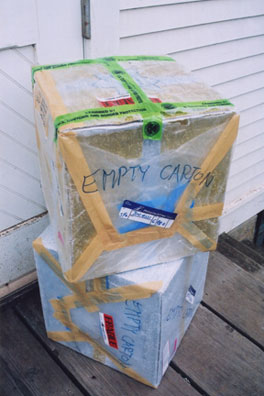
Balikbayanned. After a magical 10 days in Manila, re-entry to the US — the banalities, the rat race, the predictability — was rough. Similarly, the balikbayan boxes in the Regalos project went through their own ordeal as Galleon Trade mastermind, Jenifer Wofford, attempted to repatriate them via Air Cargo. As a transit-specific project (as described by scholar Eric Estuar Reyes), these new marks of transit bring the work to a different stage of the project. I’m looking forward to showing these works to a local audience at the Euphrat Museum in October.

Standard