Art & Development

Hreinn Fridfinnsson

It’s not a typo, it’s a delightful Icelandic conceptual artist, who made me want to share his works:

From Malmö Konsthall’s Future section, Fridfinnsson image gallery:
photographs of sky and grass
(Uncaptioned)

From Malmö Konsthall’s Future section, Fridfinnsson image gallery:
hand in mirror
(Uncaptioned)

From Gallerie Nordenhake website, Artist section, Fridfinnsson page
glass object
Jar, 2004, stainless steel mirror, glass object, 125 x 200 cm

From E-flux’s event page for Fridfinnsson’s show at Malmö Konsthall:
shoes and mirror
Pair. 2004
Mirror with silver wooden frame, shoe
48 x 57cm (mirror)

From Serpentine Gallery website, Past section, Fridfinnsson’s 2007 show page:
box with pink liner
Hreinn Friðfinnsson
Floor Piece 1992-07
Fluorescent paper, bookbinding material, cardboard box
Collection of Pétur Arason and Ragna Róbertsdóttir
© 2007 Hreinn Friðfinnsson

Standard
Art & Development

This is all just rehearsal for the big gig in the sky…

In case you were wondering, even art world types can object to baseless arty jargon. New York Times critic Roberta Smith lodges her complaints with “What We Talk About When We Talk About Art” (December 23, 2007). She calls out the oft-loftified terms “reference” (in place of “refer”) and “privilege” (over “favor”).

I sympathize with Smith’s overall point — I have always felt a little fake using the terms “moment” (as in, “Longo’s drawings reflected the anxiety of the historical moment”). And my ears prick up with irritation whenever I hear the word “rubric.”

[While I’m on this point, let me clarify: not all art jargon, as much as some common-sense belly-achers like to say, is B.S. For example, you could say, “how the painting is laid out,” but why would you, when “composition” is concise, coherent and unambiguous? More often than not, jargon is purposeful.]

Still, I disagree with Smith when she argues that “practice” is a destructive, misleading characterization of what an artist does. Smith associates an artist’s “practice” to a doctor’s or lawyer’s practice, with the implications that (1) artists must be sanctioned, (2) art making is “depersonalized” and controlled, and (3) practice “sanitizes a very messy process.”

But Smith doesn’t acknowledge the other use of “practice” — the one I embrace — suggesting a rehearsal or exercise. For example, I maintain an art practice. That’s not to say I’m open for business like a doctor or lawyer. It means I’m committed to keeping up this activity against the odds; with or without external validation, without predetermined outcomes. It also suggests that I’m not out to make my magnum opus today or tomorrow, but am confident that achievements are arrived at through repeated engagement.

Furthermore, Smith suggested alternatives to some phrases, but not for “practice.” Despite its divergent interpretations, I think “practice” is the best we’ve got for now. It serves an important function: to distinguish between “the Work” (as in outcome or product) and an artist’s “work” (as in labor or process).

Standard
Art & Development

Website & Blog Overhaul

Welcome back! I’ve redesigned my site, christinewongyap.com, as well as this blog! I’ve made the interface cleaner and the navigation simpler. Hope you enjoy it.

While I love the new site, I’ve also re-configured the site architecture. So if you’ve linked to a page within my old site, you might have a broken link! Sorry about the inconvenience. I did not mean to break links with you! And I would appreciate your updating efforts.

If you come across broken or incorrect links on christinewongyap.com, I’d love to hear about it. Email me at info [at] christinewongyap.com. (Don’t forget to mention the page, or just copy and past the URL from your browser’s location window.)

Enjoy!

Standard
Art & Development

Floating my boat

Makita jig saw
Fast, clean cuts, smooth operation. I’ve joined the club of owners of iconic blue-green hard cases.

Discount Builder’s Supply
For letting me return the bad jigsaw without hassling me. Also for staff who asks if you need help finding anything, and don’t look disappointed if you say yes.

Ashby Lumber
Despite the small store, they actually have a ton of stuff if you just ask. Plus they’re cool about special orders.

American Science and Surplus
The website’s design, writing and ink drawings oozes personality. (Talk about a content-rich website. It makes me hope to work with a humor writer on a design or art project one day.) Their stock is like the East Bay Depot of Creative Re-use, but brainier.

Validation
I was skeptical about the reception of the Regalos Project in Moving Cultures, an exhibition at the Euphrat Museum (Cupertino, CA) that ended yesterday. Maybe people didn’t ‘get’ it, I thought. Maybe it’s too conceptual. Or maybe people didn’t engage with it because it looks disposable and crappy. But Diana Agrabrite, Director of the Arts and Schools Program, told me that the Regalos Project was a great way to start conversations about the nature of art and to introduce conceptualism to students. With delight in her voice, Diana mentioned how one teacher started a 30-minute discussion with his students by pointing at my work and declaring “This is not art!” Clearly Diana enjoyed having the work in the show. And whether or not people think it’s art or not, I’m thrilled the questions it raises were explored by so many school groups. Cool!

A photo of the Regalos project on the Headlands stoop:
regalos project

Standard
Activist Imagination

APA Activism: whats and whys

Coming up next Tuesday, January 22, 2008
Kearny Street Workshop presents

Where We Are Now: Activism Today
Featuring Eric Mar, Diana Pei Wu, Favianna Rodriguez, and Le Tim Ly, and moderated by Robynn Takayama
an Activist Imagination event

Join Kearny Street Workshop and a panel of activists, artists, and organizers for a discussion about the present state of activism, the arts and community.

Where We Are Now: Activism Today takes place Tuesday, January 22nd, at Kearny Street Workshop‘s space180, located at 180 Capp Street, at 17th Street, San Francisco. The panel features San Francisco School Board member Eric Mar, National Network for Immigrant and Refugee Rights Program Director Diana Pei Wu, artist-activist and founding member of Eastside Arts Alliance Favianna Rodriguez, and activist and co-founder of Liberation Ink Le Tim Ly, and is moderated by community artist Robynn Takayama, and will examine, explore, and challenge the state of activism today.

Where We Are Now: Activism Today, is the second in a series of discussions that is part of KSW’s Activist Imagination program exploring the past, present, and future of arts and activism. The Activist Imagination also features an exhibition of new work developed by three lead artists, Bob Hsiang, Donna Keiko Ozawa, and Christine Wong Yap, responding to and exploring the themes raised in the program. The visual exhibition opens Friday, February 29th, 2008, at KSW’s space180.

Date & Time: Tuesday, January 22, 2008; 7pm

Location: Kearny Street Workshop’s space180, 180 Capp Street, 3rd Floor, @ 17th Street, San Francisco

Cost: Free and open to the public.

The Activist Imagination project is made possible in part by a grant from the Creative Work Fund through support from the Walter and Elise Haas Fund, The William and Flora Hewlett Foundation, and the James Irvine Foundation. Activist Imagination is also supported in part by a grant from the San Francisco Foundation and from KSW’s members and individual donors.

Standard
Activist Imagination, Research

Attn: Miserable Idealists

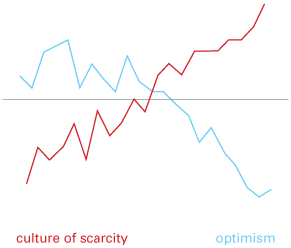
In a look at inward optimism and social pessimism, Matthew Taylor calls for a new collectivism among progressives (“Why Life is Good,” New Statesman, January 3, 2008).

Taylor writes, “miserable idealists need to make a New Year resolution to look on the bright side. Pessimism is becoming an impediment to progressive politics.” He continues:

Progressives want the world to be a better place. We bemoan its current inequities and oppression — yet if we fail to celebrate the progress that human beings have made, and if we sound as though the future is a fearful place, we belie our own philosophy. Instead, we need to address a deficit in social optimism that threatens the credibility of our core narrative.

Similarly, my works for the upcoming Activist Imagination exhibition are inspired by how we see ourselves reflected in the world.

Standard
Research

Discovering Art Collectors

Dale Eastman’s “A collector’s guide to the exploding art market” (San Francisco Magazine, January 2008) is a thorough introduction to collecting art. It features advice from local gallery owners, a list of five artists, and a reading list.

Eastman’s reporting spanned an impressive breadth — including web resources, international fairs, downtown galleries as well as alternative and artist-run spaces. The East Bay is hardly mentioned (it is, after all, San Francisco Magazine) but Oakland’s Josh Keyes and Swarm Gallery (where I’ll exhibit a new project in February) are featured prominently in Jim Hughes’ beautiful photos.

The cover photograph — a salt and peppered white male with cool glasses peers into the camera as if examining a work of art — is somewhat vanilla compared to the idiosyncratic personalities profiled inside: renegade techies, queers, family men still adjusting to their new tax bracket. The subtext is heterogeneity: San Francisco is still quirky, and by (optimistic) extension, all comers are welcome. Hopefully the next feature will include collectors of color, and emerging collectors of modest means.

The profiles of collectors starts off with a photo of Jeff Dauber, a burly dude with full sleeve tats and an even fuller ‘stache. It’s a shot fired, a proclamation that you don’t have to belong to beautiful people society pages to collect art. (Then again, why not have bikers and bears replace the gallerinas in Swells?) I also enjoyed reading about Scott and Nancy Oliver. Presumably, they helped to build the Oliver Arts Center at my alma mater. I pictured them as hands-off philanthropists, when in reality they are the owners of a construction business and the kinds of folks who feed, house and help artists during site-specific commissions.

Thanks to Eastman for the insight.

Standard