Community

Art Calendar

Tuesday, March 25

Panel: The Political Is Personal: Contemporary Women Artists and Political Expression: A Conversation
Panelists inc. Lynn Hershman Leeson, Masum Momaya (curator, International Museum of Women), Stephanie Syjuco, Favianna Rodriguez
6 pm program
Commonwealth Club, SF

Artist’s Talk: Active Phenomena: Shinichi Iova-Koga and Chris Bell
7:30 pm
Headlands Center for the Arts, Sausalito

Thursday, March 27

Opening Reception: Make You Notice
Artists: Lisa Anne Auerbach, Kate Gilmore, Laura Swanson, Jenifer Wofford, curated by Patricia Maloney
6-8 pm
SF Arts Commission Gallery, SF

Panel: Where We Are Going: The Future of Activism
With Ron Muriera, Erika Chong Shuch, Pireeni Sundaralingam, and Carlos Villa, moderated by Wei Ming Dariotis
7-9pm
Kearny Street Workshop, SF

Artist Talk and Panel: Jazz and Visual Art
Angela Wellman, Wanda Sabir, Duane Deterville, Marcus Shelby, Kimara Dixon, James Gayles
6:30 pm
Swarm Gallery, Oakland

Friday, March 28

Opening Night Party: The Way That We Rhyme: Women, Art & Politics
Inc. Andrea Bowers, Miranda July, Shinique Smith, The Counterfeit Crochet Project organized by Stephanie Syjuco, Jessica Tully
8-11 pm
YBCA, SF

Wednesday, April 2

Harriet Tubman CD Release Party: Marcus Shelby Jazz Orchestra
shows at 8 pm, 10 pm
Yoshi’s, Oakland

Thursday, April 3

First Thursday openings in Downtown SF
5-7 pm-ish

…then…

SORRY: Recent Works by Jenifer K. Wofford and Christine Wong Yap
6-9pm
Frey Norris Gallery, SF

Friday, April 4

First Friday openings in Oakland

…including…
Opening Reception: Solo show: Sam Lopes
7-10 pm
Blankspace Gallery
Oakland

Saturday, April 5

Visual and Critical Studies Symposium
11 am – 3 pm
CCA, SF

24th and Mission Art Walk
6-9 pm
SF

Sunday, April 6

Graduate Open Studios
noon-5 pm
CCA, SF

Standard
Art & Development, Research

Looking at art vs. Looking at the world

Had a “gallery day” yesterday, cut short by achy feet (wrong shoes, my bad). But visual images in the world-at-large are giving Art a run for its money.

Christian Nguyen at Patricia Sweetow Gallery
Christian Nguyen draws oppressively orderly architecture in graphite and paint on unstretched, unprimed canvas. Nightmarish, like an Anselm Kiefer, only it’s tight graphite lines, not expressive found object and paint strokes, that makes the soaring view claustrophobic. Patricia Sweetow Gallery.

Art 1, world nil.

Squirrel
People idealize working from home, but you don’t know cabin fever the way I’ve known it. Little things help, like our newest visitors. For some reason these squirrels started coming by our balcony, on weekdays only, around 5 pm. If they could talk I bet they’d say, “Quitting time!”

Art, world 1.

institute for personal change
In preparing for the upcoming two-person exhibition with the talented Miss Jenifer K. Wofford at Frey Norris Gallery,* which opens April 3, I’ve been thinking about my text-based work, which was so often about humor and pathos. This postcard (wrong address, but it’s too perfect for me to pass up) is a great example of how real life is perfectly imperfect.

thanks for being a friend
Christine Wong Yap, Thanks for Being a Friend (before and after views), 2006, letterpress on paper bag.
*Get to Frey Norris early—the first 40 people will receive a bottled beverage wrapped in an editioned print/sculpture-to-be.

Art, world 2.

ian macdonald at branstein
Ian MacDonald’s curious objects are comprised of ceramic, stone, cement, enameled steel and acrylic. Grouped objects of identical shapes and ambiguous functions formed a sort of home-design-like display. Quiet yet impressively considered. MacDonald’s show is called Optimism (if you want it) and is on view at Rena Bransten Gallery, which is also showing flawless photos by Candida Höfer. And Höfer’s good, real good. I’m neither knowledgeable nor especially enthusiastic about the medium of photography, but I have come to admire the rigor in making such symmetrical, indicting prints of lavish interiors.

Art 4, world 2.

civil disobedience
Civil disobedience at Market and New Montgomery.
I think it’s pretty joyous and admirable when people exercise their right to civil disobedience for a good cause (and what better cause than stopping this ridiculous war?). Still, I couldn’t help but feel helpless among the gawking throngs—every other person was pointing a camera/camera-phone/video cam at the silent protesters creating a vigil-like spectacle. Now, I’m that person blogging about it.

Art 4, world 3.

flowers on bart
An outlandish hair clip on a miserable BART car. Flowers, fruit, female beauty—how fundamentally human it is to equivocate the fleeting with the joyous.

Art, world: Tie. Good game, good game.

Standard
Community, Research

It’s like the liner notes said…

Faye Carol and the Marcus Shelby quartet

Tonight, as I drove across town to Jack London Square, I thought about a recent conversation about provincialism in local art. It turns out, the two neighboring galleries on Second Street unwittingly presented Oakland’s duality: in one gallery, ugly bangs, biker dudes, ironic trucker hats bearing insider slang. In another gallery, families dressed for a formal occasion: an art reception honoring African American musicians, and a jazz performance.

I’ve lived in Oakland for something like 14 years. The first few years, I found the cool café “finds” and warehouse parties really charming. But these days, I fear that I’m a resident out of sheer habit. So while I tend not to air unfavorable art criticism—it might not be the right time, the right venue, and so on—I had a realization I’d like to share. Inwardly-focused art that appeals to local scenes or styles bothers me because I’m over Oakland, or rather, I’m over the Oakland clichés used to self-identify among hipster-invaders: images of telephone wires, port cranes, Top Dog (YES, the one an Oakland museum staffer name-drop ped in the alt-weekly) etc. So at the exhibition featuring artists celebrating their gentrifying warehouse district, I was repelled by the self-aware marketing and predictability—finding beauty in mundane/abject urbanity, conventional materials, convenient scales of working, the privilege of claiming an outsider status. I think the primary criticism here—aligned with the general argument against provincialism in art—is that the show seemed to serve the purpose of building the cred among Oakland boosters, rather than the credibility of rigorous artists.

The show felt reminiscent of the pre-dot-com-boom Mission. For some that’s as a good thing, portending an “Oakland School.” For me, it’s unnerving. To paraphrase Lawrence Livermore, founder of Berkeley’s seminal Lookout Records, on his biggest and one of his last compilation records, by the time you read this, the scene will be long gone.

But I’ve gotten a renewed, precious sense of love for locality back — thanks to East Bay based Carol and SF-based Shelby, who performed at James Gayle’s opening reception at Swarm Gallery. I was transported within their original compositions from MSO’s Harriet Tubman suite, and a song from the Dynamic Miss Faye Carol’s forthcoming tribute album to Billie Holiday. I’ve heard about bodily harmonic resonance, and thought it was hocus pocus, but as soon as the first notes came out of Faye, I got shivers up and down my spine which lasted well after the performance ended.

Give thanks for Carol’s and Shelby’s commitment to excellence and integrity. See them and the Marcus Shelby Jazz Orchestra when they perform the Harriet Tubman suite at Yoshi‘s on April 2.

Standard
Community

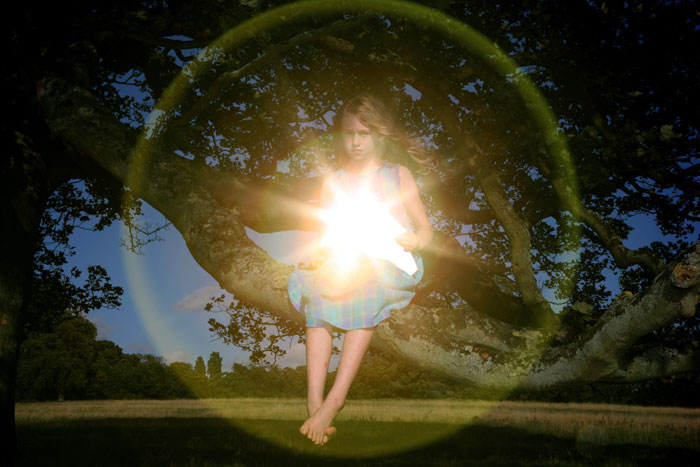
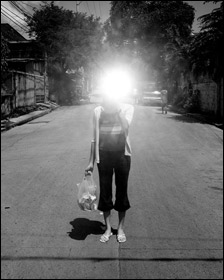
Aura, or a burst of light.

Walter Benjamin argued that reproducing a work of art kills its aura. But the aura itself has become a subject matter among contemporary artists. Witness the syncronization (both works date from 2006), from opposite corners of the earth (Paci’s Albanian based in Italy, Anading’s Pilipino):

The preview image for Adrian Paci’s Per Speculum, 2006. Courtesy of francesca kaufmann, Milan by way of E-flux. Currently on exhibit at Bonniers Konsthall.
Amazing.
Adrian Paci, Per Speculum, 2006. Courtesy of francesca kaufmann, Milan.

Poklong Anading, from ‘Anonymity’, 2006. Backlit photographic duratrans. Exhibited at Cross Art Projects.
ANONYMITY by Poklong Anading

Standard
Activist Imagination

Where We Are Going: The Future of Activism

Kearny Street Workshop presents
Where We Are Going: The Future of Activism
Ron Muriera, Erika Chong Shuch, Pireeni Sundaralingam, and Carlos Villa
Moderated by Wei Ming Dariotis

an Activist Imagination event

Join Kearny Street Workshop and artist, educator, and curator Carlos Villa, poet and writer Pireeni Sundaralingam, choreographer, director, performer and teacher Erika Chong Shuch, and community activist, performing artist, educator, Manilatown Heritage Foundation Executive Director Ron Muriera for a discussion about the future of activism, the arts and community, moderated by writer, academic, and long-time KSW member Wei Ming Dariotis.

The discussion will explore and envision activism for the days and years ahead. Given our history and the current political, social, and environmental climate, what forms of activism will be relevant in the future? How can those who want to effect real change consider technology and global forces in developing strategies? What forms of activism can we imagine that will hold relevance, and power, in the days to come? And what challenges can we identify on the horizon?

Thursday, March 27th, 2008; 7pm
Kearny Street Workshop‘s space180
180 Capp Street, 3rd Floor, @ 17th Street, San Francisco
Free and open to the public.

The Activist Imagination project is made possible in part by a grant from the Creative Work Fund through support from the Walter and Elise Haas Fund, The William and Flora Hewlett Foundation, and the James Irvine Foundation. Activist Imagination is also supported in part by a grant from the San Francisco Foundation and from KSW’s members and individual donors.

About the Panelists and Moderator

Wei Ming Dariotis is Assistant Professor of Asian American Studies at San Francisco State University, with emphases on Asians of Mixed Heritage and Asian Pacific American Literature, Arts, and Culture. Wei Ming Dariotis serves on the Board of the Asian American Theater Company and the Advisory Board of iPride, which runs the FUSION Summer Day Camp for Mixed Heritage Youth. Her recent publications include, “Developing a Kin-Aesthetic: Multiraciality and Kinship in Asian and Native North American Literature,” in Mixed Race Literature, ed. by Jonathan Brennan (Stanford University Press), “On Growing Up Queer and Hapa” in The Multiracial Child’s Resource Book, “‘My Race, Too, Is Queer’: Mixed Heritage Chinese Americans Fight For Race and Gender Marriage Equity” in Chinese America: History and Perspectives/Branching Out the Banyan Tree Conference Proceedings, and “Crossing the Racial Frontier: Star Trek and Mixed Heritage Identities,” in A Science Fiction Phenomenon: Investigating the Star Trek Effect.

Erika Chong Shuch
is a choreographer, director, performer, and teacher. Deemed by Robert Avilla in the SF Bay Guardian “among the leaders in the field”, the ESP Project (Erika Shuch Performance Project) is one of only two resident companies at Intersection for the Arts, San Francisco’s oldest alternative arts space. ESP Project’s has premiered 6 full-length performance works, as well as numerous shorter works since 2002. Exploring the inevitable terrain of love and death with vulnerability and humor, Erika’s ruminations coalesce into integrated and imagistic assemblages of music, movement, text, and scenic design. Erika’s work celebrates the extraordinary within ordinary human experience and aims to amplify the role of theater as a tool for inspiring social change. Erika was awarded the prestigious Emerging Choreographers Award by the Gerbode Foundation, SFBG’s GOLDIE Award in Dance (2003), the Dance USA grant from the James Irvine Foundation, was an Artist in Residence at the Headlands Center for the Arts (2006) and at Djerassi (2007), and worked under the mentorship of Joe Goode through CHIME (2003-2004). Erika is a co-founder and faculty member of the Experimental Performance Institute, a BA and MFA program at New College of California.

Born and raised in Sri Lanka, Pireeni Sundaralingam currently lives in San Francisco. She is a PEN USA Rosenthal Fellow and editor of Writing the Lines of Our Hands, the first anthology of South Asian American poetry (forthcoming). Her poetry has appeared in national newspapers and political journals such as The Guardian (UK) and The Progressive (USA), university teaching texts including Three Genres (Prentice-Hall, 8th Edition, 2006), and anthologies such as Masala (Macmillan, 2005) and Contemporary Voices from the East (Norton, 2008). Having given readings on national radio in Sweden, Ireland, the UK and America, Pireeni’s work has also been featured in such venues as the United Nations headquarters, the International Museum of Women and the National Theatre (UK). Working with her partner (violinist Colm O’Riain), Pireeni’s latest album Bridge Across the Blue brings together 23 musicians and poets to tell the immigration stories of America. Awarded the Californian Potrero Nuevo Fund Prize for Social Justice through the Arts, the album has been described as “a triumph of transformative collaboration, and a blueprint for cultural sanity” while the editors of About.com have selected it as “one of the best recordings of poetry and music ever recorded”.

For nearly fifty years Carlos Villa has explored the meaning of cultural diversity in his art and in doing so has expanded our awareness of what we consider as “multicultural.” What began in his early career as an attempt to understand his own heritage–a complexity of Filipino traditions with its layered strains of Asian, African, Indian and Oceanic cultures, along with influences of a Western artistic tradition–became over time an exercise in creating his own visual anthropology to represent his personal background, and, in a broader sense, the dynamics of intercultural weaving. – Preston Fletcher. For more information visit http://carlos-villa.com/

Standard
Research

Fear not contemporary art

A derisory tone prevails in most media treatment of contemporary art, whether controversial or not, a tone not appropriately skeptical or critically alert but smugly dismissive – and, I suspect, defensive.

This tone reflects little or no effort to imagine the risks of creative work in the postmodern context – the risk of self-deception, of squandering precious time and energy, of embarrassment through self-exposure. Instead, it echoes the tone of anti-intellectualism sounded in every statement in support or denunciation of public policy by every politician who dreads the stigma of “elitism” — and that seems to mean every politician, period.

–Kenneth Baker, “Saving the Soul of Art,” March 2, 2008, SFGate.com

Standard
Art & Development

Talking about art

works 2004-2008

It’s always nice to have the chance to talk about my art. In the past week, I participated in an artist’s talk at Swarm Gallery and presented a slide lecture at Helen Lee’s undergraduate Sculpture class at CCA.

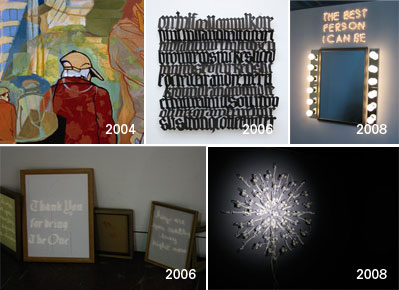
Talking about my art gives me a chance to refresh my memory about my motivations and discover significance in past projects. For example, though my most recent projects are not explicitly text-based, the small papercut, “Untitled (One Half Gallon)” seems to mark a turning-point in my practice. I realized that it marks the leap from my printmaking past to my object- and installation-oriented present; it’s almost literally the page coming off of the wall.

It’s also nice to see recurrent themes, such as in interest in light (see the Hi It’s Me project), or how far my interest in the viewer’s agency (beginning with projects like Lens Flare, large mirror) has evolved.

Of course it is interesting to hear responses to my work, but I also enjoy the opportunity to share a chance to talk about art. I think most non-artists are rarely offered a forum for their responses to art, so I hope that my audience feels as though their experience with my work—whether phenomenological or conceptual—is valid and worthy of discussion, and that they feel free to take advantage of art community events like opening receptions and artists’ talks to ask questions and share opinions.

On that note, I’m pleased to announce that I’ll be in a two-person exhibition at Frey Norris Gallery off of Union Square, which opens April 3, with an artist’s talk April 19.

Standard
Community

from our friends at koh-i-noor

Just wanted to pass on this note about a new exhibition by Jacob Borges on “Pessimisten og optimistens” from Danish conceptualists Koh-i-noor. It starts with a beautiful quote.

“The optimist proclaims that we live in the best of all possible worlds; and the pessimist fears this is true.”
James Branch Cabell

en solo udstilling af Jacob Borges
Fernisering fredag d.14. marts kl.17.00 – 20.00
åbent 15. 16. 20. 21. 22. 23. 27. 28. 29. 30. marts kl. 15.00 – 18.00
Koh-i-noor
Dybbølsgade 60
København V.

Udstillingen undersøger, gennem et enkelt konceptuelt værk ved navn ”tip of the iceberg”, Pessimisten og optimistens rolle både generelt men også i forhold til et konkret problemstilling i vores samtid. I udstillingen og ligeledes i det citat af James Branch Cabell, der her bruges som udstillingens titel, er det tydeligt at det blik der kastes på disse to modpoler oprinder fra den mere negative af de to. Udgangspunktet er en leg med to ordsprog, toppen af isbjerget og er glasset halvt tomt eller halvt fuldt.

”tip of the iceberg”
værket består af et halvt tomt/halvt fuldt glas vand. Glasset står på gulvet oplyst af et enkelt spot. Vandet i glasset har været på en længere rejse før det endte i Koh-i-noor.
Vandet startede som is på toppen af et isbjerg uden for Nuuk, Grønland hvor det efter indstrukser fra kunstner Jacob Borges blev høstet, smeltet, fyldt på flaske og sendt med pakkepost til Danmark.
Med en viden om at polernes iskapper smelter og de, stadig tildels ukendte, konsekvenser dette kan medføre, i baghovedet. Må man overveje om man kan forblive optimistist.

For more info see Koh-i-noor.org.

Standard