Art & Development

Artists’ Software: The Dark Ages

Just came across GYST 2.5, software for artists. The package looks really interesting: a combination of databases for tracking contacts and artwork inventory, checklists for different exhibitions/artist’s jobs, goal-setting and to-do list making, and resources — much of the same material covered in the artist’s professional development workshops.

This software looks like a good way to get organized. Cheers to the developers! It’s about time. I’m all in favor of artists getting organized. I’d recommend giving it a shot to any artists who haven’t gotten organized, but are self-motivated and organized enough to learn and stick with a new software. (The one thing it doesn’t seem to cover is time management — especially the week or so it’ll take to get up and running on their system).

The price — $149 — can seem high for individual artists, but for a software license, it’s not too bad. The designer in me advocates for artists to see that programming is work too, and it’s only fair for software developers to get paid.

Still, I’m not buying the software–at least, not this version of it. Here’s why:

First, my design sensibilities are too easily offended to overlook the ham-fisted interface. The olive-pumpkin-cranberry color palette reminds me of design projects driven by clients’ favorite colors, rather than the colors that best present the information. The typography isn’t especially screen-friendly or modern. It seems like an attempt to make what’s essentially a management database and digital book friendly and accessible, which seems a bit infantalizing to artists. This interface in particular seems like something that would appear in an Edward Tufte information design book — as an example of what not to do. A grid of hard-outlined buttons (with no clues to organize or distinguish the content) duplicates the list to the right. The only way to find what you’re looking for is to read every menu option, so why bother with the buttons? The round buttons seem especially problematic: white pixelated GIF edges show, and an initial appears where an icon or text should be. “NDFSEB” may be more iconographic, but it’s unintelligible. “New, Delete, Find, Sort, Email, Back” is clearer.

I like GYST’s for-artists-by-artists ethos. The only problem is: I wouldn’t expect an interface designer to make great art, so why should GYST expect artists to make great interfaces?

Secondly—I have to admit—I might not be GYST’s target user. I have lots of systems in place already: Quickbooks for bookkeeping, a series of folders named with an 8-digit deadline for competitions (YYYYMMDD keeps the closest deadlines sorted on top), an identity system for artwork labels, Address Book for contact management and exporting mailing labels, a goals binder from a previously attended workshop, Excel for budgets (compare Excel to GYST, whose budget is in a list format that lacks basic formulas like Hours x Hourly Rate, or Quantity x Amount).

The one component that I’m missing is an artwork inventory program. This software essentially has a Filemaker Pro-derived interface with an image field for a photo of the artwork. That’s a nice feature, but then again, Filemaker Pro is flexible, highly refined, and versatile, so $299 for Filemaker seems not too bad, if it means I can manage my art inventory plus any custom database I’ll need in the future.

GYST’s website is vague about cross-application integration. It doesn’t say much about simple set-up tasks like importing contacts from Apple Address Book or Microsoft Entourage, much less exporting to-do items into iCal, a feature offered in Quickbooks.

Third, it seems like part of GYST’s features is information. In this way, GYST functions like a resource book. And this is confusing—help sections are useful, but resource texts are a different beast. I think most people don’t read much in a software’s resource section, because the interfaces are not very reader-friendly (I don’t know what GYST’s is like, but being able to expand the window size and text size would go a long way here). And Web and software realms are different than books: in this realm, knowledge should be free, like in a Wiki K-base or Adobe.com’s constantly updated support section; and if the knowledge isn’t going to be free, it should be comprehensive, like how Dreamweaver comes with O’Reilly’s HTML and CSS reference.

GYST is in its early stages and I’m looking forward to seeing how it advances, streamlines and improves with a little bit of constructive criticism.

Standard
Community

Open House: sweet!

I had a great time at the Headlands Open House yesterday — thanks to everyone who came out to the Marin Headlands. It was nice to see familiar faces and meet new friends… Highlights included a Galleon Trade-ish reunion with Stephanie Syjuco and Gina Osterloh, and a surprise visit from Trisha L-G and David. Whoa!

I’ll get to see more of art by my neighbors Wednesday… In the meantime, I’m really excited about the work of my across-the-elevator-shaft neighbor, Eric Hongisto, who is currently making text-based paintings and is similarly keen on graphic design. Nice site!

Standard
News

Headlands Summer Open House. YBCA Bay Area Now.

carbon solar sculpture study
A new study for a sculpture.

7/13: Headlands Summer Open House

Join me at the Headlands Summer Open House. My studio is in Building 960 (around the bend from the main buildings) in the basement.
Headlands Summer Open House
Sunday, July 13
Noon – 5 pm
Headands Center for the Arts, Marin Headlands
event info
directions

syndicate walking tour map
Syndicate Walking Tour Map

Opening 7/19: YBCA’s Bay Area Now

I was invited by Jessica Tully to contribute to Syndicate, a collaborative project for Ground Scores. Join the fun at the opening night!

Ground Scores: Guided Tours of San Francisco Past and Personal
Guest Curated by Valerie Imus
YBCA Terrace Galleries & Off-Site Locations
Opening Night: July 19, 2008
8 pm-midnight

event info
directions

Standard
Activist Imagination, Research

Artist’s Talks: Rave. Rave. Rant.

Just heard two fantastic artist’s talks tonight!

I love artist’s talks that create narratives and contextualize work with key biographical facts, relevant personality traits and intellectual and artistic interests. It’s a superior means of learning about art and artists than reading C.V.s and looking at still images. I’m much more compelled to hear what the artist has to say and why he/she makes art. I’m looking for evidence that the artist is deeply engaged in an ongoing inquiry.

THE VIEWER AND SCOT KAPLAN

That’s why I loved hearing the talk by Scot Kaplan, a visual artist from Ohio with a conceptual- and performance-based practice engaged with the psychology of contemporary life. He also teaches theory in a university art department, which I believe accounts for his articulate, well-oiled presentation, insightful self-examination, and that driving, insistent willingness to challenge dominant paradigms (a characteristic of all the theory professors I’ve met).

Kaplan’s presentation was great because he was ready to establish the context at the start, posing the questions that drive his inquiry (about examining power relationships) and citing influences, like a Harper’s Index item on the average time spent looking at a work of art in a museum (0.6 seconds). Contending with the typical viewer’s superficial engagement with works of art, Kaplan admitted to feeling belligerence towards the viewer; that as an artist, he would require some investment from the viewer to experience his work. I wholeheartedly agree: I’m not interested in making work for others’ visual pleasure, available at their leisure. The world is full of beautiful, attractive, cute or endearing images, and the avalanche of imagery shows no signs of slowing. So as my work becomes less visual and more experiential, I’m fine with leaving those 0.6 seconds of the typical viewers’ gaze behind, if it means more selective but more meaningful engagement.

Kaplan presented early work clearly influenced by Marcel Duchamp’s L’Etant Donnes. He made a series of provocative portal-like structures, such as altered viewfinders, wall-mounted boxes into which viewers insert their heads to hear audio tracks, and even a fridge-disguised portal leading to a hidden listening chamber.

Viewer interaction was required to experience those objects and installations, but Kaplan also presented work where the viewer became agent and subject. This is something I’ve been thinking a lot about since my work for Activist Imagination. Kaplan’s work, though, directly addressed power relationships. For example, he created a small room that locked viewers inside for 90 seconds at a time, as well as a tightly-controlled project where individual viewers gave commands to the artist, who inhabited an adjacent room behind a security mirror. It was a performative social experiment that tested the lengths to which the artist and viewers would go, and it brought to mind the work of Marina Abramovich (two wrongs don’t make a right, but I still felt somewhat relieved to see someone other than a woman subjected to the disturbing, violent whims of others) and Philip Zimbardo, the author of the Stanford jail experiment that revealed how quickly ‘normal’ people abuse power. Kaplan executed this project in two locations in South Africa: a privileged university campus, and a Black township. While the performance is an important component, perhaps more so, the work is about the findings of the experiment: college students more often gave Kaplan abusive commands, while the township’s residents allowed the artist more dignity.

Kaplan’s work is provocative, but he seems thoughtful and not the least bit driven by shock value or ostentatious moralizing. His projects may be subversive, but are purpose-driven. The works create a condition where the artist’s vulnerability incites the viewers; they become culpable for completing the work of art, and in the process, making or breaking a social bond.

IVY MA: THE ADAPTOR

Ivy Ma, an artist from Hong Kong, makes poetic, phenomenological installations and photographs, and quiet but impressive drawings and paintings. I was really impressed with the diversity of her media, her capacity to create site-specific projects on residencies around the world, and how true she is to her investigation. Site-specific work can be challenging in your home town, much less thousands of miles away from your studio, tools and materials.

Like Kaplan, Ma makes some performative works involving her body, but Ma is interested in outdoor environments, like the Finnish lakes or her rapidly redeveloping Hong Kong.

She presented her work in a way that was modest and endearing — this style seems characteristic of non-native speakers from East Asia — yet she’s a fierce intellect, methodical in her presentation style, undaunted by tedious projects (like drawing a nearly life-sized tree with a fine-tipped pen, or sorting beach pebbles by color) and citing references ranging from noted Bay Area authors, Rebecca Solnit and Anne Lamott.

I thoroughly enjoyed Ma’s work and presentation. It wasn’t until later that I thought about Ma’s work in relation to identity politics—something that seems to hound A.P.A. arts presenters and the artists working with them. In fact, Ma doesn’t seem interested in identity politics at all. She’s focused on her relationship to nature, solitude, and her physical environment. She may be a contemporary artist from China, but her work isn’t about the hangover from the Cultural Revolution. She may be an Asian artist making art in North America and Europe, but she’s not hung up on re-hashing cross-cultural issues. Maybe we could lighten up about it too.

COLLATERAL DAMAGE IN SPEAKING TRUTH TO POWER.

Unfortunately, not all artist’s talks are so inspiring.

Twice, I’ve had the odd experience of feeling invisible as artists of color talked about their work in terms of representing a community of identity. What happened was this: male artists of color used their talks to “speak truth to power” — to call out a predominantly white, privileged, liberal audience on their convenient progressivism and color blindness. To me, their radical or identity-based work became less effective, because the talk essentialized their art. Instead of being artists, they became cultural-political ambassadors.

Of course, I have more to learn about other racial perspectives and identities. Of course, the rarefied art world ought to be reminded of its privileged status. Of course, liberalism can stand to be nudged along by radical insights.

But if the goal is to challenge racism, gross generalizations about the whiteness of an audience — which includes people of color with radical politics like me! — is just a poor tactic. One artist seemed intent on assaulting the audience with his didactic videos played at extremely high volume. [I’ll pass. An aspiring drummer in my teens, I’m entering my thirties a tinnitus sufferer. My ears are ringing like I just left a concert–every day.] Another artist made the statement, “We tend to be color blind” or “We don’t talk about race” (“we” meaning, presumably, white liberals). Actually, I talk about race all freakin’ the time. You talking about race and saying that I never talk about it makes me feel invisible. That is color blind.

Standard
Research

Good Old Tesla

Two things I’ve been thinking a lot about are carbon and lights, so imagine my surprise when I stumbled across the Carbon Button Lamp, Tesla’s challenge to Edison’s patented incandescent lamp.

Perkins-Mather spiral filament 1880's
A Perkins-Mather spiral filament lamp from the 1880’s. Spark Museum.

I can’t find a picture of Tesla’s Carbon Button Lamp, but visit The Spark Museum page of beautiful early light bulbs, with blown-glass details and fanciful filament shapes. Catherine Wagner’s photographs of light bulbs are beautiful, but I also like reading about the bulbs and their re-purposed parts.

Standard
Research

K.I.S.S.

Shocked. I was shocked!

“This page is so easy to read!” I thought. “Where are the ads? What’s happening?”

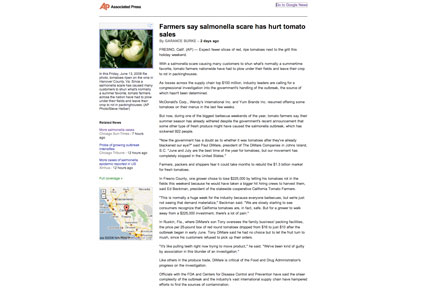
I came across a remarkably readable news article on ap.google.com today. Not an ad in sight! No gratuitous design. Plain, straightforward, attractive in its ease, and completely readable. It was refreshingly simple.

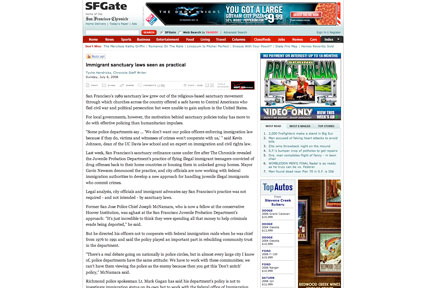
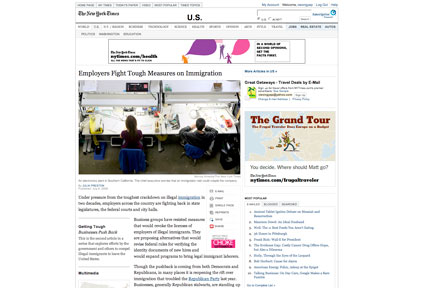
Compare the AP.Google page with other news sites’ pages. Two principles become obvious to me. First, simplest is best. Second, ads suck.

I don’t have a problem with news organizations taking ads. The New York Times is right: as a reader, I’d rather access their content for free and see advertising than pay an online subscription fee. But the ads shouldn’t blur into the content; nor should they distract from it.

I have a problem with advertisers, especially ones making the awful eye-grabbing animated GIFs. They’re only distracting and annoying. I’ve not once clicked on an online ad because the ad was cool.

There are tried and true rules to advertising:
Find your target.
Be relevant.
Advertising is the most expensive, lowest return form of marketing. (See Marketing without Advertising, from Nolo Books, which advocates ethical business practices and good service as fundamental strategies for encouraging good word-of-mouth.)

There are also tried and true rules to graphic design:
Be transparent.
Serve the content first and foremost.

And while art often breaks rules, I’d like to challenge the misconceptions that art is equivocal to expression or beauty, and that art is ultimately subjective. Objectivity and criticism can exist in fine art as well.

Often people say they like art that they can keep looking at over and over; they appreciate a temporal looking experience that results in multiple discoveries. But I would argue that making things more visually complicated does not necessarily make it more interesting.

As a reader, graphic designer and artist, I’d love to convince people not to confuse loudness with success. Generally Americans don’t like to think so, but it’s OK to err on the side of quietness and not underestimating your audience. As Jenna Fisher’s agent told her when she went into her audition for The Office, “Dare to BORE me.”

Standard
Art & Development, Values

Economic stimulus packages

I’m sure the credit card companies are releasing a collective grunt right about now, as the Fed’s stimulus checks are hitting accounts and taking a bite out of the balances artists like me are carrying. Not what the Feds had in mind — so sue me!

But for the past several weeks, artists far and wide have been not just talking together, but really working together! What’s happening? YBCA’s Bay Area Now 5, the triennial showcase of local visual arts, opens July 19th.

I’m involved times three! First, a few weeks ago, Jessica Tully invited me to contribute to Syndicate, which is part of Ground Scores, a component curated by Valerie Imus relating to San Francisco’s forgotten histories. Then, David Buuck, a psycho-geographer (look it up) working with B.A.R.G.E. (another featured group in Bay Area Now), asked me to contribute my web design services.

Last but not least, the illustrious Jenifer K. Wofford invited me to be part of Galleon Trade: Bay Area Now 5 edition, where five Bay Area artists will be presenting work in dialog with art by five Manila based artists.

For my project, I’ve sought out the help of Nyeema Morgan, an artist with loads of fabrication skills and experience. It turns out that she’s helping out two other artists for Bay Area Now as well!

It takes money to make art. So if you really wanted to stimulate the economy by turning a segment of notorious tightwads — artists — into spendthrifts, help them make and show art!

Standard
Citizenship, Research, Sights, Values

Answers: we all need them.

“In general relativity, an event horizon is a boundary in spacetime, an area surrounding a black hole, beyond which events cannot affect an outside observer. Light emitted from inside the horizon can never reach the observer, and anything that passes through the horizon from the observer’s side is never seen again.”

http://en.wikipedia.org/wiki/Event_horizon

The phrase “the art world” suggests that art is like a foreign entity with rules of its own making.

I blog to increase transparency about art and artists and bust the myths about artists and art making that are so pervasive and persistent: That a person “can” or “can’t draw.” That you don’t get famous until you’re dead. That modern art is a sham. That meaningless rhetoric turns a tampon in a teacup into art. That artists are stereotypes: the starving artist, the egocentric artist, the flamboyant, condescending artist. The anti-social artist. They’re like a list of Smurfs, where everyone’s boiled down to one outstanding characteristic designed for easy, non-threatening identification.

When you’re in a community of artists, it’s easy to feel human — whole, sane, remarkable for the breadth of our modest experiences. But it’s different in the World at Large, where one is reminded that the general public thinks of art as synonymous with paintings, that the point of art is beauty or expression (but the point of being an artist is to be famous), and that hostility towards contemporary art is a completely acceptable means of anti-elitist individuation.

Brushing up against that world can leave me feeling like my work is both less productive or valuable to society, and paradoxically, my work makes me special: I’m more tireless, more gifted (rather than skilled or disciplined), more remarkable for my Other-ness for having a creative pursuit at the center of my life.

So can you blame an artist for feeling like she navigates two worlds? For wishing to see more observers outside of the event horizon to get sucked into the World of Art?

I mean, people participate in multiple worlds all the time. For example, I skirt the edges of the macho World of fight sports. Going to a boxing match for the first time was new and scary, but I got over it. On the other hand, some people find the prospect of attending a gallery opening too intimidating or too unrewarding to try.

Fundamentally, if people think they either “can” or “can’t” draw as children, as adults they might think that they either “get” modern or contemporary art, or they don’t. That if a Matisse portrait with a green nose doesn’t stir something in you, that you’re somehow not smart enough to intuit the significance, so you shouldn’t even bother figuring out why the Donald Judd shelves are art. But how to look at a Judd, or understand the historical conditions that led to Modernism, is something that can be learned, very easily (An art history class: You sit in a dark room and keep your eyes open while someone talks and shows slides).

As an artist, it’s in my best interests for more people to engage with art, to take art history classes, to feel like art is a desirable, rewarding part of one’s life. In other words, it’s not in my best interest to be egocentric or condescending, or to be secretive about art and art making. I believe most secure artists like to encourage other artists and help the public engage art.

Earlier, I visited Yahoo Answer‘s Visual Arts forum. Most questions were about appraising antiques, materials recommendations, or requests for critiques by amateur manga artists, nature photographers and still-life painters, with a few how-to questions. I posted a few answers about techniques and materials, and more urgently, safety suggestions (melting plastic in one’s oven = not a good idea). I also responded to the heartbreaking post from a 14-year-old girl whose dad said her drawings wouldn’t be good enough for her to study art in college.

At the risk of sound like an intellectual snob, or maybe someone just someone with a sense of cynical irony, here’s a list of questions that made me want to laugh, cry, or both:

What is the significance of clowns in Chicano Art? What do they mean? Can anyone tell me?

If you sick a metal rod, (lightning rod) in sand and its struck in a storm will this make glass figures?

I want to forge my own sword. I’m in chicago, does anybody knows where do I go?

Can someone give me a list of COOL graffiti names?

Where can I register as an Artist (Oil Painter)?

What do you think of the name federico?

I need a pict of a toryilla chip next to apair of red headphones on the shoulder of a man in a bannana suit?

I have over the past few years started painting abstracts. How do I get my work into gallerys?

Is blue a real color?

How do I find an artist willing to submit to my every whim?

Can anyone tell me of a symbol that represents “being true to yourself”?

A good Logo design idea for a design and Print broker?

Why do my photos from my Sears Portrait CD come out all odd?

What kind of pictures would be funny/interesting if they were unfinished or half-drawn?

How much does it cost to order/purchase a bronze statue of a man, actual size?

IS there such website?
That allows you to see what you will look like at a certian age such at if you are 16 and you want to see what you might look like at 32 or something like that

Ideas??????
I cant think of anything to shoot!!!

To any graffiti lovers in the ny/nj area?

If the world discovered a new color, what would it look like and what would it look like?

Im not creative do you have any ideas?

Standard