Jenifer Wofford, artist, teacher, friend and Galleon Trade mastermind, is gracing Market Street with Flor de Manila y San Francisco, a new graphic novel, with help from the SF Arts Commission. The preview photos look great! So nice to see public art relevant to the area. Can’t wait to see them in person. Here’s a sample!

Author Archives: cwongyap
review: APAture
This year’s APAture exhibition at Kearny Street Workshop is different, and you can tell right away.
APAture is Kearny Street Workshop’s juried annual multidisciplinary arts festival. I’ve been involved in past APAtures and KSW, so this will be part review, part proud stock-taking of how far KSW has come.
It’s tighter and more focused, with fewer artists, more work of a higher caliber, and more professional exhibition strategies. The result is less misses and more hits. Cheers to everyone for making it all happen: for putting in the work, but also being brave enough to break from tradition and raise the stakes.
Past shows have leaned heavily towards emerging art, and, for lack of a better term, “Asian America 101” art. In this show, some work dealt with identity issues, but the overall show was much more contemporary in tone. Short artists’ statements on the wall labels helped to convey the artists’ intentions and broad range of investigations.
Here’s what caught my attention:

Prints by Dinesh Perrera
Dinesh Perrera’s screenprinted revisions of Art Nouveau-style Ceylon Tea posters are beautiful and demonstrate stylized drawing skills, but I’m not convinced that they fulfill their stated mission “to recontextualize Sri Lanka’s tea industry from being a British luxury import to a product that is integral to Sri Lanka’s cultural identity.” The artist swapped out Mucha’s fair-skinned feminine beauty for a Sri Lankan feminine beauty. In place of romanticized botanical motifs, tame elephants and critters serve The Lady tea in dainty teacups and saucers. The idealized Western images and their corresponding values — leisure, afforded by wealth — have too much of a presence, and the posters still function like ads, inspiring class aspirations, but with modified cultural symbols.
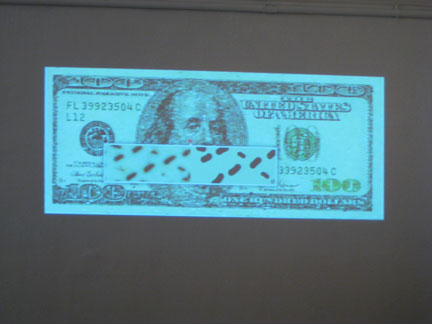
Projected interface for Takashi Kawashima's Ten Thousand Pennies project
I was really amused by Takashi Kawashima‘s Ten Thousand Cents, a participatory project in which he contracted, at the cost of one penny each, drawings of tiny fragments of a $100 bill. He reassembled the drawings to form a counterfeit image, and developed a really cool, simple interface that allows viewers to click on a pixel and see the original fragment side-by-side with a video of the drawings-in-progress. Kawashima’s project is complicated and yet cleverly circular (the labor costs were $100, and the participatory process is mirrored by interactive viewing), with a straightforward display.

Viewer in Amy M. Ho's Beyond II
Amy Ho presents a ceiling-mounted mirrored box full of cut paper that resembles leaves of grass. Viewers ascend a ladder to insert their head and see an infinite room. It’s difficult not to associate this experience with Misako Inaoka’s room-sized installation currently on view in Bay Area Now at YBCA. Inaoka’s dropped moss ceiling was interrupted with small dome-like portals to take in animated sculptures, sounds and even a view of grass. It’s an unfortunate but inevitable comparison. I was also puzzled about the placement of the box, a few feet away from an actual skylight in KSW’s ceiling. This was made up for, though, in oodles of surprise and delight when the artist appeared in a handmade durian costume.
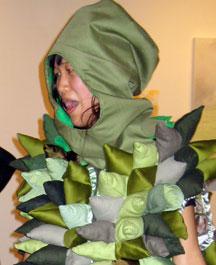
Is that a durian costume? You bet!

Detail of a work on paper by Weston Teruya
Weston Teruya is the Featured Artist in the show, and he contributed two collages/works on paper. Teruya’s work is always fantastically well-made. His imagery are piles of junk — chairs, rubbish, coolers, ladders — in what seems to be the middle of a hurricane. Flying objects may seem fanciful, but given the tumult in the world these days, the images strike a chord with the nervous sensation of impending collapse.
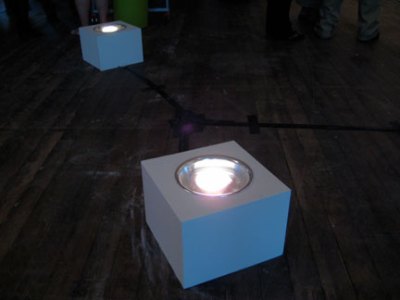
Light-boxes for Mark Baugh-Sasaki's sculpture
Mark Baugh-Sasaki makes sculptures that literalize the awkward tension between nature and industry. His hanging sculpture of two naked tree boughs mechanically splinted together is more subtle and poetic than previous works, but I’m an admitted light bulb nerd, so sue me if I was fascinated by his custom designed lighting fixtures: clamp lights embedded in low pedestals. The geometry of it all (square-circle-circle) and unexpected surfaces were just nicely weird and matter-of-fact; no illusions or pretenses. The bulbs were slightly menacing when you realized how much current passes just under the glass at foot level…
Another artist contributed a narrative photographic triptych, but she sort of approached-me-but-not before I could snap my note-taking photo of the wall label. I have seen women-in-costumes-in-the-forest photos before, but there was something ironic about these staged images that I wanted to hear more about. So I asked her. In a very brief, cagey conversation, I learned that the photos were “about race and gender.” She recasts herself as the shining prince in the fairy tale, but I was less than charmed by her reticence in person and in the exhibition materials to contextualize her work or motivations.
Barbara R. Horiuchi’s aluminum panel is basically an abstract painting, but even I found its visual drama breathtaking, and found it even more curious after learning about the strange materials behind it.
JPGs = containers; installations = contained

I’ve posted some photos of my work in Galleon Trade: Bay Area Now 5 Edition at YBCA on my site.
So strange how the physical work and the documentation have separate, yet inextricably linked, lives. The former is temporal, a bit precious, the latter is detached from meatspace reality, and lives on in the currency of images. I don’t think of myself as a maker of illusionistic images; still, it’s probably more common that my work is recalled in JPG form, than in first-hand memories.
Who gave us the right
Some of my more darker-themed artworks were inspired by the sort of pessimistic malaise seen in some recent contemporary art shows, and the related idea of the end of the American Century. More than just a form of liberal cynicism or the fatigue of constant moral outrage, I’m much more interested in an intellectual inquiry into why Americans should be skeptical the direction of our country, especially as both presidential candidates envision the US being the leader of the world.
So I was intrigued by Andrew J. Bacevich’s interview on WHYY’s Fresh Air (Sept. 11, 2008).
Andrew J. Bacevich, a professor of history and international relations at Boston University and a retired Army colonel, discusses his new book, The Limits of Power: The End of American Exceptionalism.
He argues that pragmatic realism has always been the core of American foreign policy, and current politicians would do well to remember that.
Bacevich is both a military man and a Boston University professor. He speaks candidly about how he didn’t develop a political consciousness until after he left the military. His position, now, though, is one that opposes the US’ continued Cold War-style military “strategy” to dramatically reshape the greater Middle East, and how the American public is confusing the war in Iraq and Afghanistan with the more sinister War on Terror—in which the role of this country is more like one that polices the world, rather than coexisting in it with others. He was also highly critical of the Legislative branch for giving up so much power to the Executive branch. And in one exchange that was a welcome validation of leftist values, when host Terri Gross pressed the professor on what the US should be doing, in addition to diplomacy, he mentioned increasing student exchanges and cultural exchanges to improve the perception of the US and work against our isolation from the world.
—-
ADDENDUM (added 9/26/08):
Roger Cohen’s op-ed, “Palin’s American Exception” (NYTimes.com, Sept. 25, 2008) is a great primer on why exceptionalism is a suspect position these days. Cohen proposes that behind Palin’s emphatic embrace of exceptionalism is an enraged response to the decline of American power. He promotes universalism instead of exceptionalism, interconnectedness instead of separateness, and realism not rage.
art review: new work, hahn and netzhammer at sfmoma
Just caught two shows of contemporary art and installations, breaking up the familiar galleries at SFMOMA. I was pleasantly surprised by both of these shows.
New Work: Zilvinas Kempinas, Alyson Shotz, Mary Temple
through Nov. 4 (Second floor)
I’ve already mentioned the awesome work of Zilvinas Kempinas here. At this show featuring work dealing with light and perception, Kempinas presents a site-specific installation of VHS tape attached to the floor and the wall, forming a huge, shimmering slope of black stripes. I may have to retract my statement that I’m not one of these people who likes a work wherein the more you look at it, the more there is to see. But Kempinas’ tape installation provides a wealth of optical illusions—vibrations, moirés, interfering shadows, grids of tape and shadow—which were pleasing to discover. Though one could argue that this installation falls into the category of media art using media relics, it has a stronger relationship to op-art, and consequently seems more open-ended than some media art objects.
Mary Temple contributes a subtle, effective trompe l’oeil installation miming cast window light, complete with silhouettes. She used latex paint on the walls, and stain on hardwood floors. However, the telltale additional layer of hardwood flooring over the museum’s floors gave away some of the almost-invisible process. It is what it is.
Alyson Shotz’s installation of clear beads on giant abstract wire forms was tightly constructed. It was a cool, massive installation that can only exist in behemoth galleries and museums. Still, it was not as dramatic as I had expected it might be. I don’t think all art has to be beautiful, but any abstract form playing with light seems to me to be clearly about beauty and perception, and this one fell a little short for me. I can’t figure out if it was the lighting, or if my expectations to be dazzled (or beadazzled? harhar.) were too high. Maybe I’ve been blinded by one too many beaded installations by Liza Lou?
Room for Thought: Alexander Hahn and Yves Netzhammer
Through Oct. 5 (Fourth floor)
A strange and wonderful installation of multiple video projections, sculptural objects and wall painting. In the center of the darkened space, a table sits on the ground with its legs hooved in oversized glasses; the rectangular center of the tabletop is pulled out by two ropes, forming a swing-like appendage to another twin table that hoovers, hardware hidden, in the air. Oversized ventilation pipes house a series of projectors, whose videos feature Virtual Reality-style animations of mannequin-like figures in unsettling abstract environs. I understood immediately that the doll-like bodies facilitated the telling of a deeply psychological and disturbing story. But the multiple elements were highly choreographed, and I wasn’t able to experience it all in my short visit, though I’ve got lingering spookiness to mull over.
First Impressions of the fall art season
A quick jaunt around Geary Street galleries today resulted in some decent impressions:
Andrew Schoultz at Marz and Zavaterro
A reluctant but resounding WOW. Reluctant, because I’d like to chalk up this dude as a one-trick pony (OK, the tree, the brush strokes, the symbols of capitalism recurrent in graf culture—I get it), but resounding, because he’s intensely prolific, evolving, and confident, and he pulled off a spectacular installation. There are a ton of students in the Mission School, but Schoultz is one of the deans. A lot of people enjoy art where they can discover new things every time they look at it, which tends to favor complex, layered, representational/figurative work. I’m not necessarily of that camp. Still, Schoultz’ paintings have gotten so layered they resist reading, but the density of brush strokes and mixed media (like dollar bills and glitzy stickers slashed like daggers) creates a manic, paranoid hurricane. Combined with a ridiculous, oversized sculpture of a scale on pyramids that spans the gallery, his critical position moves beyond mere painting subject to a convincing investigation.
Chuck Fahlen at Steven Wolf Fine Arts
I’m completely beguiled by Darkside, Fahlen’s wire and wood-bead sculpture that hangs from small hooks at a disconcertingly subtle downward angle on the wall. In the gallery, the yellow and black beads become doubled with shadows, and it looked to me like a messed-up, collapsed molecular model. Actually, I was off, by magnitudes—the sculpture is essentially a ball pressing down on a net, like a physics model of the universe. Of course! Endearing.
Mysteries at Stephen Wirtz
Despite a strong history of conceptual art in SF, most commercial galleries seem bent on showing paintings or photos. So this show, which features 12 “conceptually-oriented” artists curated by Melissa E. Feldman, is welcome. Thanks to Feldman for bringing the work of Jamie Isenstein to the area. I also really liked Janice Kerbel‘s contribution—an oversized playbill for a mysterious sideshow attraction. Just reading the text gave me such a strong visual impression, it was a wholly effective art experience.
Xuchi Naungayan Eggleton at Togonon Gallery
Since I first encountered Xuchi’s strange graphite- and crystal-like sculptures at the Oakland Art Gallery, I’ve been really impressed with her formal approach and execution. To me, her work is especially about materials, tactility and luminosity, hence the contrast in material properties, and the use of semi-transparent resins. Unfortunately, the space and lighting didn’t display the work to its best. (Side note: she’s exhibiting a pyramid of bricks painted pitch-black, an unexpected synchronism with Anti-Campfire, my sculpture of charcoal bricks in Galleon Trade at YBCA.)
Text-based art + Light-based art = Yum Yum!
I’ve been underground (metaphorically and literally, sort of: my studio’s in a basement), preparing for Galleon Trade at Bay Area Now/YBCA. So I’m emerging to view other shows, just in time for the fall art season! (As Anu pointed out on her blog, Why do we all still live by the semester cycle?)
The exhibitions at the Wattis can be theatrical and unconventional, but I was pleasantly surprised with rewarding experiences at the new evolution of Passengers and the brand-new The Wizard of Oz exhibition.

Carsten Holler installation at the Wattis Institutes' The Wizard of Oz exhibition
Really, even if I weren’t a light bulb freak (I dreamed of blue LED displays and reflector bulbs this morning), who wouldn’t love Carsten Höller‘s Wonderful signage, with a timed light-show sequence? Cans in the shape of letters with crystal clear incandescents. It’s nostalgic for the 20th century, which is only eight years ago when you think about it…

Glenn Ligon's installation at the Wattis Institutes' The Wizard of Oz exhibition
I was delighted to stumble into this in a far room of the Wattis. I am a huge (yooouj!) Ligon fan, and came to appreciate his black-ed out neon work more after reading a great critical and phenomenological response to “Negro Sunshine,” (Richard Meyer’s “Light it Up, or How Glenn Ligon Got Over,” Artforum, May 2006). Blacked-out neon America: Brilliant! I like the outlined typewriter typeface, it’s somehow appropriately spook-y.
One of my favorite quotes is about oscillating between the container and the contained (from the Fluxus artist Daniel Spöerri), so of course I also was thrilled to come across this neon piece on Regen Project’s website too.
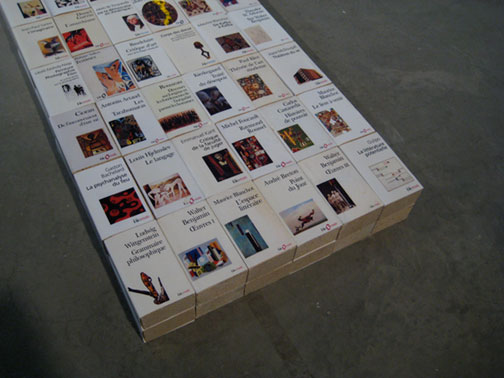
Claire Fontaine installation at the Wattis Institute's Passengers exhibition
Brick-books of theory. The Wattis, of course, is housed on the campus of my alma mater, so for purely personal reasons, critical theory book wraparounds on cinder blocks are a riot. Of course, with all good conceptual art, the more you know, the better it gets. Fontaine is not an individual, but a French collective, and the installation is a meditation on the Paris 1968 riots, where a brick was more than a building material, but a weapon, a symbol of revolutionary actions. While anarchist communities are still active today (you will know them by their bicycle bumper stickers), it’s nice to be reminded of the once-obvious connection between critical theory and direct action.
in Guangzhou this weekend?
The Guangzhou Triennial opens this weekend, and the program sounds fantastic.
I really enjoyed my 2001 visit to Guangzhou (Canton). Guangzhou is the major city in Guangdong—the large southern region including the Pearl River Delta and original home to something like 90% of Chinese immigrants who came to California prior to the 1965 Immigration Act. Guangdong is also where my maternal and paternal ancestral villages are; both family lines can be traced back several generations (as many as 26, on my mom’s side) in that region.
Anyway, during my visit I found Guangzhou to be really cool—a bustling metropolis full of young people breaking from the past. The triennial program sounds like Guangzhou is finally getting into the game with some forward-thinking contemporary art practices—a contender to Hong Kong’s and Beijing’s dominance as top art centers in China! I’m especially fascinated with the program’s theme.
For the curatorial discourse of this Triennial, we propose to say ‘Farewell to Post-Colonialism’. This represents the theoretical basis from which we hope to explore our critical vision. The Triennial attempts to open new frontiers for creativity with a critical review of the role cultural discourses of Post-colonialism and Multi-culturalism has played in contemporary art. While affirming Post-colonialism’s achievements in exposing hidden ideological agenda in society and inspiring new art, this Triennial also critically examines its limitations for creativity, and calls for a fresh start.
We hope to uncover elements of the paradoxical reality veiled by contemporary cultural discourse, to make contact with realms that slip through the cracks of well-worn concepts such as class, gender, tribe and hybridity. We hope to think together with artists and investigate through their practices to find what new modes and imaginative worlds are possible for art beyond those already heavily mapped out by socio-political discourses.
GZ Triennial will host 181 artists from over 40 countries around the world, including 50 films/videos from the Middle East, Southeast Asia and Africa under the projects “Middle East Channel”, “East-South: Out of Sight” and “Africa: Personal Poetics”….
(By the way, if you think that China is monolithic and closed, as most Americans think, I should mention that one of the things I learned on my visit were the significant numbers of African immigrants in China, who often study in the universities.)
The 7 “Forums in Motion” of the 3rd Triennial is a long expedition that traverses across a wide terrain of ideas which focus on Farewell to Post-Colonialism, Limits of Multi-Culturalism, Thinking Through the Visual, … Anxiety of Creativity and Possible Worlds and Farewell to Post-colonialism — Towards a Post-Western Society?
Saying farewell to post-colonialism and peering into the future for glimpses of a post-Western society— or the century to follow the American Century—is something that really resonates with my installation, Binary Pair, in Galleon Trade: Bay Area Now 5 Edition.
THANKS to everyone who made it to the opening last night! I had a blast and it was so nice to see smiling faces and hear respected colleagues’ impressions of the work! If you missed it, stop by YBCA before October 19 to catch the show — it’s almost all new work, featuring 5 CA artists paired with 5 Manila-based artists.
 R+D
R+D 