Research

Highly recommended: Jeremy Deller’s podcast lecture

I first heard UK public/conceptual artist Jeremy Deller on an interview on NPR. He was discussing It Is What It Is, a project commissioned by the New Museum, in which he set up a tour of a blown-up vehicle from Iraq as a conversation piece around the US. As you can imagine, it’s a project that takes guts, and I was impressed with Deller’s thoughtfulness and integrity. His approach just seemed right — political sentiment balanced with an urge to connect with average citizens and the absence of ideological rhetoric.

His well-known projects also include a re-enactment of a miner strike and the commissioning of an acid-house brass band. I also loved the site-specificity and public nature of the Procession he organized for the recent Manchester International Festival.

In his podcast lecture at the University of Michigan, Deller delivered a chronology of his background and the development of his approach, and an overview of his major projects and inspirations. If you’re interested in his work, and seek context for his idiosyncratic ouvre, I highly recommend it.

Deller is very British — unfailingly polite, serious, a tad self-deprecating, thoroughly appreciative of British folk culture, and concerned with overcoming the UK’s North-South divide. In contrast with the stereotype of English reserve, I’ve found that many Brits can be forthcoming, and Deller talks unapologetically (and also, without the American tendency for dramatized moral indignation) about his focus on working with people, rather than making art. Exhibition-making is merely coincidental to the culture industry that supports his public projects.

This got me thinking about how the work of exceptionally visionary people like Jeremy Deller don’t fit in other modes of production, and somehow, the culture industry (in this case, art institutions and networks) is able to make room for them. I am interested in this expansive, fungible realm of art practice, in which the forms are not conventional (pictures/sculptures/environments), and the sites outside of white cubes/black boxes. Furthermore, Deller didn’t once mention “relational aesthetics” or “Bourriard” in his talk. The work is valid on its own terms. It’s not “Art” as your grandparents understood it, yet the phrase, “art,” is useful for creating an exceptional space for social, experiential, participatory play.

Here are iTunes URLs for Jeremy Deller’s lecture at the University of Michigan:
Audio podcast
Video podcast

Standard
Art & Development, Community

A place you should be: Stephen Wirtz Gallery

A quick jaunt around commercial galleries in downtown San Francisco left me feeling a bit “meh.” Maybe because it’s August and galleries aren’t too bothered about mounting statement-making shows, maybe because my nerves were frazzled by high-tourist-season traffic, or maybe my critical eye has become a cynical eye, informed too much by thinking about art as artifactual production, parallel to other forms of industrial and cultural production. My taste for commercial art is nearly nil; like commercial radio, its near-ubiquity ensures that the odds aren’t in my favor — I’ll have to tolerate it far more often than I will be happily drawn towards it.

castneda reiman
Image Source: Stephen Wirtz Gallery Website, Castaneda/Reiman’s Places We Have Never Been Exhibition page.
Image Caption: left: Three Tree Lake (drawing #2), 2009, laser etched paper, pigment print. middle: Rocky Seascape (paper 2 x 4), 2009. pigment print, found 2 x 4, oak veneer, 28 1/2 x 96 x 3 1/2 inches. right: Painting Stack with Rocks, 2009, pigment prints, oak, sheetrock, paint, cast porcelain rocks, 53 x 79 x 70 inches

One show, though, stood head-and-shoulders above the rest. It was Castaneda/Reiman’s “Places We Have Never Been” at Stephen Wirtz Gallery. The Bay Area duo has installed reproductions of landscape paintings — complete with frames and odd slices of textured drywall — a tad too close to adjacent shelves, so the prints sag or drape abjectly. The gallery walls are painted with mismatched roll-outs, and areas of sanded joint compound are visible. Cross-sections of stacked gypsum boards are housed in beautiful stained oak; the effect is a framed geometric minimalist abstraction, contrasting sharply with the unframed reproductions. Impossibly uniform opaque white rocks cluster near the gypsum board, missing any glints of quartz, or the rough scale of granite. You can tell the rocks were man-made, but you can’t tell from what. A small landscape print or hand-drawn transfer sits in a corner, heavy rag paper with deckled edge unnervingly out in the open, unframed. An expressionistic landscape — really, not unlike the kind of commercial schlock you find in rural membership galleries — uses some slate blues and greens that appear almost municipal, echoing the industrial hues of manufactured building materials.

The whole effect creates a tense contradiction: provisionality, finely tuned to point one’s attention to multiple illusions.

To ask “Where is the art?” begets affirmative answers without clear resolution. Yes, the framed painting in the reproduction is art. Yes, the print of the painting is art. Yes, the white rocks are art. And yes, the mismatched latex paint is art.

Casteneda/Reiman successfully disperses the location of the art throughout the site — the artists’ installation is theatrical, staged — while simultaneously saying that the gallery is always a staged installation. In this way, Casteneda/Reimen highlight the artifice inherent in all art. I have no qualms with using the word “artifice,” which does not in itself posses negative connotations (though you may be of the Romantic/Modernist persuasion and your value system only allows for art that is expressive/authentic/autonomous/evidence of genius or some kind of moralistic humanism).

I realize that my description of the work — abject, quoting, dispersed — makes it sound like an exercise in endgames, and the artists like over-theorized malcontents. And I can’t say that all viewers will appreciate the work in the show; in fact, many will do a walk-by, feeling put off (rather than attracted, like me) to the exhibition’s absence of grand gestures, obvious attempts at spectacle and feats of craftsmanship. But I really enjoyed the work, and found the illusions and forms to be quite humorous. There was wit, and yes, ironic distance, and yet, there were so many ideas and connotations that unfolded in my viewing experience.

Places We Have Never Been closes August 22. Concurrently on view at Wirtz, Kathryn Spence’s Cloudless White, another assembly of abject parts, slightly more expressive and endearing but also with moments of humor.

Standard
Research

The Object of Art and the Art

This sounds like an AMAZING class — the use of the phrases “symbolic capital” and “artifactual production” suggest the influence of Johanna Drucker’s writings on complicity in contemporary art. I heard Ken Lum speak at CCA a few years back — really bright thinker and artist.

Master Class: The Object of Art and the Art as Object with Ken Lum
The Banff Centre

The relationship between art and life (in terms of the potential collapse of one term into the other or the discursive separation between the terms) has underlined the primary function of the avant-garde in art. The dialectical tension between those objects deemed art or non-art is itself an institutional function of the cultural (social) category of art. How is artistic discourse produced to transform an object into art? In what ways does artistic discourse negotiate the question of the art object as commodity? What role does the artist play in this negotiation?

This Banff Master Class will study the operational functioning of the work of art within the constitution of the art world and in relation to different institutional frames. The relationship of art to the concept of “symbolic capital” and “artifactual production” will also be explored. As interest in art continues to accelerate and spread globally, the aim of this class will be to revisit the most fundamental questions about the status and function of art.

The class will take the form of a bi-weekly seminar. The first class of the week will critically examine an assigned reading. The final class of the week will be an open session moderated by the Master Class leader.

Now if only I had $5k for the class/room/lodging fee and the means to take 6 weeks off of work… Back in my twenties, my roommate would visualize finding a paper bag full of cash, and I think she did eventually did find a bag with like $40 on the street, once — maybe if I start visualizing a grocery bag or garbage bag or sofa stuffed with cash (Would walking distance to my house be too much to ask? OK.), it’ll magically appear.

Standard
Art & Development

New Workbench

workbench

Just installed my new workbench / pegboard / shop light in my new studio.

Like my calendar? (Not a Mac Tools girlie one, but an awkwardly funny Pet Lovers one.)

I never had the space or need for a workbench, but I’m getting there now. I didn’t go too overboard, I think; it set me back about $125 in lumber and hardware (and a set of countersinking bits). The pegboard came pre-painted, which sped things up.

If you’re thinking, What kind of workbench is so clean?, the answer is One that’s got a fresh coat of varnish on it.

Don’t worry, lots of projects to come.

Standard
Art & Development

another entry in the “art takes you to some funny places” diary

Maybe it’s too soon to say, but based on my initial experience, being a curator seems like one part Director, one part Gopher. I expected to fetch odds and ends for the exhibition, but I was bit surprised how much artists entrusted me with creative decisions regarding their art. Guess I’ll just have to get used to it.

Two items I found myself chasing down recently:

78-rpm records. N. Sean Glover’s cardboard record player works better with fatter grooves. A Jackson Five 33 had to do for the opening. (It seemed fitting because “I Want You Back” was on heavy rotation in the shops while I was in Manchester.) But today, at the East Bay Depot for Creative Re-Use, I scored two 78s — Sarah Vaughn and the Benny Goodman Sextet.

Butane. David Moises’ Egoshooter is a modified barbecue lighter. Lighters can go in the mail completely emptied of fuel, so it was my job to re-fuel it for the exhibition. The gallery (understandably) didn’t want visitors to get hurt, but I just couldn’t show the Egoshooter disarmed — I was plagued with memories of grad school critiques of art “with no teeth.” Not having ever owned a refillable lighter, I wandered the aisles of CVS before I realized that, of course, butane is probably kept behind a counter, next to cartons of cigarettes. The CVS in North Oakland, formerly Long’s, was sort of an ideal place to find such a slightly obscure, anachronistic item. (It was also the source for my new white painter’s pants. Maybe I’m projecting, but I get a lot more respect at Home Depot when I’m wearing proper Dickies.)

Standard
Research

Happiness: can do / can’t do

In “Averted Vision” (NYTimes.com, August 2, 2009), Tim Kreider proposes that happiness is a something like a state of nostalgia for times past — that some of his happiest memories were in fact miserable as he experienced them. He says when he’s lost himself drawing cartoons, he’s happy, though he’s not aware of his happiness or self-consciously searching for it.

This is what Philip Zimbardo and John Boyd called “finding the flow of the activity” in their book, “The Time Paradox.” The psychologists might also gently suggest that Kreider, who already acknowledges the past as a source of happiness, see the present and future in the same light.

Kreider writes:

I suspect there is something inherently misguided and self-defeating and hopeless about any deliberate campaign to achieve happiness.

But Zimbardo and Boyd urge readers to shape their present and future to lend themselves to finding happiness. In fact, feeling a sense of control in one’s life — feeling efficacious, and able to actualize one’s plans — is fundamental to having a good attitude and feeling happy. They acknowledge, too, that happiness is too fleeting to be merely achieved, but it can be cultivated.

Kreider continues:

Maybe we mistakenly think we want “happiness,” which we tend to picture in very vague, soft-focus terms, when what we really crave is the harder-edged intensity of experience.

In “Sex, Drugs and Chocolate: The Science of Happiness,” Paul Martin delves into the importance of the phenomena of pain in evolutionary psychology. Humans weren’t designed to be happy; they were designed to survive. Creatures living in anxiety and fear tended to ensure higher rates of survival. In this sense, Kreider is right — humans are hardwired to pay attention to that which works against us in life. Yet, our base natures need not dictate our potentials for leading lives rich with meaning and purpose.

Standard
Art & Development, News, This & That Mail Art Swap

Involved, Socially and This & That opens

Thanks to Dina and Joyce at Triple Base, Michelle Blade for having me in the show and compelling me to go one step beyond only exhibiting a work, M for love and support despite my week-long installation myopia, and the countless friends, supporters and mentors who attended, the opening reception for Involved, Socially seemed like a success.

It was well-attended, with a constant flow of people, and lots of time spent looking at art, reading texts and having good conversations.

I feel like both projects that I contributed, This & That International Mail Art Swap (a curatorial project in the back room featuring 32 artists) and Unlimited Promise (an installation in the basement) were strong, so I’m content.

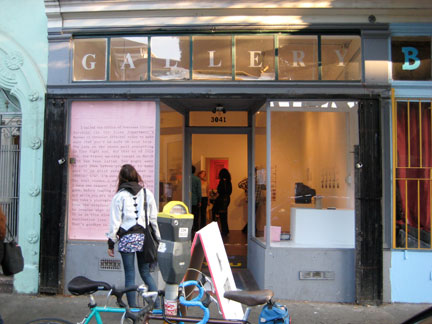
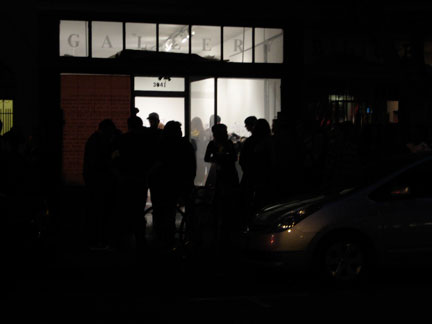
Sandwich board typography by Mylinh Nguyen, via Michelle Blade. Window: project by David Horvitz. You know it's San Francisco's Mission District by the taqueria and bicycle.

Sandwich board typography by Mylinh Nguyen, via Michelle Blade. Window: project by David Horvitz. You know it's San Francisco's Mission District by the taqueria and bicycle.

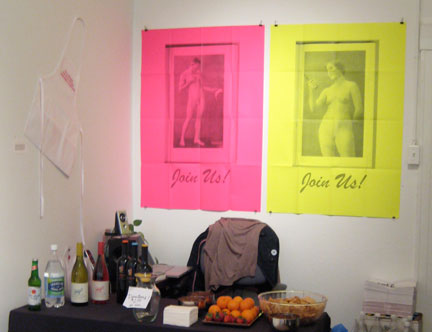
The main (front) part of the storefront held several artist's projects; This & That was in the back room. Yuen Fong Ling's fluourescent posters, commanding JOIN US, are visible from the street.

The main (front) part of the storefront held several artist's projects; This & That was in the back room. Yuen Fong Ling's fluourescent posters, commanding JOIN US, are visible from the street.

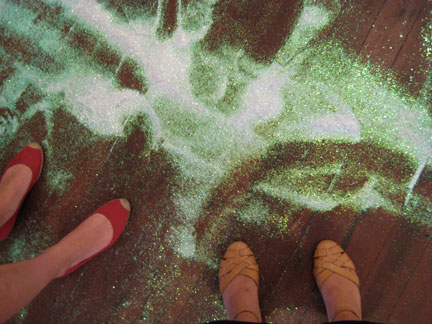
Amanda Curreri's and Sally Elesby's project - a line of iridescent glitter is drawn across the gallery. amandacurreri.com

Amanda Curreri's and Sally Elesby's project - a line of iridescent glitter is drawn across the gallery.

Left, works by Mark McKnight. Right, t-shirts by Amanda Curreri.

Left, works by Mark McKnight. Right, t-shirts by Amanda Curreri.

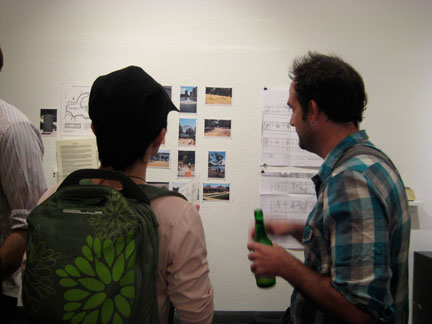
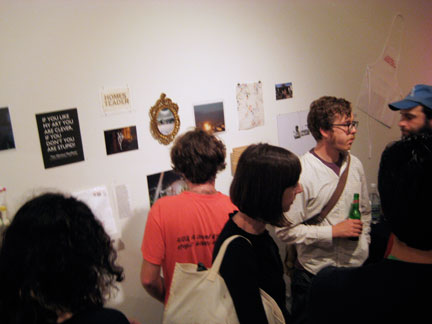
Photographer Seth Lower (far left, sethlower.com) inspects This and That; Jeronimo Roldan and Marcella Faustini and friend inspect Amanda Curreri's/Sally Elesby's correspondence (center). Jessica William's art (right). Not pictured: David Horvitz' letters about the Indian Ocean.

Photographer Seth Lower (far left, sethlower.com) inspects This & That; Jeronimo Roldan and Marcella Faustini and friend inspect Amanda Curreri's/Sally Elesby's correspondence (center). Jessica William's art (right).

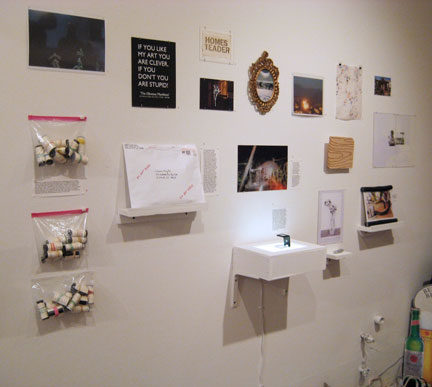
This and That, with works by Crowe and Rawlinson, Tan, Chavez-Dawson, Churchill, Hongisto, Blackmore, Chen, Staincliffe and Hall.

This & That, with works by Nick Crowe and Ian Rawlinson, Tattfoo Tan, Mike Chavez-Dawson, Joshua Churchill, Eric Hongisto, Simon Blackmore, Susan Chen, Daniel Staincliffe and Antony Hall.

This and That, works by same artists as previous photo, plus Anading, Bell, Payot, Brumit and Wagner, the Bloors, and Carollo. Lower corner, a moment for our sponsor.

This & That, works by same artists as previous photo, plus Poklong Anading, Chris Bell, Laurence Payot, Jon Brumit and Sarah Wagner, Simon & Tom Bloor and Michelle Carollo. Lower corner, a moment for our sponsor.

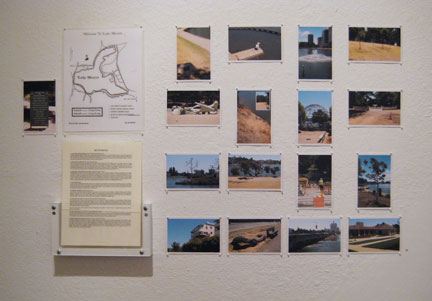
Scott Oliver's Lake Merritt walking tour.

Scott Oliver's Lake Merritt Walking Tour.

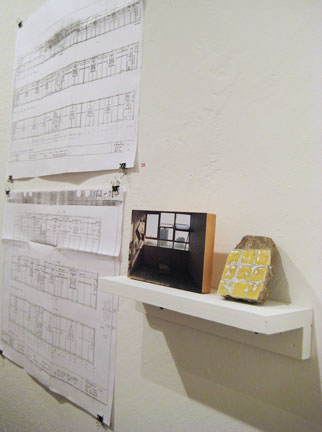
Verity-Jane Keefe's project on a housing estate in Barking, East London.

Verity-Jane Keefe's project on the estate in Barking, East London.

Works by Oliver, Keefe, Hattori, Glover, Pest.

Works by Oliver, Keefe, Taro Hattori, N. Sean Glover, Pest.

Works by Ryan, Woff, Sherry, Griffiths, Ma, Kabot, Kaplan, Yu.

Works by Anthony Ryan, Jenifer K Wofford, David Sherry, Mary Griffiths, Ivy Ma, Sarah Kabot, Scot Kaplan, MM Yu.

Works by O'Malley and Ling. Below, the spread.

Works by Susan O'Malley and Yuen Fong Ling. Below, the spread.

This & That artist Anthony Ryan takes home court advantage to inspect potential swap selections.

This & That artist Anthony Ryan takes home court advantage to inspect potential swap selections.

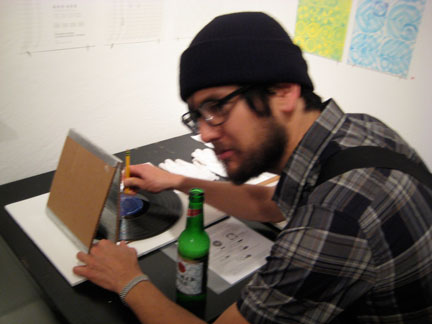
Joshua Churchill, looking uncharacteristically dodgy, powers N. Sean Glover's cardboard record player.

This & That artist Joshua Churchill, looking uncharacteristically dodgy, powers N. Sean Glover's cardboard record player.

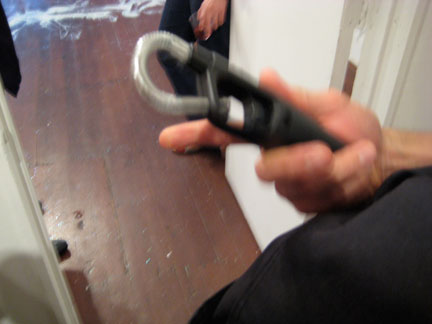
Churchill also tries out David Moises' Ego Shooter, but he's too fast for the camera.

Churchill also tries out David Moises' Ego Shooter, but he's too fast for the camera.

Mik Gaspay -- mikgaspay.com -- sports a This and That-like cardigan.

Painter/photographer Mik Gaspay -- mikgaspay.com -- rocks a This & That-like cardigan.

Taro Hattori and Scott Oliver discuss amongst themselves.

This & That artists Taro Hattori and Scott Oliver discuss amongst themselves.

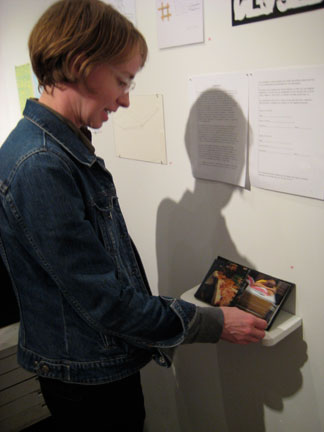
Naomi Vanderkindren -- vanderkindren.com -- browses MM Yu's Book of Sleep.

Naomi Vanderkindren browses MM Yu's Book of Sleep. (Naomi's photographs can be viewed at vanderkindren.com.)

A visitor inspects Antony Hall's Hele shaw cell experiment.

A visitor inspects Antony Hall's Hele shaw cell experiment.

Yuen Fong Ling's posters in background.

Yuen Fong Ling's posters in background.

MJ-jacket sporting Vice leans in to hear Joshua Churchill's sound project.

MJ-jacket sporting Vice leans in to hear Joshua Churchill's sound project.

A viewer reads N. Sean Glover's instructions for the cardboard record player.

A viewer reads N. Sean Glover's instructions for the cardboard record player.

Back room. Painter Marci Washington and mixed media artist Justin Hurty, and others. marciwashington.com. justin.hurty.com

Back room. Painter Marci Washington and mixed media artist Justin Hurty, and others. marciwashington.com. justin.hurty.com

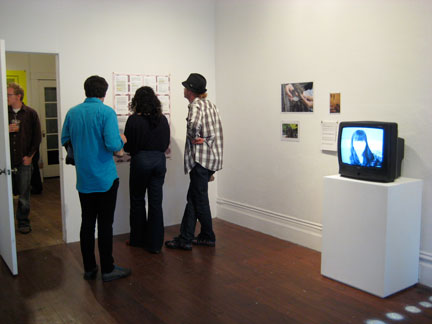
Main gallery.

Main gallery. This & That artist Chris Bell talks shop with Naomi.

Amanda Curreri's glitter line, a few hours later...

Amanda Curreri's glitter line, a few hours later...

My installation, Unlimited Promise, in the basement.

My installation, Unlimited Promise, in the basement. Produced during the Breathe Residency at Chinese Arts Centre, Manchester, UK.

Spillage.

Spillage.

Thanks to all the artists in This & That for being such interesting artists and exhibiting professionalism, generosity and flexibility. Big thanks to Chris Bell, Joshua Churchill, Taro Hattori, Ali Naschke-Messing, Anthony Ryan, and Scott Oliver (who helped tremendously by installing his multi-part work) for coming to the opening. Thanks also to Susan Chen, who dispatched patience and editorial advice.

Involved, Socially runs through September 6th. Gallery hours are Thurs-Sun 12-5pm. For more info visit basebasebase.com. To learn more about This & That International Mail Art Swap, visit mailartswap.christinewongyap.com.

Standard
Art & Development, This & That Mail Art Swap

This & That and you

It’s complicated, but actually very simple:

Involved, Socially =
*curated by Michelle Blade
*features 5 artists
*the upcoming exhibition at Triple Base Gallery

This & That International Mail Art Swap =
*curated by Christine Wong Yap
*features 32 artists/artists groups
*a show in the back room at Triple Base Gallery, part of Involved, Socially.

You might think of This & That as a:
*curatorial project
*sub-show
*Little Big Show

Factoids:

The acronym for This & That could be “TnT.” (Thanks Churchill.) Hence the AC/DC theme song suggests itself.

Standard