Community, Values

Finishing the Game: a movie, but not just a movie

Finishing the Game (2007, dir. Justin Lin, dist. IFC Films) is an indie mock-umentary of the re-casting of Bruce Lee’s unfinished film after his death in the 1970s. The auditions bring out Asians of all stripes — suave professionals, dreamers and actors of integrity — throwing kicks and emitting feline howls. It’s a light-hearted movie with lots of big hair, but in the subtexts are plentiful jabs at the movie industry’s racism and money-grubbing values.

Go see it!

I really liked the film. It’s funny and irreverent, and inherently Asian without being limited to Asian-ness, yet it touches on serious issues of race and representation. Plus there’s a token white guy! Come on! That’s hilarious! I hear the subtext, and it sounds like: You know where you can stick those quirky sidekick / comedic relief roles?!!

Finishing the Game just opened in the Bay Area. Haven’t heard of it? That’s because they don’t have a marketing budget.

But the upswing is that since the cast is involved in grassroots promotions, I caught a really eye-opening Q&A with some of the actors and producers. The discussion (which provided a classic example of who feels entitled to speak) kept coming back to the clash between representation and the movie industry, or art and business. I knew that Justin Lin’s first big feature film, Better Luck Tomorrow, was a “credit card film.” Talk about self-subsidizing (think six figures!) Its success was a miracle story. But actor Roger Fan (who stars in both films) explained that the popularity of BLT provided Hollywood studios with the hard evidence to take on movies with APA leads, and the result was that MTV became BLT’s distributor, and Harold and Kumar was green-lighted.

But here’s the sad news. Actor Sung Kang shared a maxim: people make indie films because they have to. The irony is that Lin originally wanted a Hollywood studio behind BLT at the start — and he had his chance — he was offered $2m to make BLT as long as the cast was not APA. So three cheers to Lin and BLT producers Julie Asato and Curtis Choy (yeah, the Curtis Choy who made The Fall of the I-Hotel. Uh huh!) for sticking to their guns. You can cite their integrity for the recent improvements in APA representation in American cinema. Cheers!

But Kang also pointed out that he’s just an actor: all he can do is be the best actor he can. What talks to studio execs is dollars, so, as cheesy as it sounds, support your independantly-produced APA film! Your ticket really means something.

http://www.youoffendmeyouoffendmyfamily.com/

Standard
Activist Imagination, Citizenship

The Fall of the I-Hotel, Revisited

I went to the screening of Curtis Choy’s film, The Fall of the I-Hotel (2005, 58 minutes) at the Oakland Museum of California last night with a sense of obligation to my research for the Activist Imagination project. I left with reverance and lots of food for thought.

Some impressions:

• I sort of thought that by default, early APA graphics would borrow heavily from established visual languages of resistance (such as Chicano graphic arts or social realism). Surprisingly, the mural on the outside of the I-Hotel was very cartoonish. More Vaughn Bodé than Diego Rivera.

• The film also included a beat-infused poem by Al Robles. Which maybe means that Robles was at least equally influenced by San Francisco’s literary history than other essentially activist or APA forms. Which leads me to a new line of thinking: of course APA art can look or sound any way. Does this seem was more so in the old days than now (when everything seems so hybridized and postmodern)?

• Shots of the original Kearny Street Workshop storefront inspired me to think, If I could go back in time and check it out, one thing I’d want to know is what Cooper Black (the typeface of KSW’s original signage) conveyed in the 1970s. Today, it’s so retro, goofy and playful (and judging from the pop culture references on the Wikipedia entry for Cooper Black, “budget”), it’s hard to imagine what it signified in the context of the I-Hotel.

The struggle to save the I-Hotel could signify the birth of APA activism, but the gestation of a movement of this magnitude went far beyond this one building. The I-Hotel happened to be the right time and place (a pretty great congruence of ‘Asian’ and ‘Pacific’ in Asian and Pacific American, right?), following over a decade of displacement — those manongs were the last 50 of the 10,000 Fil-Ams displaced from Manilatown (as Al Robles explained) — and of course, the historical moment.

There wouldn’t have been an I-Hotel struggle without the post-1965 immigration wave and the 1960s youth movement, which in turn wouldn’t have emerged without the 1950s civil rights movement and the collapse of old-world-style colonialism around the world.

I think some people view activism today with a sense of futility, and the 1960s and 1970s seem like a golden era when change was possible. But we have to keep in mind how political change evolves over time.

In the 1990s, I thought the times were similar to the 1950s: obsessed with technology and consumerism, revolution seemed distant, if not impossible. I was wrong. The picture-perfect nuclear family was only middle-class white (male) America’s narrative. The 1950s marches and boycotts were certainly more consequential, but the 1990s were not without their acts of mass resistance in LA and Seattle. (So instead of, How do we create a revolution now, a better question would be, How do we continue and amplify the struggle for racial, gender, and class justice in addition to facing emergent issues — immigration status, the global “north-south” divide, environmental justice — with a united front? What does this mean for APA activists?)

• One last note about history… I know the impact of the 1965 immigration act is far-reaching, but had to be reminded that it made possible the birth of the APA movement. And working backwards: Yes, as I wrote in “The Stone Age,” the history of APA art is short — as so, the history of Asian Pacific America as we know it now. (Next year, Kearny Street Workshop celebrates its 35th anniversary — and to all of us immigrants and decendants of immigrants, let’s also celebrate the 43rd year anniversary of the Immigration and Nationality Act of 1965.)

The screening was followed by a panel with Emil deGuzman, Curtis Choy, Al Robles, and Dr. Estella Habal. I would have liked to ask them:

Why was art so important in this particular struggle? Clearly a screening on the 30th anniversary of the I-Hotel demonstrates the importance of media, and the organizers in the film evidenced rigorous organizing tactics. So why was it important to have murals and screenprints?

[ Judging by a response to a different question, the answer probably would be something like, “Self-expression is an act of defiance. We were asserting our oun human-ness in a time where we were being told that we didn’t count.” Having seen and sat on numerous panels where the “why does art matter” question was asked, invariably by people who already believe it matters, this answer’s fine. Still, I wouldn’t mind being surprised by some new insight here. ]

My second question would have been:

For future APA activists, what are key issues and how must our tactics change?

I can surmise on possible responses, but as usual, I’d rather leave the strategizing to the strategizers.

Watching The Fall of the I-Hotel was a contradictory experience for me. On one hand, the shots of the final evictions made the event more real — the brutality of the police department was terrifying, the spirit of resistance electrifying. On another hand, the historic footage matched my pre-exisiting “memory” of the event. Even though I was born in 1977, the same year as the evictions, I must have seen clips of the film or photographs from other sources. So the film is important and worth watching, but it also cannonizes this event… And I imagine that it has a similar effect for everyone else of my generation.

This brings up a host of issues for me as a visual artist: How do we tell what’s real? How we assimilate visual images into memory, and who do we tell them apart? How do we contend with the limits of representation while continuing to struggle to control our means of self-representation?

[There’s some really interesting film theory that relates the cinematic apparatus to our psyche… For more, check out the essays in The Dream of the Audience, catalogue for the Teresa Cha exhibition at the Berkeley Art Museum.]

So here are some photographic impressions. I snapped these from my seat in the theater.

blank theater screen
Setting. My poor woman’s Hiroshi Sugimoto.

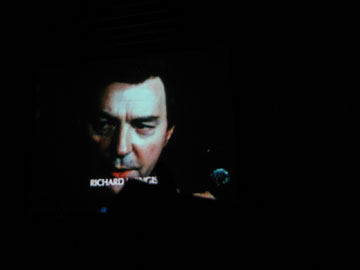
movie title

Richard Hongisto
Richard Hongisto, sheriff. He spent 5 days in jail for contempt for resisting eviction orders, and later reluctantly oversaw the evictions.

hotel signage

police action
While so much of the film was so distinctly 1970s — the cars, the activist’s facial hair and clothing styles — riot cops look relatively the same.

crowd shot

Standard
Activist Imagination, Research

The Stone Age

“We’re in the Stone Age of environmental consciousness.”

That’s what I thought the other day when I saw a recent print advertisement for Chevrolet’s new hybrid vehicles. In the full-spread photo, a mean-looking concept car with oversized rims sits on a grassy meadow surrounded by rolling, tree-covered hills.

car ad

The ad rings false for me because American car manufacturers have been slow to release hybrid vehicles and adopt alternative technologies. The big 3 automakers are, as many others have pointed out, dinosaurs of the Industrial age, who ruled by the might of mass production. The sweet irony is that one can ‘buy American’ — and purchase a Toyota made in Fremont, CA. Dinosaurs, after all, are slow on the uptake of the ‘adapt or perish’ idea.

And so with the art direction here. Every element of this ad is a cliché. The message — “Chevy’s gone ‘green'” — has been clunkily literalized: Take a Chevy. Put it in a leafy locale.

What’s missing is a critical visual and conceptual analysis.

First, to point out the obvious: parking a car on a meadow isn’t environmentally friendly. Most meadows function as natural water filters for underground streams, so oil leaks are bad news blues. And driving on critters’ homes can’t be fair play.

Second, the grass’s cut tips give away that it’s not a meadow, but a lawn that was recently mowed. Since manicured lawns suck up water and pesticides, they don’t make good symbols for ecological health, either.

What makes it necessary to convey environmental soundness so literally? The car’s engine may be green, but that’s not reflected in its design. Outwards, it’s conventionally stylish. The bullish front-end and low-slung cab references the gas-guzzling muscle cars of yesteryear. In fact, for a futuristic prototype, it looks a lot like today’s Dodge Charger. Oversized rims and minimized tires give away Chevy’s conceit to style over function. I thought green meant you take only what you need, and you don’t need huge alloy rims.

The problem is that the fear of crunchy-granola designs has overshadowed the imaginative possibilities for what a green car could look like. And imagining change is the first step in making change, as Angela Davis recently discussed at Los Angeles’ Museum of Contemporary Arts (check out a podcast of Angela Davis’ lecture on contributions to feminism from theorists of color). Green can, and should, look different. I’m sure that environmental concerns will force the tide of mass opinion to turn towards an attitude that desires green inside and out. We won’t have a choice: either we choose green, or Mother Nature will choose it for us.

Of course, the ad itself is printed on paper, which is gloss-coated and therefore probably not recyclable. Worse, the ad appeared in a special supplement, of which this reader received two unsolicited copies. By extraction, I’d guess that thousands, if not tens of thousands, of these ad-revenue-driven publications have entered the waste stream, courtesy of a giant publishing house.

This ad reminds me of old advertisements with laughable premises — like the young actor Ronald Reagan endorsing smoking as healthful. I’m looking forward to the day when green visual literacy is so prevalent that corporations can no longer pass off half-hearted attempts at consciousness.

. . . . .

Similarly, I sometimes feel like we’re in the Stone Age when it comes to identity and art. The critique of formulaic Identity Art is that it operates on a one-plus-one equation, like the ad above:
green + car = green car

Its corrolary, so to speak:
identity + art = Identity Art

such as,
asian design motifs + painting
Or
migration story + photo-collage

Thankfully, postcolonial theorists provide a critique of essentialism, the idea that certain groups carry innate characteristics, implying the inability to transcend one’s traits. In art, essentialism is when artists “get put in a box” or marginalized, and it feels like, well, being stuck in the Stone Age. There’s some validity to this feeling, considering that women and people of color have had a relatively short history of participating in “high” art discourses in the US (and we are still struggling for control over the modes of our self-representation). So in the US we are in an early era of art that can emcompass the voices of women, people of color, the working classes, immigrants, etc. I think the first task is to debunk the perception that art by certain groups should look a certain way. I was reminded of this earlier today.

In To Hedonopolis, From Melancolony, curator Rico Reyes explores the emergence of two thematic strains in art works by Filipino and Fil-Am contemporary artists. So the show brings light to two distinct perspectives. The works are in diverse styles and media, but the artists are uniformly confident and adept. Some, but not all, of the content transparently corresponds to aspects of Filipino identity.

I was admiring an abstract painting by Reanne Estrada, when an agitated stranger next to me asked aloud, “How is this Filipino?”

I wish I could say that I helped the young viewer critically engage with Reanne’s work (afterall, he’s an APA, I’m an APA, he’s a student, we were on a university campus), but I’d be lying. Instead, I was flabbergasted that an APA would suggest that art that isn’t overtly Filipino isn’t Filipino enough.

When I was in Manila, the question of “What is Filipino?” followed us Galleon Traders around like white on rice. I didn’t learn an answer so much as gain a comfort with the standing question (not unsimilar to an ‘intersectional’ position advanced by feminist theorists of color, described in Davis’ lecture). To leave the question unanswered acknowledged the Philippines’ complex history of colonization and its people’s ongoing perserverance and shifting identities. To attempt to answer it, and make “capital-F” Filipino art (i.e., as Carlos Celdran joked, nailing a bangus to a wall), would be to ascribe to an essentialist point of view.

Which relates to ideas I’m thinking about now for Activist Imagination. I think it’s time to start reimagining the blanket term “APA” (Asian Pacific American) for the future: APA can, and should, look different. But how?

And how will this change the function of an APA arts organization?

Standard
Community, Research

A blip on the APA media sonar

Three years ago, when Bollywood seemed poised to take America by storm, I published an op-ed that warned South Asians that increased media attention isn’t the same as improved representation (“Come on Down [Expect Stereotypes as South Asians Make U.S. Film, TV Debuts]” Oakland Tribune, KALW radio). I used examples of East Asians in mass media to show how little progress towards accurate representation has been achieved. Little has changed since then.

Though working towards institutional social change will always be more pressing than issues of representation, I always register APAs in the media on my mental sonar. The Korean actor on Heroes? Blip. Kal Penn in a leading role? Blip! Kenneth Eng? Ugh—blip!

Recently, a blip popped up–it may not be significant, but it was new, and it made me laugh. In a comedic situation typical of white “politically correct” middle classes, the narrator of Scrubs, played by Zach Braff (himself hamming up the neurotic white man who warrants the cool-begetting approval of an African American buddy) is mistaken for a racist after offering the word “chink” as a crossword puzzle solution.

In a subsequent scene, Asian doctors and Filipina nurses give the increasingly uncomfortable protagonist the stink eye. They’re pissed, and the APA stink eyes keep coming for several hilarious seconds. Too mortified by his breach of “political correctness” to attempt a clarification, Braff’s character feigns ignorance of the hostility, until a linebacker sized Pacific Islander violently jostles him with an contemptuous screw face.

The representation is not unproblematic (Non-speaking roles? C’mon!). Still, in a refreshing contrast to the stereotypes of demure APA women and emasculated APA men, Scrubs’ Angry Asians showed some serious indignation, even if it was based on a comedic premise. Better yet, the Angry Asians–of the various ethnicities and professions you would find in a real hospital–expressed solidarity. BLIP!

On a somewhat related note, Colma: The Musical is playing at the Embarcadero Center Cinema in San Francisco this week. I’m proud to big-up my hometown hero, H.P. Mendoza, who wrote the screenplay, music and lyrics and stars in the film. It’s directed by Richard Wong. The movie’s been written up in many local rags, but I really liked Glen Helfand’s review in the San Francisco Bay Guardian.

Standard
Community, Values

Going: Philip Kan Gotanda’s “After the War” at A.C.T.

After the War is about life and love in the Fillmore district after WWII. I’m fascinated by many of its subtexts: racial politics, the strained relationships between APIs and African Americans, jazz, culture as a space of connection, SF Bay Area (re)development, California history…

Since I hope that dancers, actors and choreographers would be interested in going to gallery openings, I’m trying to make a point of attending performances. It’s also nice to support work that deals with identity issues and isn’t relegated to second-stage status. To show that this work can be viable means supporting it with your dollars.

Standard