Today I de-installed my installation at the Museum of Craft and Folk Art‘s Beats Per Minute exhibition. Being part of the show was a great experience on so many levels!
And below, here’s why.
[By being transparent about what makes for good artists’ experiences, at least from my perspective, I hope to inspire aspiring artists, art supporters and art promoters.]
The studio visit. I try to celebrate my “firsts,” and this was my first important studio visit. Looking back, I probably put too many expectations on it. Later, I learned that visits are not about getting a commitment, as much as beginning a conversation. Of course, I was thrilled to continue the conversation as an artist in BPM.
The space. MOCFA has a professional, compact space in downtown SF. It has a great location, and seems to get quite a bit of foot traffic. I suspect that museum audiences are broader than gallery-goers, which is another plus.
The curatorial premise. I enjoy working with curators who create shows that are good-looking as well as indicative of focused, convincing central arguments. In BPM, the curator and museum director wanted to bridge contemporary music-influenced work with crafts. Moreover, they (and MOCFA) have the capacity to do it.
The artists. I’m honored to be among artists of such high caliber. (Check out Mung Lar Lam, Walter Kitundu, Christy Matson, and Torolab). I admire and respect their work. Not always liking the work you show alongside comes with the territory in group exhibitions, but I was all-around proud to be in BPM. Plus, the artists I met were all sweet, sincere, thoughtful people.
The organizers. In any collaboration, you have to trust your partners. I trusted the curator and museum director because their past projects were excellent and interesting. The exhibition became a good reason to get to know them–they’re genuine people whose thoughtful work makes me excited about being part of the Bay Area art community.
Events. MOCFA held supplementary public events: the opening, an artist’s talk, Mung Lar’s ironing performances, and family workshops. I was happy to participate in them. I feel like anything that can give people an entryway into the show is a good thing. It’s a great opportunity and honor for artists to interface directly with the public during an exhibition run.
Documentation & Publicity. A third party company assisted with documentation and media relations. They were great. Often the business aspects of art, such as publicity, are hidden. But how could an exhibition succeed if the public doesn’t know about it? BPM appeared in calendar listings, a TV segment, and a SFGate slide show. Self-interest aside, I think it helps a lot to have media specialists on the task. If it’s a good show, publicity benefits everyone–the organizers, the artists and the public.
Professional practices. To me, these “little things” take an exhibition experience from OK to Great…
- An installation crew was friendly and available.
- There were adequate tools and ladders.
- The museum provided custom-built pedestals and shelves.
- The curator or staff members adjusted the lights before the opening for maximum effect.
- The wall labels looked clean and professional.
- The staff was friendly and available to answer questions from the public.
- The museum’s Education Director was organized and communicative, so planning and implementing the workshop was a breeze.
- I was reimbursed for my expenses (additional art supplies, installation hardware, parking–these could easily add up!).
- Whenever I dropped by unannounced during operating hours, the exhibition was picture-perfect (they were open, the lights were on, etc. Unfortunately, I think many struggling non-profits let gallery operations slide. The consequences are not immediate to them, but to me, a sense of disappointment registers.)
- Lastly, I wasn’t expecting it, but I received an honorarium. It’s a welcome gesture. I probably spent 20 hours on installation, de-installation, the artist’s talk, workshop and a TV interview. (This doesn’t include the studio visit, paperwork, my own promotional efforts, or, of course, the actual time making the art, or other expenses of art supplies, studio space, etc. This isn’t intended to diminish the honorarium, but just to let people know about the costs involved in being an artist, and to advocate, whenever possible, that artists are paid for their work just like any other profession.)
I’m going into so much detail to counter the myth that being an artist just means having fun in the studio. In other words, people think being an artist is 90% inspiration, 10% perspiration. But it’s not how it goes, at least not for me. Studio work is one part–albeit the most important part–of an artist’s responsibilities: prospecting, procuring, publicity, administration of what’s essentially a small business, professional development, installing/deinstallation, documentation, shipping/delivering, packing. Yes, packing. Being an artist is not all intuition and expression–it calls for professional and organizational skills too.
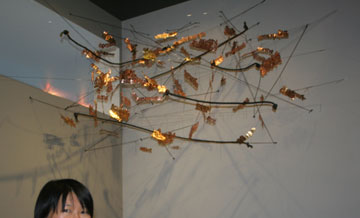
Before. “Cloud” at the Museum of Craft and Folk Arts. 2006, copper, elastic, rope, string, approximately 7x7x5′. Cropped photo from a photo courtesy of MOCFA/David Perry Associates.
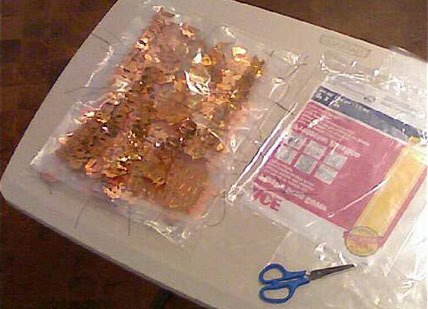
After. The copper text of Cloud, de-installed and packed up with hardware store plastic sheeting as interleaving.
 R+D
R+D 