Art & Development

Irrational Exuberance (Asst. Colors) Closing

Irrational Exuberance (Asst. Colors) closed today with a closing reception and an open dialogue featuring guests curator and critic Glen Helfand and artist, writer and theorist Ginger Wolfe-Suarez. Writer and curator Patricia Maloney moderated a lively discussion on topics such as optimism and pessimism, pleasure in art, the search for happiness, beauty, Kant, viewers’ experiences, discount stores, metaphorical/literal readings vs phenomenological readings, readings vs experiences, and critical versus psychological readings of the work in the show. Work by artists such as Haim Steinbach, Allan McCollum, Cary Leibowitz, Amanda Ross-Ho and Stephanie Syjuco also came up. Numerous artists, critics and curators were in attendance.

I was honored to help convene such thoughtful guests and attendees. Hearing their responses, reservations and speculations about my work was especially humbling.

As Is: Pop & Complicity

Dialog at the closing reception to Irrational Exuberance, Asst. Colors at Sight School, Oakland, CA

Featured guests (L-R): artist, writer and theorist Ginger Wolfe-Suarez, curator and critic Glen Helfand, and writer and curator Patricia Maloney.

Vicki Gannon poses a question, as Amanda Curreri, Frank Ebert, Matthew Rana and others look on.

Standard
Art & Development

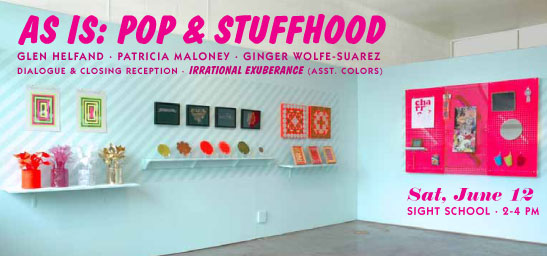
Sat., June 12: As Is: Pop and Stuffhood, Dialogue and Closing

as is

Sight School presents
AS IS: POP & STUFFHOOD
Closing reception for Irrational Exuberance (Asst. Colors) art exhibition and dialog featuring Glen Helfand and Ginger Wolfe-Suarez
Moderated by Patricia Maloney
Saturday, June 12
2-4 pm

An open dialogue agitating notions about artists’ shops, pop art, complicity and metaphors

Glen Helfand is a freelance writer, critic, curator and teacher. His writing on art, culture, design and technology, often concentrating on works by Bay Area artists, has appeared in Artforum, Art on Paper, Salon, SFGate, Wired, San Francisco Bay Guardian, and many other publications.

Patricia Maloney is a curator and writer living and working in Berkeley, CA. In addition to her role as Editor-in-Chief for Art Practical, she works with the alternative exhibition space Ampersand International Arts, is a contributing writer to Artforum.com and a frequent commentator on the weekly contemporary art podcast Bad at Sports.

Ginger Wolfe-Suarez is an emerging sculptor, writer, and theorist whose work has used a combination of sculpture, ephemeral events, text, and performance to negotiate shifting concepts of memory–both historical, personal, imagined, and desired.

In conjunction with the closing reception for Irrational Exuberance (Asst. Colors), on view May 14 – June 12, 2010, Wed-Sat, noon-5pm and by appointment.

Sight School
5651 San Pablo Ave (at Stanford Ave)
Oakland, CA

In preparation for the dialog, I’ve compiled a list of artists’ shops. One of my favorites:

Allan Ruppersburg, Als Cafe, 1969 Installation, 1913 West Sixth Street, Los Angeles, CA. Source: Air de Paris website, Artists, Allan Ruppersberg, Kunsthalle Dusseldorf page

Al’s Cafe, a diner re-imagined by Allan Ruppersberg in the 1960s in LA.

To give thanks where they’re due: I first approached Michelle to do a show because I was so inspired after visiting a series of “feral events” programmed by Kim Anno and friends in empty storefronts in Berkeley. The sense of potential that incredible, urgent art experiences could happen here was an irresistible, welcome alternative to the deference given to San Francisco/commercial galleries.

Thanks to Kim for the leadership and inspiration, Josh Churchill for the invitation, and Justin Limoges, Brian Barreto, Dana Hemenway, Suzanne Husky, Amanda Curreri and Michael Yap for the support, without whom Irrational Exuberance (Asst. Colors) would not have been possible.

Standard
Art & Development, Community

parallels

Some connections between projects in Oakland, California, USA and Birmingham and Manchester, England, U.K….

Simon and Tom Bloors' exhibition at Eastside Projects, Birmingham UK, 2009

Simon and Tom Bloors' exhibition at Eastside Projects, Birmingham UK, 2009

Eastside Projects is an artist-run space, a public gallery for the City of Birmingham and the World. It is organised by a founding collective comprising Simon & Tom Bloor, Céline Condorelli, Ruth Claxton, James Langdon and Gavin Wade, who first conceived and now runs the space.

Eastside Projects is a new model for a gallery, one where space and programme are intertwined: a complex evolving programme of works and events starting from radical historical positions. We aim to commission and present experimental contemporary art practices and exhibitions. The artist is invited to set the existing conditions for the gallery. Work may remain. Work may be responded to. The gallery is a collection. The gallery is an artwork. The artist-run space is a public good.

We aim to support the cultural growth of the City.

James Sterling Pitt, installation view, Sight School

Sight School is an artist-run exhibition space directed by Michelle Blade. The space began from a desire to create dialogue around new modes of living and being in the world in order to reveal connections between art and life.

As Michelle and I have worked together on Irrational Exuberance (Asst. Colors), I’ve gotten a better sense of her vision for Sight School. She’s committed to her local neighborhood—she makes a point to get to know her neighbors, put up flyers at local businesses, and support the growth of the Golden Gate Arts District (an emergent auxiliary to downtown Oakland’s wildly popular Art Murmur). She is highly invested in community—her decisions that structure the gallery and space are often driven by generosity and openness. She’s got a keen sense of contemporary practice in art. I get the feeling that the gallery is something like a commons for art experimentation; that her aim is to provide a site for artists to do experimental projects that would be considered untenable elsewhere. She seems interested in this as an experiment, thinking of every next move as an opportunity to innovate. This is not merely another gallery; she’s stepping out of the white cube by hosting one-night events, mutual learning projects and discourses. So when I re-visited Eastside Projects’ mission statement, particularly

The artist is invited to set the existing conditions for the gallery.
The gallery is an artwork.
The artist-run space is a public good.

it occurred to me that ESP and Sight School might be kindred spirits, with their energetic, unruly collectivity.

The director of ESP is an interesting curator and artist’s book instigator named Gavin Wade. In an interview on NYFA.org, Wade says that American artists differ from their UK counterparts because we’re less

willing to interact and collaborate and allow their work even to sit on top of someone else’s. There’s a certain individuality here; New York is so much about standing alone.

That interest in interaction, collaboration and experimentation that challenges artworks’ autonomy will be at work in Unlimited Potentials, an exhibition organized by Manchester-based curator and performance artist Mike Chavez-Dawson at Cornerhouse.

The show is comprised of several ambitious components, including loads of collaborators (including Wade), a project instigated by Liam Gillick, dozens of contributors (myself included) and a talk with Kwong Lee, the brilliant director of Castlefield Gallery, an important MCR artist-run space (their recent exhibitions include shows by David Osbaldeston and Leo Fitzmaurice and Kim Rugg).

Last year, when I exhibited my installation, Unlimited Promise, at an open studio at the end of the Breathe Residency at Chinese Art Center in Manchester, Mike Chavez-Dawson told me about Unrealised Potentials. I’m excited to play a small part in his forthcoming exhibition, especially when you consider the themes of resisting finished-ness in artwork in We have as much time as it takes at the Wattis:

We have as much time as it takes questions and highlights expectations of achievement, productivity, and established systems of management that make up the programs and academic mission of the Wattis Institute and CCA. … The works embody circular processes, resist completion, welcome change, and refute demands for definable results and resolution. They challenge the conventional form of the art object and the traditional parameters of exhibitions.

I’m excited that this conceptual investigation and expansion of exhibition-form-making is occurring in so many spaces around the world right now. In conjunction with more traditional viewing experiences, viewers of art are being offered more ways to think about art, participate in exhibitions, and complete the speculative thought processes artists begin.

Standard
Community

Three cheers for great Studio-mates!

Check out these forthcoming shows! My studiomates rock!

CURRERI.Occupy 7

Ping Pong Gallery is pleased to welcome Amanda Curreri back to the gallery for her second solo exhibition, OCCUPY THE EMPTY. There will be an opening reception for the artist this FRIDAY, June 11, 6-9PM.

Following the inspired careers of such artists as Felix Gonzalez Torres, Lygia Clark, and Helio Oiticica, whose work centered on the commingling of public and private spheres, and the sustained commitment to narrative, social engagement and cultural commentary, Curreri offers an exhibition that depends on the consideration, sensitivity, and participation of its audience.

OCCUPY THE EMPTY is born from an experience the artist had last summer in the Massachusetts courthouse where Italian-American anarchists, Sacco and Vanzetti, were sentenced to death in the early 20th century. The court case Curreri participated in was for her deceased father, also an Italian-American. The experience of those two weeks spent in the historical courtroom with her father’s loved ones, with lawyers, a judge, and jury shared qualities with the dramatic arts and the stage: theatrical and performative, positioning Curreri as one of the characters. Inspired by the work of radical democracy theorists Ernesto Laclau and Chantal Mouffe, Curreri considers the assumption that democracy is inherently available, empty to be inhabited, performed and occupied. This exhibition takes the courtroom, the American hallmark of democracy, and translates it to the space of the gallery. Explicitly empty by design, the gallery becomes a tangible stage for testing ideas of personal histories, democracy and the social body.

WithinOCCUPY THE EMPTYare paintings and sculptural arrangements, schematic works on paper, documentation, and an interpersonal durational piece that will come to create the portrait of the people involved in the themes of the exhibition. Working in response to ideas of community, family, history, equivalence, Curreri’s work suggests that individuals, perhaps fixed in certain roles, can become illuminated, freed, re-invented, and moved to a place where they can participate, act, and speak freely. By shifting the expected experience (spectatorship?) within the gallery, and making intimate/active the relationships within, the artist traverses the divide between public and private. In so doing, Curreri encourages the formation of a broader social movement, one where the audience of active creators becomes part of the story, sharing and ultimately helping engineer a collective transformation. The invitational gesture for viewers to play a part in the formal creation and conceptual democracy of the work is one that might come to highlight the healing qualities of art and its ability to serve as catharsis for viewers.

In the words of Helio Oiticica: “The crucial point of these ideas […] is that the artist’s task is not to deal in modifications in the aesthetic field, as if this were a second nature, an object in itself, but to seek to erect, through participation, the foundations of a cultural totality, engendering deep transformations in man’s consciousness which, from being a passive spectator of events, would begin to act upon them using the means at hand: revolt, protest, constructive work, to achieve this transformation… (General Scheme of the New Objectivity).

Curreri holds an MFA from the California College of the Arts, a BFA from The School of the Museum of Fine Arts, Boston, and a BA from Tufts University in Sociology and Peace & Justice Studies. The artist was the recipient of a Joan Mitchell Foundation fellowship in 2009 and her work has been reviewed in the San Francisco Chronicle, ArtForum.com, FlashArt Online, The SF Weekly, and The Portland Phoenix, among others. She is the co-editor and co-founder of an (ir)regular artist publication, Color&Color, which aims to tactically connect artists with new audiences and expanded dialogue through the serial print medium of small books.

For additional information, please contact the gallery at 415.550.7483 or email info

PING PONG GALLERY
1240 22nd Street
San Francisco CA 94107
415.550.7483

GALLERY HOURS:
Tuesday 6-9PM, Thursday 6-9PM, Friday 11-5, Saturday 11-5; Appointments welcome

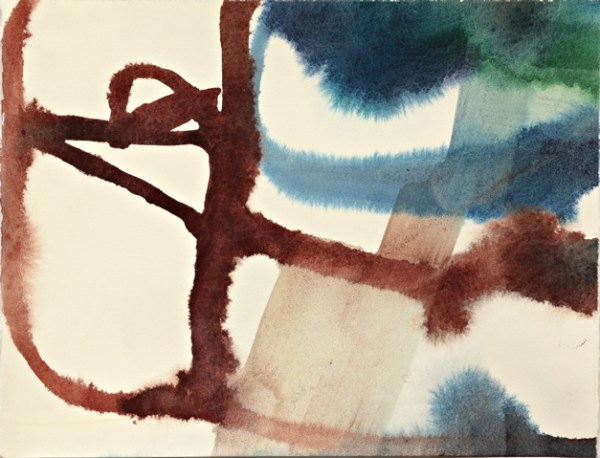
Splitside 9″ x 11″ watercolor on paper 2010

Opening June 15th
Linda Geary- Thirteen Watercolors
Reception: Tuesday June 15th from 6-8
Rose Burlingham Living Room Gallery
15 Park Row, #16E, New York, New York 10038
By appointment through the summer: 646 229 0998

Like a poem buried in the silence of things…Linda Geary’s abstract watercolors are full of unexpected configurations. Spontaneous drips and blurred bands of elegant color recall ambiguous plant and landscape forms but mostly refer back to themselves. There is a tension between her reductive, expressive line and blocks of organic melting color. We are somehow at a remove from the emotional qualities of color. Two-dimensional space is indicated without symbolism. At first look they appear to be describing the process of their own making but gradually her particular place emerges.
No matter what the scale they feel monumental. Color extends past the page’s edge with a vastness that recalls Chinese landscape painting. She transposes compositions with ease to a very large size for the medium (up to 40 x 60”). Some sing in elegiac tones interwoven with underwater darkness. Others are about pure and brilliant light. The simple titles reveal her preoccupations: Fuse page, Split side, Saw tooth, Untraceable, Fall out, Zero to indigo.
Aqueous light as well as a physical sense of water mixed with pigment reinforces the materiality. She allows the paint to do what it will, to pool and run and blend without losing control. Geary’s expansive openness grants us the latitude to acknowledge the ambiguity inherent in vision itself and it’s promise of free play of the mind.

Recent exhibitions and publications include, 2010 Solo exhibition, Rena Bransten Gallery, SF, 2010 Interview with Bruno Fazzolari and John Zurier, in Artpractical.com. 2009 Group Exhibitions at Pulliam Gallery, Portland, Rose Burlingham, NY, 2009 Night Tide, curated by Colter Jacobsen, SF, Pulliam Deffenbaugh Gallery in Portland, Oregon; Barry Sakata Garo Gallery in Sacramento; and HP Garcia Gallery in New York. Her solo exhibition at Rena Bransten Gallery, San Francisco, was reviewed in ArtForum (February 2007), residency at Art Omi International New York in 2007. 2006, solo exhibition of works on paper in Otranto, Italy, organized through the Bau Institute in New York and Otranto, curated by Lilly Wei, with a catalog essay by Kenneth Baker.

Standard
Art & Development

Frieze rocks

I love Frieze. I hope to attend the Frieze Art Fair one day. It’s exceptional because scholarship and artists’ projects are just as prominent as sales. The magazine is beautifully designed, well written, global yet succinct.

Here are even more reasons to be excited about contemporary art, courtesy of Frieze:

1. This cover.

Cover of the June-Aug 2010 issue of Frieze

2. Frieze Fair Podcasts
My two favorite art podcasts are recordings of art lectures from the Tate and from Frieze Art Fair. (Right now I’m working my way through Tate’s series of talks held in conjunction with their recent exhibition, Pop Life.)

3. Frieze Projects
Frieze produces commissioned projects at every fair, including a highly competitive, juried Cartier Award that is open to artists to apply. The 2010 awardees were just announced, and their projects sound fantastic.

Jeffrey Vallance is especially entertaining and delightfully disruptive.

Standard
Art & Development

From the Light Bulb department…

Finally, someone points out the environmental cost of those trendy exposed-filament light bulbs in rustic restaurants everywhere…

Customers, particularly in San Francisco, complained that they hated how those squiggly [CFL] bulbs looked in their vintage fixtures, casting an odd green tinge inside their restored Victorians. Around the same time came a boomlet of nostalgia-infused restaurants in New York, like Public, which opened in 2003 in a former Edison laboratory in NoLIta.

…The bulbs are now popular all over the world, in Germany, England, Australia and even Hong Kong Disneyland, [reproduction bulb maker] Mr. Rosenzweig said….

“Everybody’s going green, but we’re still hot and red,” he said. “My bulbs use a lot of energy and make the air conditioning work overtime.”

In the United States, the craze has spilled over into home décor, with demand high enough that even mainstream retailers like Pottery Barn, Restoration Hardware and Anthropologie sell the lights for $9 to $20 each….

I do love a beautiful old light bulb, but I have to agree that…

“It boggles the mind that in these times of economic hardship and interest in environmental sustainability that restaurant owners would choose the light bulb that uses 5 to 10 times more power than the other bulbs on the market,” Noah Horowitz, a senior scientist at the environmental group, wrote in an e-mail message. “You can’t on the one hand brag how green you are by serving organic beer and locally grown produce while you are lighting your business with the least efficient light bulbs available in the world.” (Diane Cardwell, “Vintage Light Bulbs Are Hot, but Ignite a Debate,” NYTimes.com, June 7, 2010)

The thing is, fluorescent lights are available in warmer tones. Manufacturers need to start making CFLs and medium Edison-base LEDs in better tones, more attractive globe-shaped housings and more powerful, versatile parabolic lamps (which museums and galleries rely on). Furthermore, CFLs seem like a patch, not a solution; with CFLs, the bulb plus the ballast become one-use-only….

Standard
Art & Development

Reviews, reviewed

In the current issue of Art Practical, I review Elaine Buckholtz’ exhibition at Triple Base. There’s also a thoughtful review of We have as much time as it takes by Jessica Brier.

My review of Black Glass at [2nd floor projects] appears in the recently-released Talking Cure Quarterly.

Standard