Impressions

Ecstatic Alphabet/Heap of Langauge and Tom Sachs

I am really blessed to live in NYC, as well as have days like today, when I can sample from some of its bounty.

Just as I was finishing up work early, a friend emailed to remind me about Ecstatic Alphabets/Heaps of Langauge at MoMA, a survey of text-based art. A very well-edited selection of 20th c. works on paper and printed works are on view, followed by a larger gallery with bigger projects by contemporary artists.

Among the first half-dozen works viewers will encounter are:

I was hooked. My favorite discoveries in the modern section were:
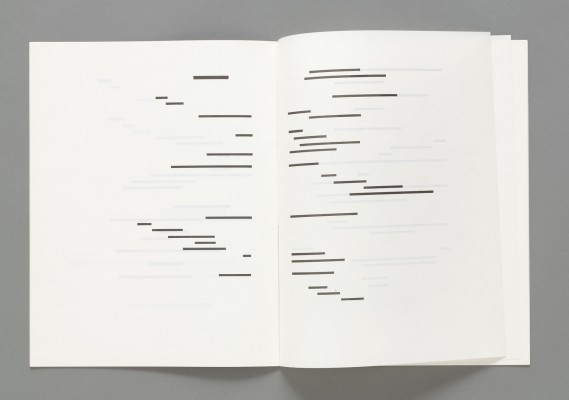
Marcel Broodthaers. Un Coup de dés jamais n'abolira le hasard. 1969. // Source: moma.org.

Marcel Broodthaers. Un Coup de dés jamais n’abolira le hasard. 1969. // Source: moma.org.

Marcel Broodthaers‘ version of Stéphane Mallarmé’s “Un Coupe de Dés…” Simple redaction rectangles on translucent vellum. Hints of what will come, and what has past, is visible. The book is time, and the open spread the present moment. It’s such a simple idea, but so well executed, that its elegance is quite profound. Being moved by simple gestures is always welcome.

Carl Andre‘s now now (1967). I have mixed feelings about Andre, but the textual/typographic gesture was so simple, yet so evocative of objects in space, that I really had a durational experience, to my surprise. (See it on page 2 of this exhibition PDF.)

There were many more works I enjoyed by Henri Chopin and Christopher Knowles. Of course, it’s really amazing and cool that Robert Smithson‘s Heap of Language is on view.

The contemporary gallery provided a nice opportunity to see Shannon Ebner‘s large photos of landscape interventions, as well as Tauba Auerbach‘s paintings.

Tauba Auerbach, RGB Colorspace Atlas (Volume 1), 2011, Digital offset printing on mohawk superfine paper, 3200 pages, linen, binder's board, acrylic paint Measurements for closed book Binding: Daniel E. Kelm and Leah H. Purcell at the Wide Awake Garage in Easthampton, USA Edition of 3 / SOTA/S 2011-036/1. // Source: StandardOslo.no.
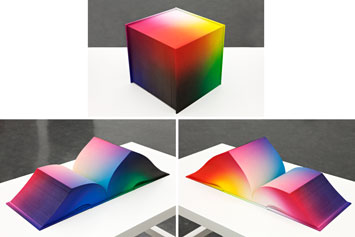
Tauba Auerbach, RGB Colorspace Atlas (Volume 1), 2011, Digital offset printing on mohawk superfine paper, 3200 pages, linen, binder’s board, acrylic paint Measurements for closed book Binding: Daniel E. Kelm and Leah H. Purcell at the Wide Awake Garage in Easthampton, USA Edition of 3 / SOTA/S 2011-036/1. // Source: StandardOslo.no.

Tauba Auerbach, RGB Colorspace Atlas. (2011). // Source: Rhizome.org.

Tauba Auerbach, RGB Colorspace Atlas. (2011). // Source: Rhizome.org.

Most of all, Auerbach’s recent RGB Colorspace Atlas series was ingenious and visually lush. They’re books—blank, hardbound, filled with pages so that it forms a perfect cube. Then, it’s airbrushed to create an RGB colorspace. Six examples are on view—three closed, three open—and they’re breathtakingly beautiful.
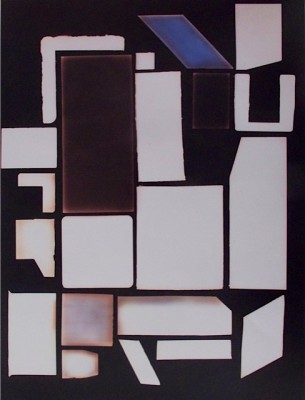
Paul Elliman. My Typographies (2). 1994 Paul Elliman (British, b. 1961). My Typographies (2). 1994. Photogram, 11 x 14" (27.9 x 35.6 cm) Courtesy the artist. © Paul Elliman. // Source: moma.org.

Paul Elliman. My Typographies (2). 1994 Paul Elliman (British, b. 1961). My Typographies (2). 1994. Photogram, 11 x 14″ (27.9 x 35.6 cm) Courtesy the artist. © Paul Elliman. // Source: moma.org.

I also appreciated getting to know the work of Paul Elliman (British, b. 1961), whose Found Fount series is a series of typologies of odds and ends. (Fount/Foundry/Font, get it?) The objects are on view, but the photograms are also very enjoyable.

A few weeks ago, I decided to switch directions in the studio and give text-based art a rest to see what would happen to my work. I was afraid that working with text might be too easy or formulaic, and result in art that is too quick a read. Ecstatic Alphabets/Heap of Language reminded me of the joy of elegant solutions—textual or not—and my love of the printed page.

The crowds were in full force for Free Fridays at MoMA, rewarding persistence and patience. About a mile uptown, I visited Tom Sachs’ Space Program: Mars, organized by Park Avenue Armory and Creative Time.

Tom Sachs. Creative Time/Park Avenue Armory. Source: CreativeTime.org.

Tom Sachs. Creative Time/Park Avenue Armory. Source: CreativeTime.org.

Tom Sach's Space Program: Mars. Source: Park Avenue Armory newsletter.

Tom Sach’s Space Program: Mars. Source: Park Avenue Armory newsletter.

It was my first visit to the Armory. I knew that art and antique fairs are held there, so I understood that it is a huge space. Still, nothing quite prepared me for turning the corner of the sole freestanding wall in the Armory, and seeing the expanse of space populated by precisely-lit installations/stage sets as well as various artist-made (or artist’s studio-made) space vehicles.

The show was unlike anything I’ve ever seen, and I found myself at a loss for words. I don’t want to ruin the experience for anyone, so I’ll leave you with the fragment M shared with me: “It’s so earnest.” The exhibition continues through June 17. I recommend attending a public program, such as the Demonstrations. And allow lots of time.
Standard
Artists

Amalia Pica

In my post-work, just-about-closing-time dash through The Ungovernables at the New Museum, I enjoyed Amalia Pica’s works. Looking deeper at the Argentinean artist’s ouvre, there’s still more that resonates with me and my practice—interests in celebration, simple forms, and the futility of language.

At Ungovernables:

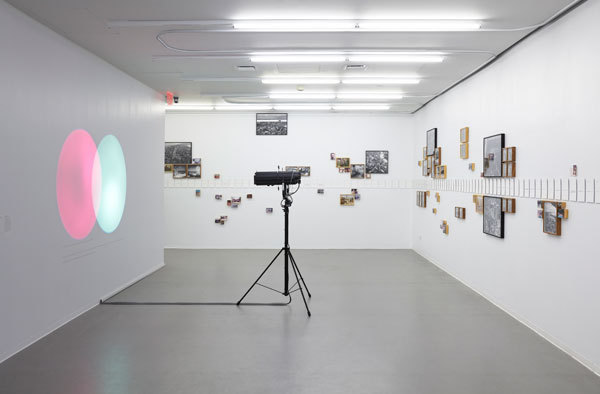
Installation view of the Ungovernables at the New Museum, NY. Foreground/left: Amalia Pica, Venn diagrams (under the spotlight). 2011 Installation with spotlights, motion sensors and text. // Source: NewMuseum.org.

Installation view of the Ungovernables at the New Museum, NY. Foreground/left: Amalia Pica, Venn diagrams (under the spotlight). 2011 Installation with spotlights, motion sensors and text. // Source: NewMuseum.org.

Amalia Pica, Venn diagrams (under the spotlight). 2011 Installation with spotlights, motion sensors and text. // Source: rolu.terapad.com.

Amalia Pica, Venn diagrams (under the spotlight). 2011 Installation with spotlights, motion sensors and text. // Source: rolu.terapad.com.

Amalia Pica, Eavesdropping (Version #2, large), 2011, found drinking glasses, glue. Collection of James Keith Brown and Eric Deifenbach, New York. // Source: Flavorwire.com.

Amalia Pica, Eavesdropping (Version #2, large), 2011, found drinking glasses, glue. Collection of James Keith Brown and Eric Deifenbach, New York. // Source: Flavorwire.com.

More projects:

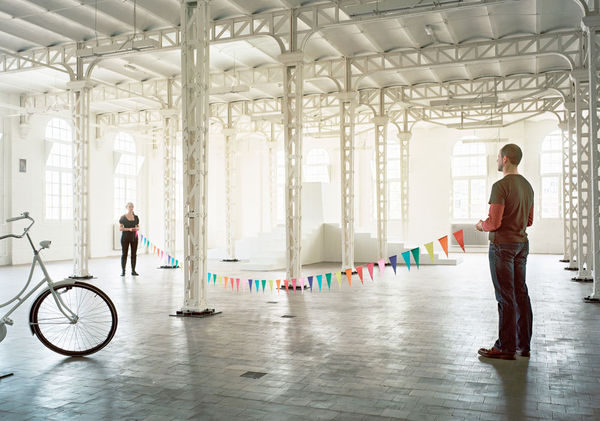
Amalia Pica, Strangers, 2008. Tableau vivant performed by two actors that never met before, holding a string of bunting for hours at time. Source: Artlicks.com.

Amalia Pica, Strangers, 2008. Tableau vivant performed by two actors that never met before, holding a string of bunting for hours at time. Source: Artlicks.com.

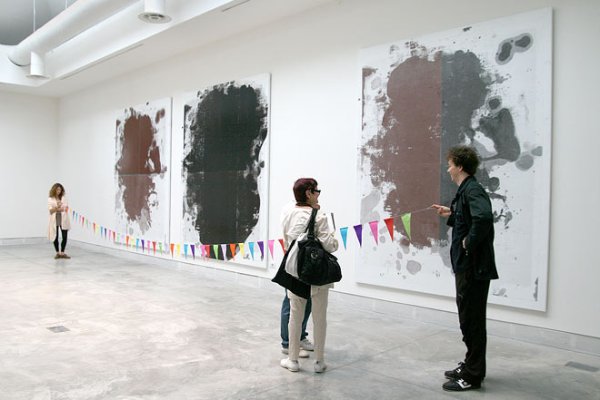
I love Strangers. What a brilliant project. I often think about how a work of art mediates relationships, and this project is a fantastic staging of such physical presence yet mediated distancing.

Amalia Pica’s forthcoming exhibition at Chisenhale (London)

elaborates upon Pica’s ongoing interest in the social act of listening, sites of celebration and technologies of mass communication.

(via Artlicks)
Amalia Pica, Strangers, 2008. Tableau vivant performed by two actors that never met before, holding a string of bunting for hours at time. // Source: Universes-in-universes.org.

Amalia Pica, Strangers, 2008. Tableau vivant performed by two actors that never met before, holding a string of bunting for hours at time. (Foreground. Christopher Wool paintings in background.) // Photo: Haupt & Binder // Source: Universes-in-universes.org.

Unsurprisingly, Marc Foxx Gallery in Los Angeles represents Pica. I’ve followed this gallery for years thanks to Foxx’s tastes in subtle, conceptual work.

Amalia Pica, Some of that Colour #4, 2011. Paper flags, drained paper flag dye on watercolor paper, chair. 78 x 155 x 60.5 inches. // Source: MarcFoxx.com.

Amalia Pica, Some of that Colour #4, 2011. Paper flags, drained paper flag dye on watercolor paper, chair. 78 x 155 x 60.5 inches. // Source: MarcFoxx.com.

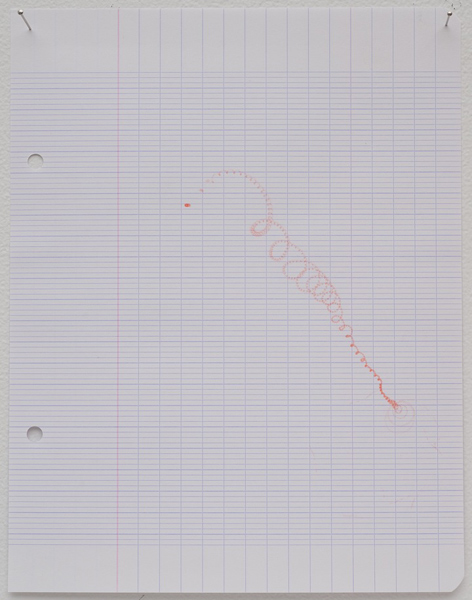
Amalia Pica, Spinning Trajectories - #1, 2009. Felt pen spinning top on graph paper. Individual works, various sizes. // Source: MarcFoxx.com.

Amalia Pica, Spinning Trajectories – #1, 2009. Felt pen spinning top on graph paper. Individual works, various sizes. // Source: MarcFoxx.com.

Amalia Pica, Spinning Trajectories - #4, 2009. Felt pen spinning top on graph paper. Individual works, various sizes. // Source: MarcFoxx.com.

Amalia Pica, Spinning Trajectories – #4, 2009. Felt pen spinning top on graph paper. Individual works, various sizes. // Source: MarcFoxx.com.

I love the simplicity of these gestures—a variant of a similar impulse behind Ceal Floyer’s Ink on Paper series.

Amalia Pica, Under the spotlight (white on white), 2011. Installation with spotlight, motion sensor, paper and paint. Source: MarcFoxx.com.

Amalia Pica, Under the spotlight (white on white), 2011. Installation with spotlight, motion sensor, paper and paint. Source: MarcFoxx.com.

Standard
Artists, Meta-Practice

From the Economist: Top 10 most expensive post-war artists

The Economist’s blog post (“The Price of Being Female,” May 20, 2012) reveals the most expensive works of art sold. It compares the  top 10 works by male artists against the 10 top works by female artists. The differences are astounding. They created a table that’s data-rich; I wanted to see it visualized a bit more.

Each $ represents $1M.

10 Most Expensive Works by Female Artists:

$$$ Lee Krasner

$$$ Cindy Sherman

$$$$ Agnes Martin

$$$$ Eva Hesse

$$$$$ Yayoi Kusama

$$$$$$ Marlene Dumas

$$$$$$ Cady Noland

$$$$$$$$$ Joan Mitchell

$$$$$$$$$$ Louise Bourgeois

10 Most Expensive Works by Male Artists:

$$$$$$$$$$$$$$$$$$$$$$$$$ Jeff Koons

$$$$$$$$$$$$$$$$$$$$$$$$$$$ Willem de Kooning

$$$$$$$$$$$$$$$$$$$$$$$$$$$$ Jasper Johns

$$$$$$$$$$$$$$$$$$$$$$$$$$$$$$$$$ Lucien Freud

$$$$$$$$$$$$$$$$$$$$$$$$$$$$$$$$$$ Yves Klein

$$$$$$$$$$$$$$$$$$$$$$$$$$$$$$$$$$$$$$$$$$$ Roy Lichtenstein

$$$$$$$$$$$$$$$$$$$$$$$$$$$$$$$$$$$$$$$$$$$$$$$$$$
$$$$$$$$$$$ Clyfford Still

$$$$$$$$$$$$$$$$$$$$$$$$$$$$$$$$$$$$$$$$$$$$$$$$$$
$$$$$$$$$$$$$$$$$$$$$$ Andy Warhol

$$$$$$$$$$$$$$$$$$$$$$$$$$$$$$$$$$$$$$$$$$$$$$$$$$
$$$$$$$$$$$$$$$$$$$$$$$$$$$$$$$$$$$$ Francis Bacon

$$$$$$$$$$$$$$$$$$$$$$$$$$$$$$$$$$$$$$$$$$$$$$$$$$
$$$$$$$$$$$$$$$$$$$$$$$$$$$$$$$$$$$$ Mark Rothko

Standard
Sights

See: Common Ground @ City Hall Park, Lower Manhattan

I just spent the past few days assisting an artist producing a massive concrete sculpture for Public Art Fund’s upcoming exhibition. If the other projects in the show are as ambitious the one I worked on, it’s going to be very inspiring.

May 24–Nov. 30, 2012
Common Ground
Public Art Fund
Elmgreen & Dragset, Ian Hamilton Finlay, Roger Hiorns, Jenny Holzer, Matthew Day Jackson, Christian Jankowski, Justin Matherly, Paul McCarthy, Amalia Pica, Thomas Schutte
City Hall Park
, Bordered by Broadway, Chambers Street, Centre Street, and Park Row, NYC
Opening: Wednesday, May 23, 2012, 5:30 – 6:30pm
Performance at 5:45pm // Remarks at 6:00pm

Throughout history, art in the public realm has been a means to represent common beliefs, values, and ideals. However, in our own diverse and pluralistic society, we value art most highly as the expression of a unique personal vision. Common Ground brings together the work of an international group of contemporary artists, each with a strikingly original artistic language and a strong engagement with the civic role and context of public art.

Standard
Sights

see: Michael Jones McKean’s The Rainbow

Last year I started running a loop that spanned the East River, and I got the crazy notion of creating a massive rainbow connecting Queens and Manhattan, without the slightest notion of how to manifest such an art project. Luckily, I don’t have to; another artist has figured out how to, in Omaha.

Michael Jones McKean, The Rainbow, 2011 (test).

Michael Jones McKean, The Rainbow, 2011 (test). Source: Art-Agenda.com.

June 1–September 15, 2012
Michael Jones McKean
The Rainbow: Certain Principles
of Light and Shapes Between Forms

Bemis Center for Contemporary Arts
724 S 12th Street, Omaha, Nebraska 68102
Opening weekend: June 21–23

Michael Jones McKean’s The Rainbow: Certain Principles of Light and Shapes Between Forms creates a simple but phenomenal visual event—a rainbow in the sky. The public artwork will produce temporary rainbows above the Bemis Center using the most elemental materials: sunlight and rainwater. Twice per day with clear sun, for 20 minutes each, a rainbow will appear above Bemis Center’s downtown building.

A rainbow operates as an egalitarian visual experience. It is by nature temporary, undetermined, and wonderful. The Rainbow exists somewhere between real and representation, actual and artifice. McKean is deeply interested in the rainbow as a complex form—ephemeral and steeped in mythology—that possesses an out-of-time existence as pure optical phenomena. The image of a rainbow extends through time, surpassing our known and archived histories, and operates as a constant unchanged form. Although the symbol of a rainbow has been co-opted, politicized, branded, and commodified, an actual prismatic rainbow still has an ability to jolt us from the everyday. It feels hopeful, yearning, optimistic, ghost-like, and meaningful.


Standard
Sights

See: Light and Landscape and Tom Sachs

These look like they’ll be great show, well worth the hike upstate and uptown.

May 12–November 11, 2012
Light and Landscape
Storm King Art Center
Old Pleasant Hill Road‬, Mountainville, NY 12553‬

Storm king presents contemporary art that explores creative and conceptual possibilities of natural light.

Storm King Art Center presents a special exhibition devoted to contemporary art in which natural light is both a primary medium and a conceptual focus. Light and Landscape, organized by Associate Curator Nora Lawrence, encompasses 25 works by 14 artists who use a variety of strategies to engage with light as a central component of their art. Encompassing sculpture, installation, works on paper, and video, the works encourage viewers to contemplate not only their natural surroundings and the effects of sunlight, but also the vast impact of light on our daily lives and ecosystem.

Artists represented in the exhibition are Matthew Buckingham, Peter Coffin, Olafur Eliasson, Spencer Finch, Katie Holten, Roni Horn, Donald Judd, Anish Kapoor, William Lamson, Anthony McCall, Katie Paterson, Tobias Putrih, Alyson Shotz, and Diana Thater. Their work will be installed across Storm King’s 500 acres of hills, fields, and woodlands—interspersed with the Art Center’s permanent collection—and in the Museum Building.

May 16–June 17, 2012
Tom Sachs: SPACE PROGRAM: MARS
Park Avenue Armory
643 Park Avenue, between 66th and 67th Streets, New York, NY 10065

From May 16 through June 17, Park Avenue Armory and Creative Time join forces with artist Tom Sachs to launch SPACE PROGRAM: MARS, a four-week mission to the Red Planet that explores the universe as a path to discovering ourselves. This interactive installation recasts Park Avenue Armory’s 55,000-square-foot drill hall as an immersive space odyssey featuring dynamic and meticulously crafted sculptures, including elaborate spacecraft, Mission Control, a launch platform, a Mars landscape, and much more. SPACE PROGRAM: MARS will be manned by Sachs and his studio team of thirteen, who will perform the myriad procedures, rituals, and tasks of their mission at the Armory.

Standard
Citizenship

Repair Cafes

Love this idea, from the New York Times (“An Effort to Bury a Throwaway Culture One Repair at a Time,” May 8, 2012):

At Amsterdam’s first Repair Cafe, an event originally held in a theater’s foyer, then in a rented room in a former hotel and now in a community center a couple of times a month, people can bring in whatever they want to have repaired, at no cost, by volunteers who just like to fix things….

“I had the feeling I wanted to do something, not just write about it,” [Martine Postma, repair cafe founder] said. But she was troubled by the question: “How do you try to do this as a normal person in your daily life?”…

“The value of the Repair Cafe is that people are going back into a relationship with the material things around them,” [architect William] McDonough said.

Standard