Research

Good Old Tesla

Two things I’ve been thinking a lot about are carbon and lights, so imagine my surprise when I stumbled across the Carbon Button Lamp, Tesla’s challenge to Edison’s patented incandescent lamp.

Perkins-Mather spiral filament 1880's
A Perkins-Mather spiral filament lamp from the 1880’s. Spark Museum.

I can’t find a picture of Tesla’s Carbon Button Lamp, but visit The Spark Museum page of beautiful early light bulbs, with blown-glass details and fanciful filament shapes. Catherine Wagner’s photographs of light bulbs are beautiful, but I also like reading about the bulbs and their re-purposed parts.

Standard
Research

K.I.S.S.

Shocked. I was shocked!

“This page is so easy to read!” I thought. “Where are the ads? What’s happening?”

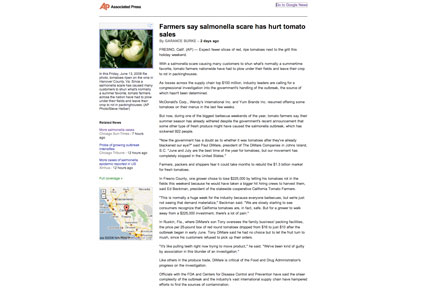
I came across a remarkably readable news article on ap.google.com today. Not an ad in sight! No gratuitous design. Plain, straightforward, attractive in its ease, and completely readable. It was refreshingly simple.

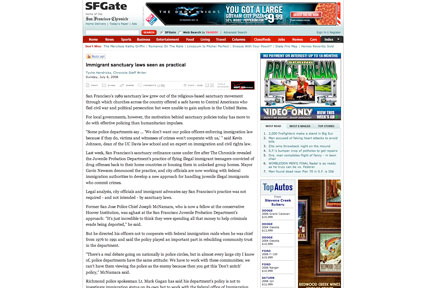
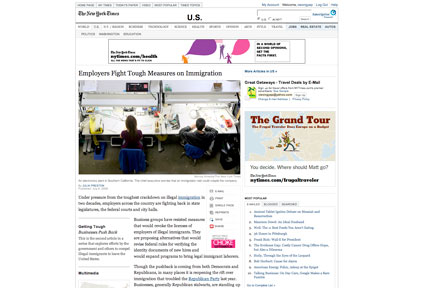
Compare the AP.Google page with other news sites’ pages. Two principles become obvious to me. First, simplest is best. Second, ads suck.

I don’t have a problem with news organizations taking ads. The New York Times is right: as a reader, I’d rather access their content for free and see advertising than pay an online subscription fee. But the ads shouldn’t blur into the content; nor should they distract from it.

I have a problem with advertisers, especially ones making the awful eye-grabbing animated GIFs. They’re only distracting and annoying. I’ve not once clicked on an online ad because the ad was cool.

There are tried and true rules to advertising:
Find your target.
Be relevant.
Advertising is the most expensive, lowest return form of marketing. (See Marketing without Advertising, from Nolo Books, which advocates ethical business practices and good service as fundamental strategies for encouraging good word-of-mouth.)

There are also tried and true rules to graphic design:
Be transparent.
Serve the content first and foremost.

And while art often breaks rules, I’d like to challenge the misconceptions that art is equivocal to expression or beauty, and that art is ultimately subjective. Objectivity and criticism can exist in fine art as well.

Often people say they like art that they can keep looking at over and over; they appreciate a temporal looking experience that results in multiple discoveries. But I would argue that making things more visually complicated does not necessarily make it more interesting.

As a reader, graphic designer and artist, I’d love to convince people not to confuse loudness with success. Generally Americans don’t like to think so, but it’s OK to err on the side of quietness and not underestimating your audience. As Jenna Fisher’s agent told her when she went into her audition for The Office, “Dare to BORE me.”

Standard
Citizenship, Research, Sights, Values

Answers: we all need them.

“In general relativity, an event horizon is a boundary in spacetime, an area surrounding a black hole, beyond which events cannot affect an outside observer. Light emitted from inside the horizon can never reach the observer, and anything that passes through the horizon from the observer’s side is never seen again.”

http://en.wikipedia.org/wiki/Event_horizon

The phrase “the art world” suggests that art is like a foreign entity with rules of its own making.

I blog to increase transparency about art and artists and bust the myths about artists and art making that are so pervasive and persistent: That a person “can” or “can’t draw.” That you don’t get famous until you’re dead. That modern art is a sham. That meaningless rhetoric turns a tampon in a teacup into art. That artists are stereotypes: the starving artist, the egocentric artist, the flamboyant, condescending artist. The anti-social artist. They’re like a list of Smurfs, where everyone’s boiled down to one outstanding characteristic designed for easy, non-threatening identification.

When you’re in a community of artists, it’s easy to feel human — whole, sane, remarkable for the breadth of our modest experiences. But it’s different in the World at Large, where one is reminded that the general public thinks of art as synonymous with paintings, that the point of art is beauty or expression (but the point of being an artist is to be famous), and that hostility towards contemporary art is a completely acceptable means of anti-elitist individuation.

Brushing up against that world can leave me feeling like my work is both less productive or valuable to society, and paradoxically, my work makes me special: I’m more tireless, more gifted (rather than skilled or disciplined), more remarkable for my Other-ness for having a creative pursuit at the center of my life.

So can you blame an artist for feeling like she navigates two worlds? For wishing to see more observers outside of the event horizon to get sucked into the World of Art?

I mean, people participate in multiple worlds all the time. For example, I skirt the edges of the macho World of fight sports. Going to a boxing match for the first time was new and scary, but I got over it. On the other hand, some people find the prospect of attending a gallery opening too intimidating or too unrewarding to try.

Fundamentally, if people think they either “can” or “can’t” draw as children, as adults they might think that they either “get” modern or contemporary art, or they don’t. That if a Matisse portrait with a green nose doesn’t stir something in you, that you’re somehow not smart enough to intuit the significance, so you shouldn’t even bother figuring out why the Donald Judd shelves are art. But how to look at a Judd, or understand the historical conditions that led to Modernism, is something that can be learned, very easily (An art history class: You sit in a dark room and keep your eyes open while someone talks and shows slides).

As an artist, it’s in my best interests for more people to engage with art, to take art history classes, to feel like art is a desirable, rewarding part of one’s life. In other words, it’s not in my best interest to be egocentric or condescending, or to be secretive about art and art making. I believe most secure artists like to encourage other artists and help the public engage art.

Earlier, I visited Yahoo Answer‘s Visual Arts forum. Most questions were about appraising antiques, materials recommendations, or requests for critiques by amateur manga artists, nature photographers and still-life painters, with a few how-to questions. I posted a few answers about techniques and materials, and more urgently, safety suggestions (melting plastic in one’s oven = not a good idea). I also responded to the heartbreaking post from a 14-year-old girl whose dad said her drawings wouldn’t be good enough for her to study art in college.

At the risk of sound like an intellectual snob, or maybe someone just someone with a sense of cynical irony, here’s a list of questions that made me want to laugh, cry, or both:

What is the significance of clowns in Chicano Art? What do they mean? Can anyone tell me?

If you sick a metal rod, (lightning rod) in sand and its struck in a storm will this make glass figures?

I want to forge my own sword. I’m in chicago, does anybody knows where do I go?

Can someone give me a list of COOL graffiti names?

Where can I register as an Artist (Oil Painter)?

What do you think of the name federico?

I need a pict of a toryilla chip next to apair of red headphones on the shoulder of a man in a bannana suit?

I have over the past few years started painting abstracts. How do I get my work into gallerys?

Is blue a real color?

How do I find an artist willing to submit to my every whim?

Can anyone tell me of a symbol that represents “being true to yourself”?

A good Logo design idea for a design and Print broker?

Why do my photos from my Sears Portrait CD come out all odd?

What kind of pictures would be funny/interesting if they were unfinished or half-drawn?

How much does it cost to order/purchase a bronze statue of a man, actual size?

IS there such website?
That allows you to see what you will look like at a certian age such at if you are 16 and you want to see what you might look like at 32 or something like that

Ideas??????
I cant think of anything to shoot!!!

To any graffiti lovers in the ny/nj area?

If the world discovered a new color, what would it look like and what would it look like?

Im not creative do you have any ideas?

Standard
Research

Podcast Reviews: Art school lectures

In the studio, I listen to a lot of podcasts, including lectures by contemporary artists, lit, conversations on astronomy, to public radio arts and culture shows. In the past few years a lot more interesting podcasts have popped up, so I thought I’d spread the good word and post reviews of notable podcasts here.

I’ve already mentioned the fantastic artist’s lecture by Kerry James Marshall at SFAI, as well as the really great presentation by Johanna Drucker at SVA.

SFAI’s podcast features world-class artists, but is rarely updated, and seems under produced (it’s just an audio recording of the lecture, but the levels aren’t balanced, and some of the Q&As should be cut or filled in). Likewise with CCA on iTunes U, except CCA’s recently hired some professional with a broadcast voice to conduct interviews. Though, with a podcast of first-year students seems more like an enrollment tactic, rather than intellectual endeavor.

SVA’s got a better-produced series of podcast lectures. As I mentioned, the Drucker lecture from the MFA Art Criticism and Writing department is great. I also tried listening to Barry Schwabsky present a paper on the ontology of painting — but had to stop due to a fatal flaw: the lecture was presented bilingually (English and French), but the levels were not balanced, and the translator was blasting my ears while I could barely hear Schwabsky. Too bad.

But SVA really excels with their Graphic Design lecture videos, including a Paul Rand series with notables like Milton Glaser, as well as a series presented by the design genius, Steven Heller. I haven’t got a portable player for videocasts, so I’m just scratching the surface of the design lectures, but they seem better produced. Learn more at the nicely designed web site, of course.

Standard
Research

A point of reference: Carbon

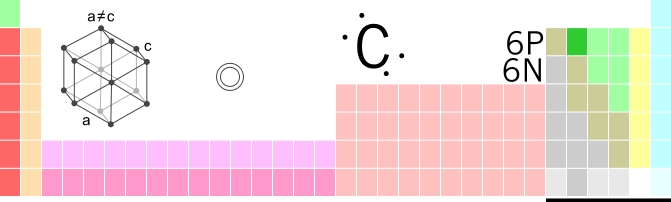
carbon periodic chart, wiki commons
From the Wikipedia Commons.

Life is often represented as Light.
As in, “Then there was light.”
Or photographs of a dewy leaf bathed in sunlight. But it’s not the light that gives light, as much as the chlorophyll that transforms light into food.

Guess what?
Chlorophyll is comprised mostly of carbon atoms.

Carbon — literally — is the building block of life.
And it’s intrinsically tied to light: Carbon reflects light (as diamonds), creates light (and electricity, as the primary element in the hydrocarbons coal and petroleum), and absorbs light (charcoal, a result of the release of energy and light in a fire).

Standard
Community, Research

White stuff I like, more or less

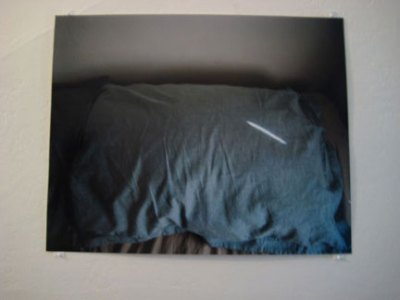
I have always liked Lindsey White‘s photos. Her new photos and videos make up a nice show at Partisan Gallery, somebody’s house on Guerrero. Endearingly earnest, like her previous portraits, but less quirky-cute, and more chance-magic (in the end, it’s just about personal taste: arty vs. Art). The new works are about light, and veer between optimism and the pathetic/mundane.


A bad pic of a great photo by Lindsey White, of a spear of light on a pillow. She shoots digital and 120mm, if you wanted to know.


A multi-channel video installation; each video is a single shot of a single thing. It functions like a sequence of photos in a book, only with slight movement and minimal audio. Great!

Also liked Richard T. Walker‘s two-channel video installation at Iceberger. More instruments, letters to nature, human projection onto the romantic ideals of nature. His English accent adds something; for no good reason, I assume that it suggests more of an awareness of the Romantic period than if he were American. Maybe my visit to Cumbria, the land of all those English Lake writers, has something to do with it.

It was a nice summer evening, and I enjoyed chatting with artists and meeting some guys showing with Little Tree Gallery, but I couldn’t shake my self-awareness of the New Mission, as youthful gallery-goers drank Pabst on the sidewalk for hours on end, just like during First Fridays in Oakland. What’s at stake is so different for different people, isn’t it? Earlier in the day, I found a kindred iconoclast willing to challenge hipsters’ endorsement of dingy ethnic restaurants in rough neighborhoods like Tu Lan and Shalimar. WTF? Thanks to the digital age, there is a source to explain this behavior: Stuff White People Like. See #91: San Francisco and #71: Being the only white person around.

Another thing White People like is critical theory (see #81: Graduate School). I must be White, because the podcast of Johanna Drucker‘s lecture at SVA blew my mind. The artist and author challenges Adorno’s 20th c. aesthetic theory and explains her notion called aesthesis, a specialized form of knowing (through art), characterized by knowing grounded in central experience, emergent experiences and co-dependent relationships. In contrast to Adorno’s assertion that art is autonomous, Drucker suggests that art is complicit and co-dependent; that it is in fact a form of commodity production, even if we don’t like to think of it so.

A tasty morsel:
She classifies low-brow pop paintings and drawings that reference comics or media as:

combinatoric mass culture kitsch production

And on the meat of the matter, for me:

To dispute Adorno’s assertion that because art is removed from the world of utilitarian objects, they are inherently resistant, Drucker says:

The notion of resistance [inherent to art] will die hard because it is the last link to the kind of utopian belief that … has a long history with modernism, and certainly gets reformulated again in mid-19th century with the coming of political philosophy…. The shift to political philosophy from ‘regular’ philosophy is that rather than understanding or describing the condition of knowledge or sensation or the mind, the political philosophy said the point is to change it. So the task of change — which again, the world is broken, we do need to fix it — … comes to be identified with the avant garde and … the role of art assumes a moral hierarchy and a moral high ground for the artist and the work of art. And that seems to me to be highly suspect. And that’s where I come back to complicity. We are not better than the world we inhabit….

The notion that difficulty, in and of itself, is a form of resistance that performs some sort of political efficacy—it’s just not true. It’s what I call magical politics. It’s like, where exactly does the transformation of power relations and political agency actually occur in those difficult works? It doesn’t….

I make difficult work. I write really obscure things. But I don’t imagine that they are making a transformation of the political structure. I do imagine, and I do believe that they transform the meme world. That’s what we do. We are meme makers. We transform. We reimagine. We remodel. We offer new models of cognition and new models of experience. And we produce that as an effect. We don’t produce that inherently in objects. It is an effect of what we do.

I had similar feelings of caution around the sense of artists having a moral high ground in the process of developing new work for Activist Imagination. So it’s great to hear Drucker put a historical framework around the conditions of art-viewing that we are subject to, and available for displacement if we choose.

Standard
Research

Walker ramblings

I had the good fortune to visit the Walker Art Center last Fall, and it knocked my socks off.

The Walker is striking in how top-notch it is all around. The collection is incredible, with lots of contemporary projects. The building is huge, with lots of interesting spaces: some grand foyers, some interesting changes in elevation, a nice split-level gallery, not to mention the sprawling grounds. And of course, the Walker graphic design department kicks ass. (Check out their site.)

Lately I’ve been really feeling the interconnectedness among art, design and architecture. I’ve always been interested in design — in fact, it’s how I got into art in the first place — but until recently I’ve been sort of oblivious to architecture. But like seeing the crystal goblet of graphic design, I’m finally starting to really see the matrix of the built environment.

Cheers to the Walker for maintaining a high level of commitment to excellence in these overlapping spheres of inquiry.

I’m excited about two programs at the Walker this season. And guess what? They’re cross-disciplinary.

Art + Graphic Design :
Call for submissions for artist-designed political yard signs

Art + Music + Performance + Architecture + Video :
Meredith Monk and Ann Hamilton
A multi-media music-theater-performance work set against video of a tower Hamilton designed in Northern California.

[On another note, I’m fascinated by artist’s strategies for presentation. I watched Hamilton’s video clip on Spark, showing the construction of the massive tower and early collaborations with Monk. But the tower is on the Olivers’ private ranch. I wondered, who will see it? Then I get an email from the Walker; the architectural work in CA sparks a performance work, which sparks a video that gets parlayed into a theater-based work in MN. Brilliant! As a project-based artist (that is, making projects rather than ongoing bodies of work), I love how Hamilton took a sketch and used its momentum to build traction on multiple presentations of the work.]

Standard
Research, Values

Kerry James Marshall on artists becoming agents in their own lives

From Kerry James Marshall lecture at SFAI (via podcast)

This article [in Modern Painters] called “School is Out” which… is a conversation between John Baldessari and the British teacher, Michael Craig Martin…. The principle notion [Baldessari] was operating on was … one cannot teach art. That art is somehow, this sort of strange and alien phenomenon that happens to people… He said, it’s like all the planets around you have to line up in the right way, with the right students, and the right time, and the right faculty and the right city. So everything’s got to be just right, you got to have the right kinda people and all that stuff. And that’s precisely the kind of ideas and attitudes that everything I do is fundamentally opposed to. The sort of rightness of a kind of person who is privileged enough to … be invited into this circle of people who are artists….

This [painting called The Lost Boys] was the pivotal painting for me…. This was the painting I had always imagined myself being able to make…. Everything I was doing was leading me to that place where I could make that painting…. And once I made these paintings everything about the way I operated as an artist changed…. from that moment I understood… what I had to do in order to make the kinds of images that I need to make. And I can say I never … stumbled again after that…. I was sure of myself; of what I could do and needed to be done. That was a profoundly empowering moment for me….

[As a youth] I used to hang out [at LACMA]… and [getting my work] in there with one of those artists was a goal that I set for myself. And that painting…, the first big painting that I made, it was the first major museum purchase that was ever made of my work and it was purchased by LACMA. And then to be in there amongst all those people I had admired, I had arrived, I had succeeded in everything I had set out to achieve,… from that moment I felt free to do anything I wanted to do.

Now, I can sort of go for the next thing. And for me,… it’s a question is whether one finds a very secure place in the historical narrative of art so that whenever that story is told, it cannot be told without the presence of either me or somebody like me there….

On some levels, I have already…. There are books in which my work is represented…. But I’m not in everybody’s book…. I want people to stumble on me, like I stumbled on everybody else… Jackson Pollack or Jasper Johns or Willem de Koonig or Mark Rothko or Ad Reinhardt—those people, there are no books being written on the history of art in which those people are not being represented. And as far as I’m concerned, if you don’t achieve that level of recognition and representation in the history, then you still don’t really exist. Because your presence there is conditional… on a sympathetic writer, critic or historian who is willing to place you there. But that kind of placement can be contested. And I’m looking for an un-contestable position in the historical narrative…. This is how I think. I’m purpose-driven. I have a mission. And I’m all about knowing what I need to know, and having the requisite skills that I need to have in order to manufacture this position that I think I need to occupy…. And, well, people laugh at that kind of conceit. But the truth be told: I don’t know any artists of consequence that didn’t have that kind of conceit. And if it’s acceptable for other artists who are already there to think and speak like that, how come it’s not acceptable for somebody else to think and speak like that? And if we’re not thinking and speaking like that, what’s wrong with us? I mean, really? If you take this seriously…. These institutional structures that we kneel and bow and defer to are not inviolate institutional structures…. They’re not entitled to exist without challenge…. So you have to put yourself in a position where you are capable of knocking them off the position they occupy, because we are not bound to defer to anything that exists. Everything is available for critique—and also displacement….

Your development as an artist is a fluid occupation. Wherever you are at any given moment doesn’t mean anything about where you can be or might go. But when you take control, when you take charge of your development as an artist, you make those kind of decisions because you’re trying to get to a very particular kind of place, and so you should be driving your development in a particular direction, and you should know what the destination is. It’s the only way you can know whether you’ve succeeded at the challenges you set for yourself or not, because if you are not sure what you are doing,… you are at the mercy of forces outside of yourself.

And as far as I’m concerned the stakes of this sort of enterprise are way too high to relinquish that kind of control to people…. who you can always bet don’t have your best interest at heart. It’s the only way you can avoid that situation [where Baldessari can say that art requires the right people, the right situation]. This rightness of people thing, I mean… To be honest, that’s the white racist, white supremacist basis on which the United States was organized. And we cannot have that kind of foolishness anymore.

Standard