Research

The dangerous pretension of knowing what’s best

Sarah Vowell shares a look at the roots of American Exceptionalism, tying…

Gov. Sarah Palin
to
Pres. Ronald Reagan
to
Puritan leader John Winthrop (1588-1649), who wrote “A Model of Christian Charity”
to
Jesus and his “Sermon on the Mount”

…in this week’s episode of Studio 360 from PRI.

I suspected that American Exceptionalism stems from the same principles that justified Manifest Destiny — that Americans are ‘chosen’ people, and that non-Americans are rightfully subject to Americans’ will.

So the fact that its roots go back to 15th century — the Age of Discovery, when Christian missionaries were covering the earth — affirms my suspicions. Furthermore, John Winthrop may have been interested in helping the poor, but he was also anti-democratic: he believed that aristocrats had a responsibility to help poor people, but the poor shouldn’t be allowed to have a voice. How paternalistic.

As Stuff White People Like #62: Knowing What’s Best for Poor People goes, “It is a poorly guarded secret that, deep down, white people believe if given money and education that all poor people would be EXACTLY like them.” If American Exceptionalists believe we Americans are similarly privileged — we know what’s best for the rest of the world — and we embody the universal ideal — that the greatest potential of the world is to become more like us: more democratic, more free-market Capitalist, more Wal-Marts and Whole Foods — it’s an awfully pretentious vision.

I realized that my objection to American Exceptionalism is similar to my position on Activist Art; that the underlying assumption that one is responsible for fixing the world is based on distinguishing oneself from the world. But as Johanna Drucker reminds us, “we are not better than the world we inhabit.” We are part of the world. And that we ought to accept our interdependence and complicity in the state of the world. The responsibility to fix it isn’t ours alone, but should be approached with mutual investment and collaboration.
Standard
Research

more on the end of the american century

“One thing seems probable to me,” Peer Steinbrück, the German finance minister, said recently. “The U.S. will lose its status as the superpower of the global financial system.” At another time, that remark might have sounded like mere nationalist bluster. Right now, it doesn’t seem so ridiculous to ask whether 2008 will come to be seen as the first year of a distinctly non-American century.

…and yet…

The political language of both presidential campaigns makes clear that many voters, for all the current pessimism, still believe in the idea of American pre-eminence.

David Leonhardt, “A Power That May Not Stay So Super,” NYTimes.com, October 11, 2008

Standard
Sights

Missed connections

The good news is: we’re halfway through Mercury Retrograde.
The bad news is: we’re halfway through Mercury Retrograde.

Feeling frustrated? Misunderstood? Like you’re speaking a different language than everybody else? A friend has posted a fine astrological and personal account of Mercury Retrograde. It totally describes my experience with Mercury Retrograde where all communication goes down the drain. Everything seems haywire, bent out of shape. Plus, it’s got an animated GIF, to boot.

In my text based work, I thought a lot about the general inadequacy of language, and the gap between word and meaning. And after the recent campaign debates, I find myself unable to resist seeking out colleagues who can vet my perceptions—Nooo, he didn’t say that! She totally dodged the question! Did you see that? Tell me I’m not alone here. We aren’t speaking different languages, are we?

Regardless, hopefully, those of you who can make it to the Headlands Open House will do so. Of course since it’s Mercury Retrograde, double check your calendar, bring directions, and don’t forget to say hi to me in my studio in the basement of 960.

Fall Open House
Sunday, October 12, noon–5 pm
Headlands Center for the Arts
944 Simmonds Road, Sausalito, CA (directions)

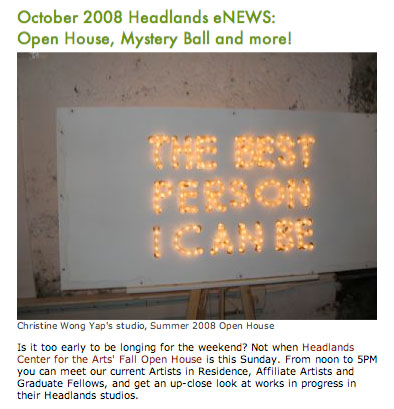
A relic in my studio from The Best Person I Can Be in the recent Headlands' eNews. Will you look at that!

A relic in my studio from The Best Person I Can Be in the recent Headlands' eNews. Will you look at that!

Standard
Research

bummers and more

All of my work is about optimism and pessimism. In late 2007, I decided to be an optimist. I am thinking about being a pessimist again. Here’s why:


Bummer: With all the spectacular financial ruin on Wall Street, I was thinking that maybe I should pull my money out of my bank. Too late!

Bummer: I know everyone’s got it tough, I’m afraid these lean times will get even leaner. Like Emil Hirsch’s character in Into the Wild, says, Where are the the F’n animals?

It’s not all pity party yet. There are still a few things that float my boat– examples of smart people doing interesting things:

Red Lines
Death Vows
Foreclosures
Risk Structures

September 9 – December 21, 2008
Architectures of finance from the Great Depression to the Subprime Meltdown
An exhibition by Damon Rich and the Center for Urban Pedagogy (CUP)
Commissioned by the MIT Center for Advanced Visual Studies (CAVS)
Hosted by the MIT Museum
MIT Museum Compton Gallery, Cambridge, MA
How timely! What a great idea to develop an exhibition model for examining these rather convoluted economic structures.

Won Ju Lim: 24 SECONDS OF SILENCE
September 27 – November 26, 2008
Curated by UCCA Curator David Spalding
I really loved Won Ju Lim’s work at Patrick Painter, and I’m sure she’s up to something amazing at the huge, recently opened Ullens Center.

Apex Art’s Franchise opportunity.
Strange curatorial potential.

Josiah McElheny’s “The End of the Dark Ages” sculptural infographics of the Big Bang at Andrea Rosen Gallery

And finally, a smart person has written a (presumably) interesting book about a really, really big bummer:

David S. Mason’s blog for his new book, The End of the American Century, is already really topical, though the book isn’t due out until Oct. 1. The timing really couldn’t be worse, if you’ve already got the bad news blues, or better, if you’re a fan of Lehmannfraude.

Standard
Citizenship, Research

Who gave us the right

Some of my more darker-themed artworks were inspired by the sort of pessimistic malaise seen in some recent contemporary art shows, and the related idea of the end of the American Century. More than just a form of liberal cynicism or the fatigue of constant moral outrage, I’m much more interested in an intellectual inquiry into why Americans should be skeptical the direction of our country, especially as both presidential candidates envision the US being the leader of the world.

So I was intrigued by Andrew J. Bacevich’s interview on WHYY’s Fresh Air (Sept. 11, 2008).

Andrew J. Bacevich, a professor of history and international relations at Boston University and a retired Army colonel, discusses his new book, The Limits of Power: The End of American Exceptionalism.

He argues that pragmatic realism has always been the core of American foreign policy, and current politicians would do well to remember that.

Bacevich is both a military man and a Boston University professor. He speaks candidly about how he didn’t develop a political consciousness until after he left the military. His position, now, though, is one that opposes the US’ continued Cold War-style military “strategy” to dramatically reshape the greater Middle East, and how the American public is confusing the war in Iraq and Afghanistan with the more sinister War on Terror—in which the role of this country is more like one that polices the world, rather than coexisting in it with others. He was also highly critical of the Legislative branch for giving up so much power to the Executive branch. And in one exchange that was a welcome validation of leftist values, when host Terri Gross pressed the professor on what the US should be doing, in addition to diplomacy, he mentioned increasing student exchanges and cultural exchanges to improve the perception of the US and work against our isolation from the world.

—-

ADDENDUM (added 9/26/08):

Roger Cohen’s op-ed, “Palin’s American Exception” (NYTimes.com, Sept. 25, 2008) is a great primer on why exceptionalism is a suspect position these days. Cohen proposes that behind Palin’s emphatic embrace of exceptionalism is an enraged response to the decline of American power. He promotes universalism instead of exceptionalism, interconnectedness instead of separateness, and realism not rage.

Standard
Community, Research

Text-based art + Light-based art = Yum Yum!

I’ve been underground (metaphorically and literally, sort of: my studio’s in a basement), preparing for Galleon Trade at Bay Area Now/YBCA. So I’m emerging to view other shows, just in time for the fall art season! (As Anu pointed out on her blog, Why do we all still live by the semester cycle?)

The exhibitions at the Wattis can be theatrical and unconventional, but I was pleasantly surprised with rewarding experiences at the new evolution of Passengers and the brand-new The Wizard of Oz exhibition.

Carsten Holler installation at the Wattis Institute's The Wizard of Oz exhibition

Carsten Holler installation at the Wattis Institutes' The Wizard of Oz exhibition

Really, even if I weren’t a light bulb freak (I dreamed of blue LED displays and reflector bulbs this morning), who wouldn’t love Carsten Höller‘s Wonderful signage, with a timed light-show sequence? Cans in the shape of letters with crystal clear incandescents. It’s nostalgic for the 20th century, which is only eight years ago when you think about it…

Glenn Ligon's installation at the Wattis Institute's The Wizard of Oz exhibition

Glenn Ligon's installation at the Wattis Institutes' The Wizard of Oz exhibition

I was delighted to stumble into this in a far room of the Wattis. I am a huge (yooouj!) Ligon fan, and came to appreciate his black-ed out neon work more after reading a great critical and phenomenological response to “Negro Sunshine,” (Richard Meyer’s “Light it Up, or How Glenn Ligon Got Over,” Artforum, May 2006). Blacked-out neon America: Brilliant! I like the outlined typewriter typeface, it’s somehow appropriately spook-y.

One of my favorite quotes is about oscillating between the container and the contained (from the Fluxus artist Daniel Spöerri), so of course I also was thrilled to come across this neon piece on Regen Project’s website too.

Claire Fontaine installation at the Wattis Institute's Passengers exhibition

Claire Fontaine installation at the Wattis Institute's Passengers exhibition

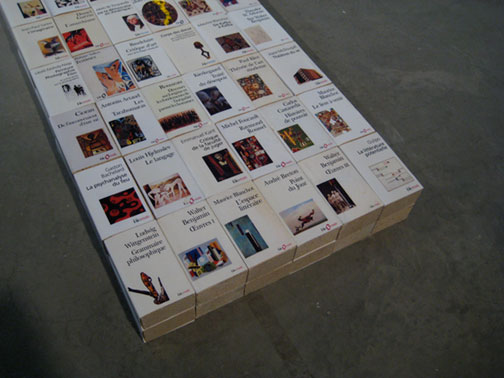
Brick-books of theory. The Wattis, of course, is housed on the campus of my alma mater, so for purely personal reasons, critical theory book wraparounds on cinder blocks are a riot. Of course, with all good conceptual art, the more you know, the better it gets. Fontaine is not an individual, but a French collective, and the installation is a meditation on the Paris 1968 riots, where a brick was more than a building material, but a weapon, a symbol of revolutionary actions. While anarchist communities are still active today (you will know them by their bicycle bumper stickers), it’s nice to be reminded of the once-obvious connection between critical theory and direct action.

Standard
Art & Development, Research

in Guangzhou this weekend?

The Guangzhou Triennial opens this weekend, and the program sounds fantastic.

I really enjoyed my 2001 visit to Guangzhou (Canton). Guangzhou is the major city in Guangdong—the large southern region including the Pearl River Delta and original home to something like 90% of Chinese immigrants who came to California prior to the 1965 Immigration Act. Guangdong is also where my maternal and paternal ancestral villages are; both family lines can be traced back several generations (as many as 26, on my mom’s side) in that region.

Anyway, during my visit I found Guangzhou to be really cool—a bustling metropolis full of young people breaking from the past. The triennial program sounds like Guangzhou is finally getting into the game with some forward-thinking contemporary art practices—a contender to Hong Kong’s and Beijing’s dominance as top art centers in China! I’m especially fascinated with the program’s theme.

For the curatorial discourse of this Triennial, we propose to say ‘Farewell to Post-Colonialism’. This represents the theoretical basis from which we hope to explore our critical vision. The Triennial attempts to open new frontiers for creativity with a critical review of the role cultural discourses of Post-colonialism and Multi-culturalism has played in contemporary art. While affirming Post-colonialism’s achievements in exposing hidden ideological agenda in society and inspiring new art, this Triennial also critically examines its limitations for creativity, and calls for a fresh start.

We hope to uncover elements of the paradoxical reality veiled by contemporary cultural discourse, to make contact with realms that slip through the cracks of well-worn concepts such as class, gender, tribe and hybridity. We hope to think together with artists and investigate through their practices to find what new modes and imaginative worlds are possible for art beyond those already heavily mapped out by socio-political discourses.

GZ Triennial will host 181 artists from over 40 countries around the world, including 50 films/videos from the Middle East, Southeast Asia and Africa under the projects “Middle East Channel”, “East-South: Out of Sight” and “Africa: Personal Poetics”….

(By the way, if you think that China is monolithic and closed, as most Americans think, I should mention that one of the things I learned on my visit were the significant numbers of African immigrants in China, who often study in the universities.)

The 7 “Forums in Motion” of the 3rd Triennial is a long expedition that traverses across a wide terrain of ideas which focus on Farewell to Post-Colonialism, Limits of Multi-Culturalism, Thinking Through the Visual, … Anxiety of Creativity and Possible Worlds and Farewell to Post-colonialism — Towards a Post-Western Society?

Saying farewell to post-colonialism and peering into the future for glimpses of a post-Western society— or the century to follow the American Century—is something that really resonates with my installation, Binary Pair, in Galleon Trade: Bay Area Now 5 Edition.

THANKS to everyone who made it to the opening last night! I had a blast and it was so nice to see smiling faces and hear respected colleagues’ impressions of the work! If you missed it, stop by YBCA before October 19 to catch the show — it’s almost all new work, featuring 5 CA artists paired with 5 Manila-based artists.

Standard