Citizenship, Community, Sights

get excited: open studios, mfa shows, more

Besides Frieze, NADA, and Pulse art fairs in NYC this week, there’s a slew of auxilliary events, open studios, and MFA shows to check out. In support of friends and community, here’s my list:

Go Stephanie!

May 4–6
Stephanie Syjuco: RAIDERS (Redux)
Catharine Clark Gallery’s New York Pop-Up Gallery
313 W 14th Street, 2F, NYC

May 4–6
LMCC’s Open Studio Weekend
125 Maiden Lane, 14th Floor, NYC

Go Michael!

Saturday, May 12
IN/VISION
2012 MFA Interaction Design Festival at the School of Visual Arts
Thesis Presentations: 11am – 4pm @ SVA Theatre
Thesis Exhibition: 5–7pm @ SVA Interaction Design Department
Go Nyeema!
May 12–13
NARS Foundation Open Studios
88 35th Street, 3rd Floor, Brooklyn
May 18–19
Kambui Olujimi: A Life in Pictures
Apex Art, 291 Church Street, NYC
Saturday, May 19
Question Bridge: Black Males Blueprint Roundtable
Brooklyn Museum 
Finally, if that’s not enough, learn about Emergency USA‘s amazing projects building medical infrastructure in areas of conflict:
Thursday, May 3, 7pm, E-USA office @ 21 Exchange Place. Presentation. RSVP to nyc@emergencyusa.org.
Sunday, May 6, 5–8pm, Randolph Beer, Nolita. 15% benefit happy hour.
Standard
Citizenship

Via e-flux: Sotheby’s: offer your art handlers a fair contract

Don’t be jerks, Sotheby’s. Do the right thing.

Art handlers lift things that are heavier than you want to lift, handle things that you’re too nervous to handle yourself, and pack and unpack things that you’re not skilled to handle. If you want workers to handle art and antiques with care, treat your workers with dignity.

Sign the petition at change.org.

For the past eight months, Sotheby’s has locked its 43 unionized art handlers out of work. Rather than negotiating a fair contract with its employees, the company has issued a set of demands: the gutting of the art handlers’ union, the elimination of health insurance and other benefits, and the replacement of full-time skilled workers with temporary unskilled laborers.

Sotheby’s has decided that the handling of priceless artworks is an easy job; that low-paid temporary workers with little training or incentive can manage the constant stream of artifacts into and out of the world’s largest auction house. The 43 locked-out workers who have made art handling their career know this is not true.

There have been no negotiations. Read on.

Standard
Citizenship, Values

write, and write back

Recently a fellow artist asked for advice on how to respond to an unfavorable blog post. I hope that in sensitive cases, upholding bloggers to journalistic procedures would benefit everyone—blogger, subject, and readers in the end.

A few weeks ago, This American Life aired Mike Daisey’s special on working conditions in Apple factories. It turns out Daisey’s story was largely fabricated. TAL just aired a retraction episode, which was fascinating because of its:

Integrity. Devoting a full episode to retraction must have been a difficult choice; less-embarrassing options would have been easier. Countless reasons—editorial schedules, marketing goals, funder mandates, political implications, etc.—would have provided easy justification not to act, to hope that it would all be forgotten by the next news cycle. However, TAL acted swiftly, decisively, and thoroughly to respond, be transparent, and report from multiple sides of the story. In doing so it demonstrated to me its journalistic integrity even in light of this mistake. It seems anachronistic to bring up this virtue, but I thought it was an honorable thing to do.

Analytic coolness. Host Ira Glass invited Mike Daisey back on the show to parse what was true or fabricated, and why Daisey would mislead listeners and TAL. Glass’ and TAL‘s reputations could be badly damaged by Daisey’s fabrications, yet Glass did not confront Daisy aggressively nor try to embarrass or discredit Daisey. He conducted the interview in a a cool, collected manner, simply trying to get to the truth.

So much news media has devolved into screechy punditry, while much media in general seems to contend with only reality-show-style self-dramatization. Fame trumps truth. For TAL to focus on substance, not style, on facts, not rhetoric, is refreshing.

It’s very inspiring because citizen journalism can take valuable cues from traditional journalism. In art writing, I would love to see further, deeper dialogues and conversations—letters to the editor or op-ed pages. Readers should respond to critics, and critics should write back in return. It needs to happen at a deeper, more thought-out level than endless troll-filled comments sections, or like/dislike Facebook buttons. Social media is not a substitute for long-form journalism.

For example, Art Practical only publishes reviews of exhibitions that will be open for at least one more weekend following publication; this is to allow readers to view the exhibition and form their own opinions. Furthermore, anyone is welcome to submit Shotgun Reviews. For any artists dissatisfied with the state of art criticism or particular reviews, I’d recommend taking advantage of outlets and opportunities like these to shape the critical discourse you would like to see. Media can seem hopelessly sensationalist, but there is hope yet.

Standard
Citizenship

empathetic perspectives

Via podcasts, I heard pertinent reminders about how our lives are subtly and not-so-subtlely shaped by bias. The speakers work within the entertainment industry, but seem to operate as formidable intellects and commentators on their own.

Field Negro Guide to Arts & Culture
Hosted by W. Kamau Bell and Vernon Reid, with producer Alex Thornton
Segment on Jeremy Lin/Linsanity and Asian American race and representation.
Episode 32, “Too Many Turnovers,” 2/20/12, 1:00:13-1:17:47

It should be obvious that the casual, semi-oblivious racism surrounding Linsanity, such as ESPN’s “Chink in the Armor” headline, is unacceptable. But Linsanity might be remembered more for people going temporarily insane—not for a point guard—but with race itself. In the recent hubbub, I encountered classic examples of blaming the victim, in which Asian Americans who objected to racist speech were called “sensitive” “pansies.” Bell and Reid help set the record straight.

W. Kamau Bell: It’s a referendum on how racist is our society, because there’s been all these stories of racism around Jeremy Lin, even people supporting him… The Knicks threw up some thing in Madison Square Garden the other night, where it was Lin’s head coming out of a fortune cookie.

Vernon Reid: Oh, no, they didn’t! … Why would— Who would— That’s just— That’s, like, the worst shit ever. What!?

VR [Commenting on a Black sports commentator’s racist tweet]: Anytime you have a group who dominates in a particular thing, if that dominance is threatened, the ugly comes out…. We [Black people] dominate in the NFL… and the NBA. But … now, a Jeremy Lin shows up, and all of the really, really unfortunate, baiting, racist, outsider stuff starts to come out…

WKB: …It’s people who don’t know. That’s how screwed up we are in America. People who are trying to celebrate him end up being racist.

WKB: …the headline was “Chink in the Armor.”

VR: You’re fucking kidding me!

WKB: …The thing is, they don’t think they’re being— …It’s like they just don’t even see it.

VR: …That’s just— That’s just— …for real? … It’s just appalling. Appalling, appalling, appalling.

Considering Reid’s typically judicious and erudite commentary on all matters political and social, his disbelief says it all for me.

Meryl Streep: The Fresh Air  Interview 
2/6/12

This is a great interview, with many poignant moments. Streep is such a composed, accomplished actor, it was shocking to hear her reveal that she made herself more appealing to dates as a teen by withholding opinions. She also described finding her personality by attending a women’s college in the 1970s (I think we are all better for it). Echoing Bell’s comments above, there’s a litmus quality to Streep’s reflections—that it reveals something about progress—and the unreached potentials that remain.

Terry Gross quoted Streep’s commencement speech at Barnard in 2010:

The hardest thing in the world is to persuade a straight male audience to identify with a woman character. It’s easier for women, because we were brought up identifying with male characters in literature. It’s hard for straight boys to identify with Juliet or Wendy in Peter Pan. Whereas girls identify with Romeo or Peter Pan.

Meryl Streep: It became obvious to me that men don’t live through female characters.

Terry Gross: Do you think that women have that double consciousness?

MS: I think it has to do with very deep things. It might be that imagining yourself as a girl is a diminishment.

Heartbreaking. Streep goes on and says that she made movies for 30 years before ever hearing a man say, “I know how you felt.” More often, men’s favorite characters of Streep’s ouvre were of

a particular kind of very feminine, recessive kind of personality…. So they fell in love with her, but they didn’t feel the story through her body. It took, until The Devil Wears Prada, to play someone tough, who had to make hard decisions, who was running an organization,… for a certain kind of man to— empathize. That’s the word. Empathize.

This made me lament first, for my female actor friends, and second, for the diminished stories available to us all.

Standard
Citizenship

oakland: my fair city

I have a lot of love for Oakland, California, where I lived from 1994 to 2010. Here are a few new reasons to love Oakland:

General Strike poster

Love this General Strike poster. The illustrations, typography, and colors are pitch-perfect. Hard to make out the artist's name: R. Black? Source: OccupyOakland.org.

John Robb, from Fairfax, California, managed almost singlehandedly to shut down a Chase bank branch.

"John Robb, from Fairfax, California, managed almost singlehandedly to shut down a Chase bank branch" reported Adam Gabbatt, blogger for the Guardian (UK). Photograph: Adam Gabbatt/guardian.co.uk

“I got here at 10.30am, one my own,” Robb told the Guardian from his position seated in front of the entrance.

“Security kept pushing me away, but I stayed by myself for another 30 minutes. Then someone else arrived, they still pushed us away. Then the big march came past and we called everyone over, they came and the bank locked the doors.”

…Some protesters voiced their desire to smash the bank’s windows; other protesters stood in front of the bank and prevented them from doing so.

(As told to Adam Gabbatt for the Guardian, Nov. 2, 2011)

Skeptics demanding OWS’ demands ought consider this:

Occupy Oakland shuts down a Chase bank during today's General Strike.

Occupy Oakland shuts down a Chase bank during today's General Strike. (Source: Facebook, photographer unconfirmed.)

I think the message is pretty clear. If this doesn’t do it, how about this: We’re fed up with Big Banks, Wall Street, and rising inequity that grossly rewards the top 1%.

Not in Oakland, but it's a solidarity movement. This Brooklyn Bridge occupier's irresistible optimism is positively winsome. Source: OccupyWallStreet.org

Not in Oakland, but it's a solidarity movement. This Brooklyn Bridge occupier's irresistible optimism is positively winsome. Source: OccupyWallStreet.org

This photo is from a movingly penned post which proclaims:

And in our own backyard, in thousands of backyards, from Augusta and Jackson, Springfield and Sioux Falls, Vegas and Santa Rosa* and Green Bay: Americans celebrated the occupation in its infancy. Jobs with dignity. Housing fit for families. Education. Health care. Pensions. The very air we breathe. What can those who want democracy demand from the king, except his crown? Regime change is in the air. America is looking at itself, it’s place in the world and who we are to be.

This is not a demonstration. It’s participation.

(—Jed Brandt and Michael Levitin, originally printed in the Occupied Wall Street Journal, and reposted on occupywallst.org.)

(*My first hometown!)

Plus…

OWS artwork by the illustrious JL. Source: @justinlimoges.

Hallow's Eve papercut by the illustrious JL. Source: @justinlimoges.

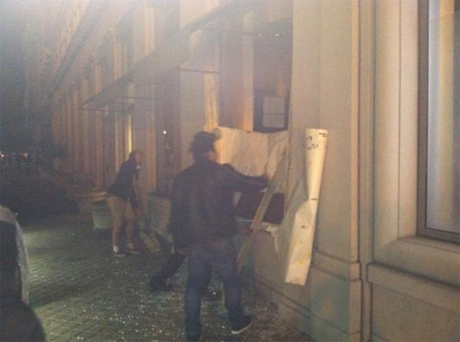
While 10,000+ occupiers were reported to peacefully protest all day yesterday, an unruly few have marred the nonviolence with acts of vandalism, early the following morning. Once again Adam Gabbatt from the Guardian reports:

Adam Gabbat for the Guardian: "10.33am GMT: Some of the Occupy protesters have been repairing the damage done by a small group of people who did employ violence." Posted about 30 minutes after another posting about the "third use of tear gas," presumably the haze in the photo? (Photo: Adam Gabbatt; source: Guardian.co.uk.)

Adam Gabbat for the Guardian: "10.33am GMT: Some of the Occupy protesters have been repairing the damage done by a small group of people who did employ violence." Posted about 30 minutes after another posting about the "third use of tear gas," presumably the haze in the photo? (Photo: Adam Gabbatt; source: Guardian.co.uk.)

I suppose the saying about spilt milk could be updated in regards to broken glass. Still, the intention to make amends—however futile—for those who don’t understand the reasoning behind a nonviolent strike, is heartening. Cynics may lump all of Oakland and her protestors together, but they act independently, and many, as we see above, act with good intentions.

Standard
Citizenship

ai weiwei: problem or placation

Kyle Chayka posted on Hyperallergic today:

According to Ai Weiwei’s lawyer Liu Xiaoyuan, Ai’s FAKE studio has been accused (and seemingly convicted) of evading over $5 million RMB ($770,000 USD) and is to pay $7 million RMB ($1 million USD) in fines.

…At Artists Speak Out, Philip Bishop quotes Hong Kong artist Kacey Wong with an unconfirmed story of the aftermath of Ai’s release, in which the artist isn’t allowed to speak with one of his consistent collaborators:

Wong said the news on Sunday in Hong Kong was that when Ai Weiwei went to a park in Beijing to talk to Chiao Chiao, one of the video artists Ai works with, Chinese security called and reminded Ai Weiwei that “that wasn’t part of the deal,” said Wong.

…It remains to be seen what consequences and impact Ai’s release will have in the Chinese art world, and if the action is the signal of a relaxation of the government’s recent “Big Chill” or simply another gambit in a balancing act to keep political dissidents silent while the international community remains too placated to openly intervene.

Standard
Citizenship

Human Rights Watch: Ai Weiwei Case Reflects Disregard for Rule of Law

Here’s a very good position on Ai Weiwei’s release from Human Rights Watch’s website, posted June 22, 2011, with the subtitle, “Unlawful, Unwarranted Detention, and Onerous Restrictions Loom.” It sums up my sentiments exactly.

The release of the Chinese artist and activist Ai Weiwei on June 22 is a relief for his family, friends and supporters, but leaves troubling unanswered questions about his arrest, detention and conditions of release, Human Rights Watch said today. In particular, Human Rights Watch is concerned about the political nature of his arrest, the conditions under which the police may have extracted a “confession” from him, and possible restrictions on freedoms he faces following his release….

“The Chinese government’s decision to arrest Ai Weiwei was political, and so is his release,” said Sophie Richardson, Asia advocacy director at Human Rights Watch. “But it is also an example of how international pressure works, since Beijing was paying a high cost to its reputation for his detention.”

…In the past six months, the Chinese government has disappeared and/or arbitrarily detained dozens of activists, writers, lawyers, and others. Upon their release, several have retreated into uncharacteristic silence and seclusion, leading to concerns that they have been threatened with further abuses if they speak out. At least 10 others who are less well-known than Ai have been victims of enforced disappearances since mid-February. They remain incommunicado, their whereabouts unknown, and thus are at high risk of torture in custody.

“International pressure apparently prodded the Chinese government to conclude that the cost/benefit ratio of continuing to detain Ai Weiwei wasn’t worth it,” Richardson said. “The international community should maintain that same pressure for the release of the many other innocent victims of the Chinese government’s current wave of repression.”

Or as the Daily Beast put it:

Released but not free

Speaking to The Daily Beast/Newsweek by phone, Ai said he has been restricted from traveling outside Beijing or giving substantive interviews to the press for “at least a year.”

Standard