Citizenship, Community

Shop here

Hope you’re excited as I about these organizations/businesses.

Cacao Anasa and artist April Banks’ Organic Fair Trade Chocolate Bars

Dagoba Chocolates. I’ve tried the dark chocolate bar — bliss slowly unraveling.

Global Exchange’s Fair Trade Online Store

Oxfam America’s Unwrapped. Gifts that make a difference for those in need around the world.

Or, instead of a gift card, try Kiva micro-lending gift certificates. Recipients lend to entrepreneurs around the world and can withdraw the funds upon repayment.

Of course shopping at eco-friendly or social justice oriented businesses is no substitute for activism, but it beats supporting corporate pet-projects (that donate only a small amount of proceeds to a good cause) or just increasing corporate profit margins.

Standard
Citizenship, Values

So You’re Planning an Art Auction: Do’s and Don’t’s

If you’re thinking about organizing an art auction, be aware of what makes an auction effective, and what is attractive to artist-donors. The Bay Area has a thriving arts scene, wonderful progressive culture and vibrant non-profit community, but with so many good causes to support, artists have to consider where their contributions will be most effective.

These are the criteria I use when I receive invitations to donate art:

Values: Is the cause worthy?
I want to help groups whose values match my own, especially those with under-served and under-funded constituencies. The need should be identifiable. Groups with a commitment to the the arts (and not just via “exposure” in your art auction) especially appeal to me.

Track record: Is the organization worthy?
I want to see evidence of an effective track record. Ideal groups make miracles on a shoestring, but are not so broke as to cultivate a culture of scarcity, crisis and turnover. Interest groups and collectives should demonstrate real capacity; initial enthusiasm to start a pet project is rarely convincing alone. Also, be transparent about your non-profit 501(c)3 status.

Art and Auction Experience: Will the auction be effective?
An art auction is only successful when the organizer sells the art. I look for groups with the ability to attract art-loving audiences and create bid-friendly environments. Having proven curators or installers on board tells me that (1) you’ve got the know-how to handle and install art, and (2) you are more likely to value my time and labor. Big red flags: You’ve never organized an art auction or installed art before. You don’t have a sense of what price range is reasonable at your event. Your publicity strategy involves hoping that my name on a flyer will be enough to attract an art-buying audience (wish it was, but it’s not… yet).

Exposure: To whom? For what? Under what conditions?
Most artists don’t just want any exposure. If you were an artist, what kind of exposure would you want: your work hung in a narrow hallway, bumped by drunk party-goers and sold for a low price? Or hung in a tasteful gallery populated by engaged viewers and interested bidders? I want useful exposure, such as sharing my work with collectors, curators and critics, to get positive responses about the work, under advantageous conditions — the best possible presentation, where the work is not undervalued.

Presentation: To complement or diminish my profile?
Publicity materials should be attractive and professional. If they are not, artists will not send them out to their own lists, and art buyers will not attend. Mail a stack of postcards to the artists well ahead of the event date. Ensure the venue will be appropriate for an art exhibit. Publicize the artists’ names on your press releases and web site. After all, artists are donors as much as anyone else.

—–

What to Do

• Use a lender form.
• Agree on the terms of the auction.
• If possible, insure the art in your possession.
• Help struggling artists offset shipping and/or framing costs.
• Invite the artist to the auction (sounds obvious, but you’d be surprised). Put them on the comp list if there is an admission fee.
• Hang the art properly. Don’t damage it.
• During and after the event, deal with the buyers. Do not expect the artists to sell their own work, or deliver the work to the collectors after you collect the funds.
• Pack unsold art properly. Don’t damage it.
• Return unsold art and send tax letters and checks promptly.
• If, in addition, you ask for artists’ time, be courteous.

—–

What Not to Do: A Case Study

I’ve learned the above lessons through good and bad experiences donating art. Here’s one story that taught me to donate with caution.

I was asked to show up three hours in advance of the auction to talk to the media — but the media were not expected to arrive until an hour before the auction. My two hour wait, it seems, was intended to allow the communications officer 10 minutes to go over his talking points with me. I was happy to be a mouthpiece for a worthy cause, but the long wait was a huge waste of time. In the end, I didn’t see one press person. My patience ran out 30 minutes before the auction. I slipped out because I was so annoyed that I wouldn’t be able to enjoy the auction, nor help others enjoy it.

My art sold, but it was delivered back to me — damaged. I spent months having the work re-framed and scheduling pick-up dates with the buyer.

Perhaps most egregiously, the organization was inconsistent about the logistics of the monetary transaction. The buyer paid the organization at the event, but I was told to ask him for a check. In my opinion, an organization should never put me (a donor) and the buyer (another donor) in the awkward position of trying to collect money from each other.

Not everything was awful: the volunteer curator was delightful and professional to work with. Cheap Pete’s replaced the frames free of charge. And I still believe that this particular organization fulfills a necessary role.

But I would think twice before entering any agreement that asked so much of donating artists, especially organizations with whom I have little to no relationship before and after the auction.

Standard
Activist Imagination, Citizenship

The Fall of the I-Hotel, Revisited

I went to the screening of Curtis Choy’s film, The Fall of the I-Hotel (2005, 58 minutes) at the Oakland Museum of California last night with a sense of obligation to my research for the Activist Imagination project. I left with reverance and lots of food for thought.

Some impressions:

• I sort of thought that by default, early APA graphics would borrow heavily from established visual languages of resistance (such as Chicano graphic arts or social realism). Surprisingly, the mural on the outside of the I-Hotel was very cartoonish. More Vaughn Bodé than Diego Rivera.

• The film also included a beat-infused poem by Al Robles. Which maybe means that Robles was at least equally influenced by San Francisco’s literary history than other essentially activist or APA forms. Which leads me to a new line of thinking: of course APA art can look or sound any way. Does this seem was more so in the old days than now (when everything seems so hybridized and postmodern)?

• Shots of the original Kearny Street Workshop storefront inspired me to think, If I could go back in time and check it out, one thing I’d want to know is what Cooper Black (the typeface of KSW’s original signage) conveyed in the 1970s. Today, it’s so retro, goofy and playful (and judging from the pop culture references on the Wikipedia entry for Cooper Black, “budget”), it’s hard to imagine what it signified in the context of the I-Hotel.

The struggle to save the I-Hotel could signify the birth of APA activism, but the gestation of a movement of this magnitude went far beyond this one building. The I-Hotel happened to be the right time and place (a pretty great congruence of ‘Asian’ and ‘Pacific’ in Asian and Pacific American, right?), following over a decade of displacement — those manongs were the last 50 of the 10,000 Fil-Ams displaced from Manilatown (as Al Robles explained) — and of course, the historical moment.

There wouldn’t have been an I-Hotel struggle without the post-1965 immigration wave and the 1960s youth movement, which in turn wouldn’t have emerged without the 1950s civil rights movement and the collapse of old-world-style colonialism around the world.

I think some people view activism today with a sense of futility, and the 1960s and 1970s seem like a golden era when change was possible. But we have to keep in mind how political change evolves over time.

In the 1990s, I thought the times were similar to the 1950s: obsessed with technology and consumerism, revolution seemed distant, if not impossible. I was wrong. The picture-perfect nuclear family was only middle-class white (male) America’s narrative. The 1950s marches and boycotts were certainly more consequential, but the 1990s were not without their acts of mass resistance in LA and Seattle. (So instead of, How do we create a revolution now, a better question would be, How do we continue and amplify the struggle for racial, gender, and class justice in addition to facing emergent issues — immigration status, the global “north-south” divide, environmental justice — with a united front? What does this mean for APA activists?)

• One last note about history… I know the impact of the 1965 immigration act is far-reaching, but had to be reminded that it made possible the birth of the APA movement. And working backwards: Yes, as I wrote in “The Stone Age,” the history of APA art is short — as so, the history of Asian Pacific America as we know it now. (Next year, Kearny Street Workshop celebrates its 35th anniversary — and to all of us immigrants and decendants of immigrants, let’s also celebrate the 43rd year anniversary of the Immigration and Nationality Act of 1965.)

The screening was followed by a panel with Emil deGuzman, Curtis Choy, Al Robles, and Dr. Estella Habal. I would have liked to ask them:

Why was art so important in this particular struggle? Clearly a screening on the 30th anniversary of the I-Hotel demonstrates the importance of media, and the organizers in the film evidenced rigorous organizing tactics. So why was it important to have murals and screenprints?

[ Judging by a response to a different question, the answer probably would be something like, “Self-expression is an act of defiance. We were asserting our oun human-ness in a time where we were being told that we didn’t count.” Having seen and sat on numerous panels where the “why does art matter” question was asked, invariably by people who already believe it matters, this answer’s fine. Still, I wouldn’t mind being surprised by some new insight here. ]

My second question would have been:

For future APA activists, what are key issues and how must our tactics change?

I can surmise on possible responses, but as usual, I’d rather leave the strategizing to the strategizers.

Watching The Fall of the I-Hotel was a contradictory experience for me. On one hand, the shots of the final evictions made the event more real — the brutality of the police department was terrifying, the spirit of resistance electrifying. On another hand, the historic footage matched my pre-exisiting “memory” of the event. Even though I was born in 1977, the same year as the evictions, I must have seen clips of the film or photographs from other sources. So the film is important and worth watching, but it also cannonizes this event… And I imagine that it has a similar effect for everyone else of my generation.

This brings up a host of issues for me as a visual artist: How do we tell what’s real? How we assimilate visual images into memory, and who do we tell them apart? How do we contend with the limits of representation while continuing to struggle to control our means of self-representation?

[There’s some really interesting film theory that relates the cinematic apparatus to our psyche… For more, check out the essays in The Dream of the Audience, catalogue for the Teresa Cha exhibition at the Berkeley Art Museum.]

So here are some photographic impressions. I snapped these from my seat in the theater.
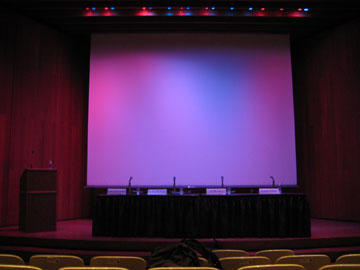
blank theater screen
Setting. My poor woman’s Hiroshi Sugimoto.

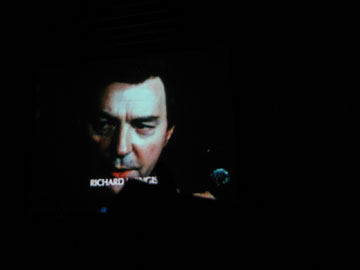
movie title

Richard Hongisto
Richard Hongisto, sheriff. He spent 5 days in jail for contempt for resisting eviction orders, and later reluctantly oversaw the evictions.

hotel signage

police action
While so much of the film was so distinctly 1970s — the cars, the activist’s facial hair and clothing styles — riot cops look relatively the same.

crowd shot

Standard
Citizenship

Large Donations to the Arts

In NYTimes.com’s “Big Gifts, Tax Breaks and a Debate on Charity,” Stephanie Strom writes about philanthrophic ins and outs in this era of Bush’s tax cuts for the wealthy.

Check out the NYTimes.com info-graphic. Attractive (Tufte readers: Yum!) and informative about the sad state, relatively, of large individual donations to the arts.

The super-wealthy have super-accountants, who take advantage of the numerous and legal means to make giving profitable. As explained by a professor, museum donors can actually make money by purchasing of significant art works and donating them incrementally over several years. Since the work appreciates as part of an esteemed museum collection, the tax write-offs increase year-to-year, eventually exceeding initial outlay.

While I am for incentives for charitable giving (for example, artists should be able to write off the sale price of works donated to non-profit orgs, not just the cost of materials used), Strom’s article correctly points out that it’s high time to re-evaluate the tax codes for charitable giving among the super rich.

Standard
Art & Development, Citizenship, Community

Generosity

[My vision for this blog is to spend more time on posts than I have right now: to mull over my ideas, and formulate opinions and theories. Of course, the reality is that there’s rarely enough time for blogging, not to mention, sleep.]

Optimism takes work.

Not everyone agrees with me that the SF Bay Area art community is populated by people who exercise professionalism, rigor and generosity. It can be difficult for me to back up my optimistic sentiments. But lately, my cup has been overflowing, and it’s due to the generosity of many artist-friends and artist-mentors.

I couldn’t have imagined that I’d be on the other side of the art auction “ask,” asking artists to donate their hard work and time to support more art- making and showing. But lately, as I’ve become more involved with Galleon Trade, I have been asking artists, and talking to everyone I can, for their support.

The response has been incredible! If there was ever a time to give thanks, it’s now. Everyone I’ve asked has responded positively. From fellow artists getting back on their feet after graduate school, to gallerists who can help get the word out to collectors (without whom an auction could not be successful), to a community-minded artist that I’m assisting, I’m really impressed and thankful for the generosity I’ve experienced.

Almost 40 works by 33 artists have been donated to support the grassroots international arts exchange. There are multiple, stunning works on paper by Megan Wilson, a really beautiful drawing by Aaron Noble, a humorous and optically-strange print by Mario Ybarra Jr. (you have to see it in person), beautiful and mysterious photographs by Gina Osterloh, a curious object by Reanne Estrada, and a striking ceramic work by Erik Scollon. At the center of it all is Jenifer Wofford, who initiated the project, and has been organizing it full-time, with little compensation, for the past few weeks. I feel extremely lucky and thankful to be an artist who benefits from the hard work, generosity and commitment of so many individuals.

See the art for yourself. And if you’re feeling generous, please show your support by donating online via Paypal.

Standard
Citizenship

A brilliant way to fund CA state arts again

Not a new tax, but a CA state Assembly bill to earmark 20% of taxes on art sales to go towards art. Sounds so simple and smart you wonder how it ever got to the Assembly… Act now to help make it into law. Or read it yourself.

Friends & Colleagues:

I urge you all to ACT TODAY! and spread the message widely:

A bill is currently making its way through the Legislature, that would create a stable funding stream for state support of the arts and programs to guarantee access for all. The bill, AB 1365, has already made it through two committees, and with strategic support, stands a real chance of becoming law.
Four years ago, the Legislature slashed support for the arts by 97%, eliminating programs that opened doors to the arts for people across the state. Today, California spends less than any other state on support for the arts–just six cents per person, compared to the national average of one dollar per capita.

AB 1365 would change that. The bill proposes to shift 20% of the sales tax collected on works of art to the California Arts Council. This isn’t a new tax but merely a designation for the spending of dollars the state is already collecting.

The initial analysis by the Board of Equalization (BOE) estimates that the 4.75% rate of sales and use tax on works of art amounts to $166 million per year. AB 1365 would transfer 20% of this amount, or $33.2 million from the state’s General Fund to the California Arts Council. Further, the BOE writes, “This bill would not be problematic to administer,” with the first transfer of funds occurring 6 months following the effective date of the bill.

The bill was authored by Assemblywoman Betty Karnette of Long Beach and is currently pending on the Suspense calendar in the Assembly Appropriations Committee (chaired by SF Assemblyman Mark Leno). The Suspense calendar will be taken up early next week . Assemblyman Leno (a great arts supporter) and Speaker Nunez of Los Angeles will be critical to moving the bill off Suspense.

If the bill moves off Suspense it then goes to a vote on the assembly floor prior to June 8th. At that time we expect to push for statewide communications to Assembly members through meetings, letters, and emails. If we can get the bill through the Assembly then it will move to the Senate.

What we need TODAY is for all of us to contact Mark Leno and his office, expressing your support for the bill and urging him, as the Committee Chair, to move the bill forward.

Calling Mr. Leno’s’s office in Sacramento to register your support is a good idea. The number is: Phone (916) 319-2013.

Emailing works too. Mr. Leno’s email address is: mailto:assemblymember.leno@assembly.ca.gov

Faxing Mr. Leno a letter, is best of all, since he can literally carry these letters with him into the chamber. Fax number: (916) 319-2113 .

Sample language for your email or faxed letter is posted below.

SAMPLE LETTER OR EMAIL

June 1, 2007

The Honorable Mark Leno
Member of the California State Legislature
State Capitol Building
Sacramento, CA 95814 Location: Assembly Appropriations Committee

Re: Assembly Bill 1365:
California Arts Council Funding
Position: SUPPORT

Dear Assembly Member Leno:

I am writing to thank you for your long support of the arts in this state and to urge you, as Chair of the Appropriations Committee, to move AB 1365 off the Suspense calendar, and I respectfully urge you to support this bill in every way possible.

As you know, passage of AB 1365 would require that 20% of state sales and use tax revenues derived from the sales of art dealers, art auctioneers, and certain other business entities be deposited in the State Treasury for allocation to the California Art Council.

The California Board of Equalization (BOE) estimates that the 4.75% rate of sales and use tax on works of art amounts to $166 million per year. AB 1365 would transfer 20% of this amount, or $32 million from the state’s General Fund to the California Arts Council. Further, the BOE writes, “This bill would not be problematic to administer,” with the first transfer of funds occurring 6 months following the effective date of the bill.

This is not a new tax; it is merely a designation for the spending of dollars the state is already collecting.

California is now in its fourth year of severe spending cuts to programs that used to help ensure access to the arts to all the people of our state. Indeed, California continues spend mere pennies per person on access to the arts, while the national median is one dollar.

AB 1365 would provide a stable funding stream to help ensure ALL the people of California have access to the rich cultural resources of our state. The arts are critical to fostering creativity, giving voice to diverse communities, building tolerance and empathy, attracting tourists, and enriching the imaginations and lives of all Californians.

The arts are vital to our culture of innovation we are so very proud of as Californians. With AB 1365 supporting new, sustained funding for the California Arts Council and its programs, the arts can continue to be a significant contributor to California’s economic recovery through tourism, jobs, social services and educational outreach. AB 1365 proposes a sound investment for California.

Thank you for your faithful commitment to a better, more equitable California.

Sincerely,

At last, adequate support for the arts – at almost one dollar per person, the national median – might just be within reach, helping us ensure that in California we can guarantee — Art for All! Not for Some!
ACT NOW!

Standard
Citizenship

The Revolution Will Not Be Funded

I’m curious about “The Revolution Will Not Be Funded: Beyond the Non-Profit Industrial Complex,” a new book by INCITE! Women of Color Against Violence (Boston: South End Press). Though I happily work with non-profits, I’m skeptical that this structure can result in widespread social change.

The good thing about non-profits is that everyone should have the satisfaction of fighting the good fight in their work. Dedicated, brilliant people work in non-profits, and young people get opportunities for leadership. But it’s unsustainable, driven by grant cycles and funding trends. Non-profit work doesn’t always provide adequate training, and certainly doesn’t offer competitive compensation!

I realize how non-profits can be manipulated to ultimately reinforce the capitalist status quo, but still, the book title makes me cringe a little. It seems to minimize the much more sinister military- and prison- industrial complexes, whose human costs are very real.

One chapter, “Non-Profits and the Autonomous Grassroots,” is written by Eric Tang, one of the smartest revolutionaries I’ve met. I met him when I lead a mural project at CAAAV: Organizing Asian Communities in the Bronx years ago. It’s probably worth the cost of the book just for Tang’s practical, informed analysis.

Standard
Citizenship, Research, Values

Inspiration: Philip Zimbardo & The Heroic Imagination

In contrast with the “hostile imagination,” in which warring countries dehumanize their enemies, Philip Zimbardo promotes the “heroic imagination”–and I love this idea.

Have you wondered if your fellow citizens would come to a stranger’s aid if needed? Have you ever witnessed a chance to do the right thing, and seen people’s reluctance to get involved? I’m tired of seeing bystanders simply stand by — from kids on a bus mutely hoping someone else will tell the bus driver he took a wrong turn, to people gawking at others obviously in need of assistance.

How can we foster the heroic imagination? In “The Banality of Heroism,” from the Fall 2006/Winter 2007 issue of Greater Good, Philip Zimbardo and Zeno Franco suggest:
1. Develop our “discontinuity detector.”
2. Don’t let a fear of interpersonal conflicts get in the way of standing up for your principles.
3. Think beyond the present.
4. Resist inaction.
5. Don’t be afraid to go left when everyone else goes right.

Zimbardo’s ideas are from his new book, The Lucifer Effect: Understanding How Good People Turn Evil. Zimbardo is the man behind the Stanford Prison Experiment, which demonstrated how quickly people abused their power over others. The subjects tortured and humiliated ‘prisoners,’ in shockingly similar ways to the events at Abu Gharib. What Zimbardo emphasizes, however, is that “there are no bad apples, just bad barrels.” That is, context is key–Zimbardo takes a “public health” approach (concerned with conditions), rather than a medical one (concerned with pathology). What were the conditions that made it possible for Abu Gharib to happen, for abuse in prisons and covert detention facilities around the world to continue?

I think the steps towards developing the heroic imagination sounds like cultivating critical thinking, courage and integrity. These are key ingredients, of course, towards becoming better citizens and resisting all forms of injustice. (How is it that “patriots,” in the U.S., often refers to people who support their government without question? Can’t we be active, critical citizens and patriots?) It’s significant for me to see this clear connection between everyday attitudes and an approach to larger, more complex issues.

If we cultivate the heroic imagination, if we maintain our integrity and courage in this age of irony and pessimism, if we did what we really knew was right—What would be possible?

Standard