Meta-Practice

New research on equality in the arts

Yesterday, the Strategic National Arts Alliance Projeect (SNAAP), a consortium of educational institutions, released its latest report, “An Uneven Canvas: Inequalities in Artistic Training and Careers” (PDF). Long-standing issues of racial and gender parity are elucidated in this survey compiling data from over 65,000 arts graduates. I noted some interesting points:

Female alumni are less likely than male alumni to ever work as artists and to do so currently.

(page 15)

(As JW put it, female artists continuing to work as artists is sometimes a matter of a war of attrition.)

Across all racial/ethnic groups, Black graduates and Hispanic graduates are the least likely to ever work as artists—with 76% of both groups ever working in this capacity.

(page 15)

Black and Hispanic alumni are much more likely to cite both lack of access to networks and debt (including student loan debt) as barriers to artistic careers, compared to White respondents.

(page 16)

SNAAP reveals sharp disparities in earnings by gender. Among alumni currently spending the majority of their work time in an arts-related job, men out-earn women. For example, among undergraduate-level respondents who currently work primarily within the arts, 56% of men earned more than $50,000 in the past year—compared to 36% of women.

(page 17)

The Question of Who Qualifies as “Artists” in the SNAAP Study

SNAAP uses the labels “art” and “artist” to refer to a broad spectrum of practicioners, including performers and creative writers. They also include workers in fields that often hire salaried employees, such as in architecture, design, film, illustration and animation—which I would consider creative industries (see also Ben Davis’ recently published 9.5 Theses on Art and Class, 2013).

I strongly believe that the inclusion of workers in creative industries skew the data—a criticism I’ve voiced about past reports. “An Uneven Canvas” seems to make a more conscious effort to acknowledge this:

Differences in the artistic fields … partially account for some disparities between groups.

(page 19)

Gender Disparity

SNAAP does a great job investigating general trends of gender-based income disparity:

the income gap between male and female arts alumni persists regardless of how long ago they graduated from their institutions

(page 21)
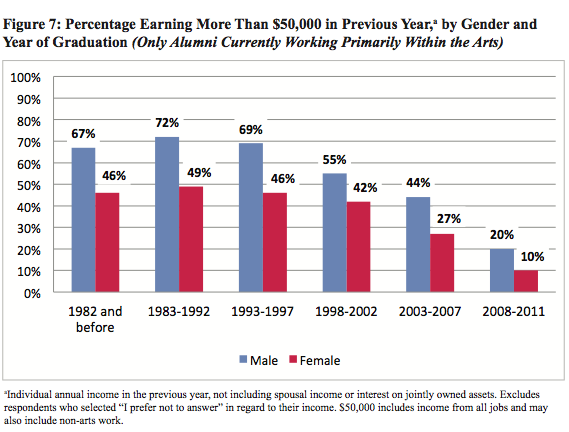
SNAAP's "An Uneven Canvas," Figure 7: Percentage Earning More than $50,000 in the Previous Year by Gender and Year of Graduation (Only Alumni Currently Working Primarily in the Arts). Those who graduated in the 80s and 90s (who are likely older), clearly make more than recent grads with less post-graduate work experience. However, the key point of this bar chart is that income disparity by gender in the arts is an ongoing trend over the past 30 years. The pay difference is highest among those who earn more; for recent grads, the 10% more of men who earned $50k is also 100% more of women who earned $50k.

It’s easy to misinterpret this bar chart as showing the reduction of income, and gender-based pay disparity, over time. What it actually shows is gender-based pay disparity in 2011 according to graduation year ranges. Those who graduated in the 80s and 90s (who are likely older and further along towards maximizing their earning potential) see the highest gender-based pay disparity. For the most recent grads, the there is relatively less pay disparity in percentage points, but, in this cohort, you could also say that the number of men who earned $50k is 100% more than women. 

One salient feature of this graph is that male artistic workers out-earn females within every cohort group. …income differences are not simply the result of men’s and women’s different work commitments, but rather reflect persistent patterns of discrimination. Furthermore, these data provide compelling evidence that gender inequalities continue to exist for the newest graduates and are not simply a relic of an older time.

(page 24)

The Data We Get vs. the Data I Want to See:
Free the Fine Artist Subset

SNAAP’s wide definition of “artist” may be useful for including the majors offered at its member institutions, but its analysis can only be applied to fine artists with remote and questionable extrapolations.

The fine arts is worthwhile of analysis as its own data subset. The fine arts are exceptional. In other words, the economics of fine arts operates does not follow any logic found in other fields (see Hans Abbing’s Why Are Artists Poor? The Exceptional Economy of the Arts, 2004).

Most pressingly, the fine arts are well-known for its huge disparities. The vast majority of artists work non-art day jobs to support their art practices, while only a tiny fraction of artists garner dramatically higher income levels from their art sales. Thanks to the media’s obsession with auction sales, gender-based income disparity is well-documented for the highest earners, but this data ignores most working artists.

SNAAP’s subset of data relating specifically to contemporary fine artists is robust, according to the interactive SNAAP Shot 2012, with about 21,000 respondents who majored in Studio/Fine Arts. This is no small data set. SNAAP should make this data set freely available, like many contemporary federal- and city-level governments, or the UK Guardian, for statisticians and information graphic designers to interpret and share.

I would love to see this data set analyzed to address questions such as:

  • What can be learned about the lives and working conditions of contemporary fine artists?
  • What percentage of fine artists’ primary means of income is from their art?
  • For fine artists whose primary means of income is not based on their art, how much of their income is?
  • How much gender-based income disparity do fine artists experience?
  • How does this change over the graduation-year-separated cohorts?
  • What are the breakdowns of racial inequality in the fine arts—how many artists of different races persist into the field of fine arts, over what period of time, and to what degree are they able to transition their art-making into a viable profession?
  • In addition to comparing people of color and women to the responses of White men, I’d like to see intersectionality integrated into this report—what can we learn about the experiences of women of color?
 

Standard
Meta-Practice

Straight talk about why you shouldn’t apply

Things to think about, artists. The Roswell AIR program application page includes this note:

A word of caution:

Artists considering applying to the RAiR Program should think carefully about what is actually involved in a year-long residency.

Do not apply if:


1) You will have a number of exhibitions opening during the period of your residency.  Roswell is a long way from most places. Transportation to and from Roswell can be costly and time consuming.  Organizing exhibitions and shipping work can be difficult and expensive from Roswell.  Extended absences from the studio breaks up the creative process and undermines the rationale for the residency.

2) You find the idea of the residency a flattering notion.  The purpose of the residency is to provide time to immerse yourself in the creative process and not just to add another line to your resume.  Artists should actually need studio time to focus on their work.  Otherwise you might be supplanting an artist just as deserving, who could use the residency year productively.

3) Your spouse or partner is not committed to the residency.  The residency is located on the outskirts of a town of 50,000 people.  There are few  employment opportunities.  A year can be a long time in some career areas.  While the Roswell area has some decent schools, no special or ‘outstanding’ private schooling is available in this part of rural New Mexico. In addition there can be considerable challenges returning to one’s pre-residency life.

4) You have unusual heath issues or heavy debt.  Our goal is to support the artists’ creative process over a period of time.  We can not, however, solve all of the artists’ life problems.

5) You are uncomfortable living alone or often find yourself at odds with your neighbors or colleagues.  The residency is small.  As few as five other artists might share the residency with you at one time.  For some artists, but not all, this is an ideal situation.

6) If you have no means transportation.  While the residency itself is essentially self contained, the facility is three miles from the nearest retailers.  In the past some residents have managed with only a bicycle but keep in mind that this is the American West and conditions vary considerably.  A drivers license and an automobile are generally considered essential to everyday living.  Additionally, numerous destinations of interest can only be accessed by car.

7) You can not live without your dog for a whole year.

For many artists, recognizing the difference between tackling bigger challenges (good) and biting off more than you (and possibly your spouse or dog) can chew (bad) is an ongoing skill, but an important one for the sake of the community of AIRs and residency programs. Residencies should be a balance of productive activity and restoration; artists should be able to contend with the site, schedule, isolation, and community structure, and tap into the self-discipline it takes to stay productive.

I’ve seen cases where an artist accepted overlapping opportunities, and people were rightly scandalized that a beautiful studio sat empty and mostly unused while the artist took the stipend and hightailed it to the opposite coast. An ethical action is declining.

As much as artists want to take advantage of opportunities as they come our way, we should also sympathize with our fellows who are runners-up. To restate in RAiR’s statement:

you might be supplanting an artist just as deserving, who could use the residency year productively.

Standard
Meta-Practice

Site-responsive proposal factors

Not all calls for site-specific projects are created equally.

Competitions reward ambition, but ambitious projects aren’t always adequately supported. I am guilty of having breathed a sigh of relief upon hearing that I didn’t receive an award for an overly ambitious or under-funded opportunity. Sometimes things change. Ideas become less attractive, or other commitments become more engaging.

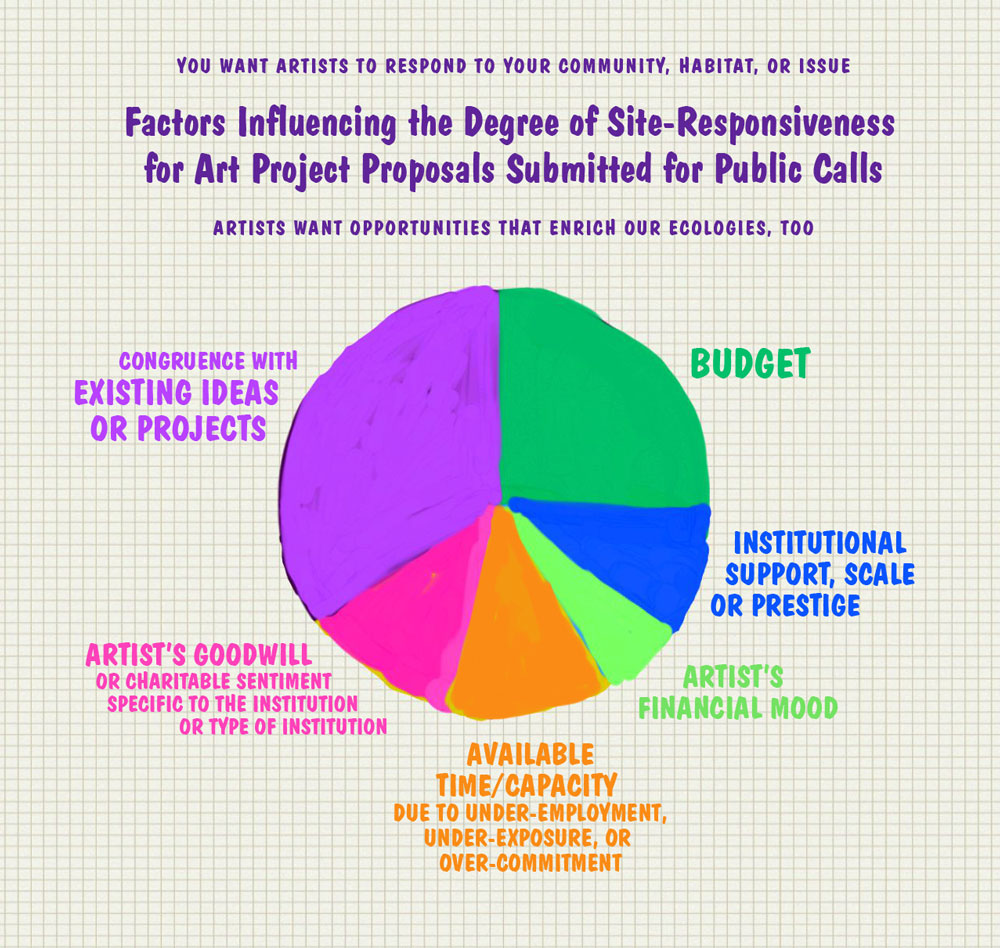
Site-specific calls are especially labor-intensive, so perhaps savvy artists embrace degrees of site-responsiveness. These are some factors that influence to what degree I push speculative projects. Enjoy.

Site-responsive proposal factors

Site-responsive proposal factors

Standard
Citizenship, Meta-Practice

art sales scams

Amazingly, internet scammers have found a way to become even lower low-lifes, now targeting artists with sales. Just received this email:

Hi,

I’m Betty Hammond from California. I was going through your works and my eyes caught this particular piece,I want to purchase it as I am moving to a new apartment next month. Kindly let me know if you still have the piece available and also let me know it’s final price and more information about it. I will be waiting to read from you.

Regards,

Betty.

Luckily, when I googled “Betty Hammond California,” this post by this fellow artist and anti-scam blogger showed up, exposing the scam. Basically, they get your mailing address and send a check in an amount way over the sale price, then ask you to forward the balance to a fictitious shipper. When the check turns out to be fraudulent, your money and possibly your art are gone.

The sad part about this is that authentic collectors may contact artists via email, and they may have different language abilities, making screening out fraudsters trickier. A commenter at the above blog post recommended only accepting payments via Paypal as one method for avoiding this scam.

Standard
Meta-Practice

Saltz, NYC galleries, and spaces for dialogue

Jerry Saltz makes some interesting observations in “Saltz on the Death of the Gallery Show” in NY Mag (3/31/13).

His main point is that

A great thing about galleries …  is that they’re social spaces….  places where one can commune with the group mind.

But due art fairs, mega-collectors, and skyrocketing rents in Chelsea, galleries are

playing a diminished role in the life of art.

The problem is

When so much art is sold online or at art fairs, it’s great for the lucky artists who make money, but it leaves out everyone else who isn’t already a brand. This art exists only as commerce, not as conversation or discourse.

….Many artists are now in “abundant production,” seducing collectors on the prowl for stuff to fill their oversize atriums.

Baffinglingly, Saltz goes on to make these statements about NYC-centrism:

Art doesn’t have to be shown in New York to be validated. That requirement is long gone. Fine. But… a good Los Angeles dealer chided me for not going to art fairs, not seeing art in L.A. and London, and not keeping track of the activity online. He said I “risked being out of touch with the art world,” and he was right….

I brooded for months over this. Then … I started thinking about “the art world.” Something clicked and brightened my mood. There is no “the” art world anymore. There have always been many art worlds, overlapping, ebbing around and through one another. 

This last realization seems a bit belated. Artists outside of NYC have had to cultivate their own art worlds for ages, not because of the recent overabundance of fairs, but because of long-standing NYC-centrism. NYC is home to major publications and art commerce, yet artists outside of NYC have found ways to persist—regardless of the facts that NYC critics focus on NYC shows (ahem!), and art fairs diminish Chelsea galleries’ audiences.

And, paradoxically, it seems as if Saltz is using the de-centralization of the art world to justify his own NYC-centrism. No one critic could see all the art in these different art worlds, but could certainly try harder to get out of his own city—and borough—more often.

He ends on an upbeat note:

When I go to galleries, I now mainly see artists and a handful of committed diligent critics, collectors, curators, and the like. In this quiet environment, it may be possible for us to take back the conversation. Or at least have conversations. While the ultrarich will do their deals from 40,000 feet, we who are down at ground level will be engaging with the actual art—maybe not in Chelsea, where the rents are getting too high, but somewhere. That’s fine with me.

That Saltz has been able to seek out dialogues in commercial galleries seems like a fluke, in my book. Most Chelsea galleries feel too-cool-for-school to strike up conversations.

Those spaces where dialogues happen, where art by artists’ artists is shown, are non-profit, alternative, and artist-run spaces. NYC has its share, but nothing like the vibrancy of SF Bay Area’s community, in my opinion.

I also sense that many NYC alternative spaces show a higher proportion of artists with commercial gallery representation (artists further along in the “emerging” spectrum) than those without. It would be fantastic to take a survey comparing the proportion of represented artists shown at Artist’s Space, White Columns, Sculpture Center, Socrates Sculpture Park, Smack Mellon, Momenta Art, Art in General, Apex Art and Flux Factory against those at Southern Exposure, Intersection for the Arts, The Luggage Store, The Lab, SF Camerawork, Pro Arts, and San Jose ICA. It would beg the question of what alternative art organizations are for, who they serve, what kind of dialogues they  create, and with whom.

What if more commercial galleries fold in NYC, but an equal number of new non-profit and alternative spaces sprung up in their wake? What if they focused on truly emerging artists—not trying to compete with commercial spaces, but were real, imaginative, risk-taking alternatives? What if big-time critics visited and wrote about alternative spaces more often, not just when they mount shows by established artists or shut their doors? What if, essentially, NYC can learn a thing or two from other cities like San Francisco?

Standard
Meta-Practice

Here’s to Doing Things the Wong Way

There’s a printmaking technique named after me.

It’s called, “The Wong Way.” The pun is intentional.

In undergrad, I was an eager student of woodcut printmaking, but not of color registration. Ken Rignall demonstrated a system involving metal buttons at the California College of the Arts, but he warned against leaving the buttons in the press. That would destroy expensive blankets and thus incur the wrath of fellow printmakers. To this day, I’ve never left the buttons in the press, because I’ve been too afraid to use them.

Either due to early twenties overconfidence or mechanic’s daughter ingenuity, I thought, if all you’re trying to do is line the block up with the paper consistently, why can’t you just jam them both into a corner? I made a 90º angle out of wood and tried it out on a block with a margin carved out. If your block or paper is less than square, you pick an edge to line them up with, and, Presto!

It wasn’t the most precise, but it was the most idiot-proof. (If there is an essence to the Wong Way, that might be it.)

Ken caught wind of this method and admired it. He coined the name and taught the technique in subsequent semesters. The pun in the name suggests that this is not how you should do it, but this is how you can do it.

I finally bought some sewing reference books—six years after buying my sewing machine, and experimenting with many combinations of needles, threads, and fabrics, not to mention patterns of my own devising. I’d been rambling between states of unconscious and conscious incompetence—sometimes completely unaware of incorrect thread tension, sometimes painfully aware that the bias in the fabric was exacting a toll for my poor cutting.

The reference books point out the sheer volume of fundamentals I’ve skipped over.

You might be thinking that I’m kicking myself for putting the wagon before the horse, but actually, I’m grateful and elated to learn these fundamentals now. I know WHY I need to acquire this knowledge, and am able to ground it in prior experience. I appreciate it so much more.

My Dad taught me to problem solve fearlessly. He’d take broken things—from toys to toaster ovens—down to his garage tool bench, rattle around in his toolboxes, crack the thing open, and have a look-see. Sometimes he repaired it, sometimes he didn’t, but he always gave it a try. Dad went to automotive school, but he learned a lot by doing. No one taught him how to re-roof our house or make a kid’s play structure from an old barrel and a car rotor. He just figured it out. He showed me that I too could figure things out, and that there’s no reason to shy away from trying.

Here’s to jumping in with both feet. To the confident leap into the unknown, that the things around us are not too complicated, that fear can be rather useless, and that curiosity is intertwined with survival.

Standard
Meta-Practice

the dreaminess of unrestricted grants

Unrestricted grants sound dreamy. St. Louis, MO has just announce that its Regional Arts Commission will disperse ten unrestricted grants of $20,000 each to individual artists.

The grants will come with no strings attached, said Jill McGuire, executive director. A visual artist need not stage an exhibit at the end of the fellowship….

The grants come in response to the Artists Count study, conducted last year. The study’s chief finding is that about one-third of artists work multiple jobs. It also found 46 percent earn less than $25,000 annually.

“Artists say their No. 1 need is time,” McGuire said. “For them, time is money. So by giving them money, we give them the freedom to maybe work one less job and have that time to create.”

This is a big deal. As I’ve found in my own experience, it’s much easier to get funding for art education projects than for art:

Not many public arts agencies give money directly to artists. After conservatives threatened to abolish the National Endowment for the Arts in the 1980s, the NEA and many state and local arts commissions focused on funding programs that reached the underserved — classical concerts in inner-city parks, dance workshops for rural students, writing programs for prisoners.

Recently, however, some arts commissions have started to offer artist fellowships.

Not surprisingly, arts commissions in Minnesota, Chicago, Portland and Seattle all offer large grants.

But so does Cleveland — 20 grants of $20,000 annually….

“When we started there weren’t a lot of models for funding individual artists,” said Cleveland program manager Susan dePasquale.

“After the culture wars at the National Endowment of the Arts, a lot of those grants stopped, but slowly they’ve been picking up. Most of those grants are smaller. But after looking at other programs and hearing directly from the artists themselves, we settled on a very generous and forward-thinking program that really is an investment in our artists. We have a very vibrant, creative community here, and we wanted to support that.”

What would I do with an unrestricted grant? The same thing that I’d hope to do with my applications to residency and project opportunities—make more ambitious art and develop exhibitions—only in my own city, my own studio, and with all my tools at hand. I could get a bigger studio, have more space for bigger projects and  comfortable studio visits, and spend more focused time in my local world-class exhibitions and research institutions. I could let ideas marinate a little more, to block off time for advancing my skills with the reference books I’ve accumulated and the classes that I haven’t yet made time for. It would be a residency of my own making: time and space to focus.

Standard
Meta-Practice, Values

How to be everywhere at once, or not

Inspired by a walk around Chelsea and CAA, here are a few thoughts about how artists of a certain level are able to sustain multiple galleries and fairs…

Variations and editions

At Doug Aitken’s show at 303 Gallery, the list of works stated that all artworks, except for the site-specific installation, were multiples. Text works that could have been fabricated by sign shops were editions of four, plus two artist’s proofs. Other text works that might involve more chance, such as a piece with broken mirrors and another foam piece that was partly carved by hand, were variations, plus artist’s proofs.

The way Aiken and many contemporary other artists edition sculptures seems  pragmatic—there is so much research and development that goes into each work, and so many venues for international artists, that being able to exhibit and sell the same work is advantageous. Yet, these editioned sculptures would never be displayed next to each other, or heavens forbid, in the same fair at different booths—like the earliest fine art print editions, the whole concept of an edition is to create scarcity and value. I’m curious if collectors feel like they’re buying originals, are concerned with the fidelity to exhibition copies, or are simply less concerned with purchasing copies, especially of industrially-fabricated works.

(The show itself was dazzling in the video as well as in person, but not especially affective. I believe a critic for the New Yorker found the show to be resemble window displays, and I got the same feeling. There were intimations of destruction, but no danger. In the large hole drilled out of the concrete gallery floor, the milky water was lit from beneath, as if a hot tub. One text work was set behind a faux wall with a cartoonish circular hole cut away; the drywall was filled with pebbly rubble painted white as if on a theatrical set made of Plasticine.)

A few rules make disparate drawings a series

Of particular interest at Mark Dion at Tanya Bonokdar:

1. The vitrines with marine encrustations that were on view in International Orange in San Francisco are now highly salable objects in a Chelsea gallery. (Also, I believe  those were clearly indicated as collaborations in San Francisco, a fact not obvious in NYC.) The settings are so different I found it humorously ironic. Fort Point was bitterly cold, practically in the Pacific Ocean than abutting it. The vitrines were lit in a theatrically dim light, which minimized Fort Point’s peeling walls. At Bonokdar, the pristine gallery housed a number of vitrines and installations, all of which were perfectly installed and maintained. The change of context from the edge of the continent to the center of a commercial art world demonstrates a fluidity that contrasts greatly with so many artists I know who exhibit in odd places in the Bay Area.

2. Dion makes preliminary sketches for his various public projects and commissions—from the UK to San Francisco’s Balboa Park—in red and blue colored pencil. Who knows why, but the effect is that a room with dozens of such drawings hung salon-style looks fantastic. A simple set of rules increases the volume of exhibition-ready work.

Conflicts of Interest Vs. Conflicts of Self-Interest

At the College Art Association conference a few weeks ago, I attended a session called “The Future of Art Magazines” (see GalleristNY.com’s write-up). A comment that has stuck with me is that people play so many roles in the art strata, that it can pose dilemmas to critics. For example, critics who are also curators may worry that they can’t negatively review certain institutions that they might work with, or risk offending artists that they might curate or be asked to curate. I wondered if this was an actual conflict of interest, when the potential of a partnership is merely a potential. Perhaps it would better be phrased as a conflict of self-interest?

Of course people do this all the time. Yet the frequency of self-interested behavior doesn’t make it right—call it Darwinian, hustlin’, or playing the game, it’s also selfish, opportunistic, and small.

To be big, one must imagine that other people are big, too. That artists or administrators won’t be offended if you write a negative review with honesty and integrity. Whether others are in a position of power or not relative to yourself, people should be able to handle direct, open communication with judiciousness and discretion. In my recent correspondence with commenters on Temporary Art Review, I have been trying to encourage artists to give feedback directly to residency administrators. It seems a reasonable thing to do, except for a fear of retaliation that is not a part of the art world that I would like to participate in.

Standard