Impressions, Travelogue

New Haven: Art, architecture, clouds, and nativity scenes

New Haven, I learned, is very sleepy during Yale’s winter break. The special exhibitions at Yale University Art Gallery and the Yale Center for British Art are in changeover. Artspace was not open during their normal scheduled hours of the current show. Though the timing of my visit was not ideal, I enjoyed looking for and finding art in New Haven today.

Yale University Art Gallery
First—Louis Kahn’s building knocked my socks off. The exterior was cold and blocky, but the interior featured a beautiful lobby, interesting textures, and warm touches, like the uneven edges on the window scrims, and a cool-while-totally-sensible triangular stairwell. Big points for the handsome building signage in projected light.

Collections worthy of a prestigious Ivy League, like an Assyrian stone wall from the 5th c. BC. C’mon! (It’s the first image in this Flash-based “gallery tour.”)

Lots of gems in European and American art. I studied debossed gold-leaf patterns at length in some stunning pre-Renaissance icons. Duchamp’s Tu M’. A good Nam June Paik closed circuit television installation showing a live video of artificial flowers mounted to the top of the tube. Lucas Samaras’ Chicken Wire Box #4 (1972) and Untitled (1963), a panel covered in concentric circles of different colored yarn, then pinned with hundreds of straight pins (kind of like this). Happy and perception-stretching.

I also very much enjoyed mentions of local industry. The decorative art and design—early modernist nickel-silver tea set, pressed lead glass bowls—manufactured in little Massachusetts towns like Dedham and North Attleboro. They assert a history about designers and craftsmen that contrasts, in my mind, the must-have (in 19th c. wealthy homes and 21st c. general art museums) portraits of wealthy patrons.

joseph smith, tea caddy, 1767, source yale university art gallery

Joseph Smith, Tea caddy, 1767. Source: Yale University Art Gallery website

Joseph Smith’s Tea Caddy (1767) kills me. It looked totally out of place in the vitrine with mirror-polished silver vases. It manages to be endearing and craptastic. The construction of the clay seems unconcerned with formal considerations, but the calligraphic curliques suggest a desire to make it beautiful and refined. It’s surprisingly complex.

I also found the Asian and African art floor inspiring—Chinese watercolors and ceramics spurred me to think about patterns and line and the tropes of genre paintings; a ceremonial mask surrounded by oversized photographs of similar masks in use in Africa seemed like a sensitive approach to exhibiting these objects in contexts so different than their originally intended ones.

Yale Center for British Art
The architecture here is opposite what you’d think—instead of heavy, dark wood paneling with ornate wainscoting is warm, orange-toned wood interrupted with concrete. The galleries were lined with unbleached canvas-covered walls and filled with light. Except for an atrium (pictured on the museum home page), which I found suffocatingly prison-yard-esque, the museum was open and welcoming. This fresh approach seemed reflected in the collections curation. There were what seemed like hundreds of British paintings on view, and I never thought I’d hold up to make it all the way through, but surprising choices in the selections kept my morale up.

John Constable’s Cloud studies are a special treat that alone would make a visit worthwhile. Even for non-painters. (Otherwise you can get the book.)

I also liked the house portraits—they are more like oil-painted illustrated 3-D maps (remember these cheesy illustrated maps?) of English estates. The perspective is often forced and awkward. They’re interesting as cultural documents. (When you have a mansion and gardens upon gardens, do you really need a painting of it too? Do the servants carrying loaded baskets upon their heads evoke the same sense of satisfaction as the parasol-wielding leisure-seekers?) They are, essentially, heavily narrated architectural and informational graphics, and their quirks appeal.

Knights of Columbus Museum

The Knights of Columbus are a Catholic service organization, and they have a huge “museum” (though it seemed more like an office building with some gallery spaces) on the edge of downtown New Haven. I visited and found their exhibition on a recent mosaic project in DC to be informative. Photographs and texts guide viewers step-by-step through the old-world tradition completed with modern industrial tools. From drawing, making the mosaic in sections, scaffolding, to installation, it was great for nerding out on technical side of art making.

There’s also the State Room, full of memorabilia of different honorary gifts that were given to various Knights. The KoC-logo has been emblazoned on cowboy boots, judge’s gavels, and even a Filipino barong. It reminded me of promotional item showrooms, which are fun to visit as an artist.

The real reason I went to the KoC Museum, though, was for the Christmas in Asia exhibition of crèches, or nativity scenes. They were so brilliant that I am still disappointed that photography was not permitted; after all, I didn’t see any individual artists credited. While a few works were attributed to specific woodcarving workshops in China, the overwhelming majority was to “Unknown Artist”—presumably, some street vendor who sold the item in a brief transaction where Western currencies were advantageous and an exhibition loan form was absent. But whatever.

The crèches generally fell into two groups. In the first category, it seemed as if Asian craftsmen did a competent job of simulating Western realism, as well as tropes about the nativity scene and the participant’s appearances. This is interesting as an outcome of globalization. The objects were made for Western audiences, or for a local audience that prefers their nativity scenes traditional. The second category, however, spoke to my taste for the awkward and funny cross-cultural translations. In these cases, artists interpreted the nativity scene with local materials (bamboo, Korean paper mâche, Indonesian woodcarving, Filipino shells) and traditional forms. Sometimes the manger was substituted with a raised bamboo platform-hut with a thatched roof. The camels gave way to elephants (Pakistan) and a cat (Korea). This kind of willful naiveté was captured in an elaborately traditional Thai scene, featuring wrapped skirts on the women, farmer’s shirts on the men and a gilt fruit basket loaded with tropical fruit. The kicker was that the three wise men included a saffron-robed monk.

The crèches might indicate a darker truth—local craftsmen turning to non-native narratives to appeal to tourists’ tastes, not to mention colonialism. However, there are other possible explanations, and here’s one: For my mom, a Buddhist, Christ presents neither conflict nor contradiction. (In fact, I think the reason Christianity is not my cup of tea is because it’s incapable of this kind of religious tolerance.) It’s possible that some of these folk crafts emerge from the same feeling of nonchalant appropriation. Or maybe the craftspeople just love Christmas.
Standard
Research

Me and You, You and Me

For those “ball and chain” jokes and the idea that relationships always come before the self, here’s a ripost in favor of mutually-enriching relationships: “The Happy Marriage Is the ‘Me’ Marriage,” by Tara Parker-Pope (NY Times, December 31, 2010).

Research shows that the more self-expansion people experience from their partner, the more committed and satisfied they are in the relationship.

To measure this, Dr. Lewandowski developed a series of questions for couples: How much has being with your partner resulted in your learning new things? How much has knowing your partner made you a better person?

The article is accompanied by a great infographic.

Standard
Art & Development

Happiness and pathology

My art has concerned happiness for the past two years, so I was fascinated to learn about a man who is forced to avoid joy and pleasure.

Neurologist Matt Frerking suffers from narcolepsy with catoplexy, a disease that results in momentarily losing the ability to move one’s muscles. In his case, the attacks are triggered by strong positive emotions. As Chris Higgins, the storyteller, narrated on This American Life (Episode #409, “Held Hostage”, originally aired June 4, 2010):

When Matt gets really happy—when he feels the warm fuzzy stuff—he becomes paralyzed by his emotions. Literally. Paralyzed.

Since I’m also interested in knickknacks and decorations, and how important and valuable they are, it was fascinating to hear this:

Frerking:

It can be a triggering condition just to discuss [looking at a wedding photo.]

Higgins:

At this moment, Matt is having an attack… Think about this: Matt had this attack while he was talking about a photo he has never seen. If just talking about a picture can cause this, imagine the other things Matt has to avoid.

It’s this kind of deep personal meaning invested in personal effects that fascinates me. How can an object can be invested with such strong memory, emotion and meaning, and yet be distinguished from art?

Higgins goes on to describe further negative impacts of the disease on Frerking’s life:

After living with this disease for four years, with being punished every time he experiences happiness, Matt’s adapted, though the way he has adapted is sad: He tries to enjoy things less. He told me he tries to think of himself as a robot, and not engage too emotionally. He’s told me he even has to be careful how he speaks, not to get too enthusiastic or worked up.

I find this tremendously tragic—and ironic, considering how much some of my past work advocated for modest pleasure. Certainly I was not talking about moderation in lieu of irrational exuberance, nor for the hostages of such diseases. If you are in good health, be grateful. It allows you the ability to feel as much happiness and express as much exuberance as you like.

Higgins ends on an optimistic note:

But it’s important to point out, even though Matt is being trained by his brain everyday not to feel these emotions, he still has them…. Although Matt tries to avoid happiness, it’s still part of his life. He’s proof that you can’t avoid happiness, it’ll still find you no matter what.

Standard
Community

Seasons Greetings

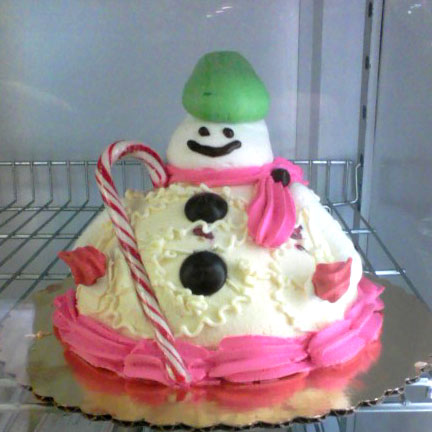
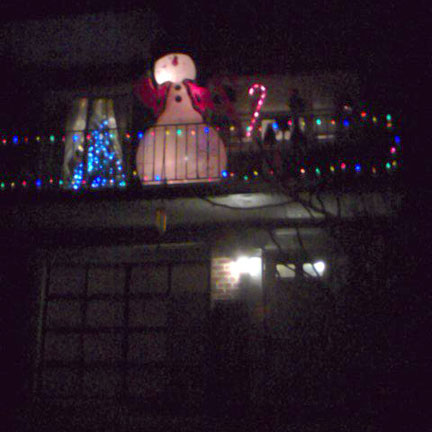
Tidings from some Astorian snowmen:

Snowman Cake at Artopolis Bakery

Snowman Cake at Artopolis Bakery

Pre-blizzard: Inflatable snowman on a balcony.

Inflatable snowman on a balcony.

Jabba the snowman

Post-blizzard: giant Jabba the snowman

I deepened my appreciation for decorations like this when I read that by filling our homes “with objects that reflect and confirm our uniqueness” we “transform a house into a home…. We need a supportive symbolic ecology in the home so that we can feel safe, drop our defenses, and go on with the tasks of life.” (Mihaly Csikszentmihalyi, Creativity, 1996)

Standard
Art & Development

The delectable joy of precision

circular saw and alumicut

When M asked me to build a pedestal for his project, I asked him for a figure on the Barreto scale: Is this a 1 or a 10 project? Ten indicates a flawless level of finish. Five means be efficient and don’t let the details take more time than necessary. I like to uphold high standards, but rarely can everything can be 10s all the time in preparator work. That’s just the nature of changeovers: your deadline is the opening. Several perfect elements won’t make up for one unfinished element.

M paused. I remembered that I was talking to a Virgo, and knew my answer: 10.

The motor on my hand-me-down circular saw sometimes loses power mid-cut, causing a skip and an ugly cut. This was fine for things like crates (a 1 or 2 on the scale), not ok for a pedestal. It was time to get a new saw. I chose a Rigid because it looked well-made (the base plate didn’t seem like an afterthought), the guard spring was not obnoxiously tight, it was light, and it was moderately priced. When I took it out of its box, it seemed surreal how pristine it was.

As soon as I lined up my first cut, the kerf cutout (which indicates where the blade will go) lined up exactly with my cutline and the blade (see pic) and I felt a surge of bliss. So much certainty and confidence! I saw my (near) future and it was a cut exactly where I needed the cut to be. Push the button. Smooth sailing. For a brief moment, I experienced a kind of Virgo’s nirvana.

Standard
Community

Tattfoo Tan: Artist funding Artists

Following Mark Bradford’s exceptional generosity, and continuing the theme of artists funding artists, NYC artist/master composter Tattfoo Tan has initiated a grant program, open to applications from non-New York City artists.

S.O.S. Guilds
Using art as a tool for social change on sustainability and ecology.

APPLY NOW
Open to all artists worldwide [except NYC residents] | Deadline: April 1, 2011

S.O.S. Guilds is an art and sustainable entity that creates social changes by applying the power of artistic imagination to inform, inspire, engage, animate and motivate in various communities around the world, by giving grants to artist to execute art project that high light the sustainable issue. As an artist, we are so used to be funded and in this economic landscape, we should seek to give and fund others artistic project that based on social activism and civic engagement. Artist that are funded by S.O.S. Guilds are encourage to pay it forward by funding others or give back to the S.O.S. Guilds pool of resources.

By offering a small grant of USD500, in two parts payment to guarantee the success and execution of the proposed project. As the founder of S.O.S. Guilds, I’m here to provide supports, marketing, and conceptual thinking to help in planning and trouble shoot in any stages of the project. Project must be completed in a season (3 months) duration and be documented from start to finish on a blog to be shared with the wider online audience. Anyone can apply except resident of New York City due to conflict of interest. Grantees must credit S.O.S. Guilds on all promotional materials.

By gathering like minded artists that are interested in deploying arts as a tools to awakes social consciousness, we as a collective whole around the world can make change one art project at a time.

Standard
Citizenship

Why bowing to censorship is a bad idea

The Andy Warhol Foundation for the Visual Arts–a briliant funder of the arts–has demanded that the Smithsonian restore David Wojnarovicz’s censored artwork to its exhibition. If the Smithsonian does not comply, the Warhol Foundation will cease funding future exhibitions at the Smithsonian. In the past three years the Warhol Foundation has given more than $375,000 to the Smithsonian.

Cheers to the Warhol Foundation. Sometimes it seems like people in the arts are so consumed with etiquette, so afraid of offending someone or burning a bridge, they haven’t got any guts. Cheers to the Warhol Foundation for putting your money where your mouth is!

This follows a national grassroots movement to exhibit the censored works at alternative art spaces and galleries. Participating spaces include the San Francisco Bay Area’s Southern Exposure and SF Camerawork.

If you are able, please support the work of these amazing nonprofits by becoming members. They are only able to support the work of artists via risk-taking funders like the Warhol Foundation, and individual members like you and me. For further backstory on the homophobic, politically-motivated censorship of this work by a seminal American artist, please see Blake Gopnik’s articles in the Washington Post.

Standard
Community, Sights

Three reasons to be excited about art

Please excuse my previous griping post and have a look at this:

1. Brendan Fernandes and Ohad Meromi at Art in General

I helped to install these two artists’ shows, and I’m very excited about the quality and experimentation in both of them. I feel very fortunate to work with wonderful staff and interns at Art in General in the production of shows by really kind, thoughtful artists.

Brendan Fernandes’ exhibition, From Hiz Hands, opens in the ground-floor Project Space tomorrow, Friday, December 10 at 6pm. In addition to a massive wall text and audio piece, there are three super neon signs you can see from the street.

Ohad Meromi contribues Rehearsal Sculpture, a likably obscure set of sculptures, props and setting for participatory action. Ohad’s prior work (see Harris Lieberman Gallery, of the sweetly ligature’d logo, for pics) are really fun combinations of formal and vernacular design with social overtones, so I’m really interested in this more explicitly performative and experiential work.

2. Mark Bradford, artist, MacArthur Genius, and artist-philanthropist-role model.

Bradford, who exuded articulateness, integrity and rigor in his talk at SFAI, is a role model. His most recent feat of fearlessness is committing to donate $100k to support other artists in the pursuit of their own projects that might not be otherwise funded. How awesome is that?

3. Via HWT, this image by Frances Twombly, found on ArtNet:

Frances Twombly, Balloons, 2004

Frances Twombly, Balloons, 2004

Standard