Art & Development, Community

Artists (and) Talking

This month, countless MFA exhibitions are occurring across the country. I’m in one at CCA, as friends and colleagues are in others around the Bay Area…

I’m looking forward to seeing the other MFA shows. It’s nice to be part of the buzz of excitement and celebration, and to see what people are capable of after two years of growth. But during a recent online search, I came across a Flickr page authored by someone who came to CCA’s MFA show to see the “competition.” Maybe it was ironic, but I don’t see the local art schools having a famous rivalry, like Cal versus Stanford or anything.

While it’s true that the art market is paying more attention to younger artists, I feel lucky to be among cohorts who value comraderie over competition.

See it for yourself.

fer·ma·ta: The 37th Annual University of California, Berkeley Master of Fine Arts Graduate Exhibition
May 18–June 10, 2007
Berkeley Art Museum

The San Francisco Art Institute’s Master of Fine Arts Graduate Exhibition
May 19–26
Fort Mason

San Francisco State University MFA Thesis Exhibition
(Oops! It ended a few days ago, but you can view the work on the website)

Mills College MFA Exhibition 2007

April 29th – May 27th
Mills College Museum

Lift Off: San Jose State University MFA Exhibiton
June 29 – August 4, 2007
San Jose Institute of Contemporary Arts

Academy of Art University
(Can’t seem to find an MFA show on the site, but there’s a school-wide Spring Show.)

California College of the Arts 2007 Centennial Graduate Exhibition
(The show closed today, but you can see lots of images at the website.

On another note, I got to present my work in the MFA exhibition today to a group of visitors from the Oakland Museum of California. They were doing a tour of several MFA exhibitions, and were genuinely fascinated by contemporary art. I had a lot of fun, and hope to have more chances to talk about my work.

It’s a common stereotype that artists don’t like talking about their work. But I’ve become very comfortable doing just that. My previous experiences probably helped — teaching forces you to get used to talking to big groups; doing presentations with clients boosts your confidence.

Plus, CCA emphasizes seminars and critiques–basically, lots and lots of talking. I’m thankful for the chances I’ve had to refine how I talk about my work, and to clarify what I want to convey.

Standard
Art & Development

MFA Exhibition Installation, Day 2

After picking up a new corner trowel today, I thought about how becoming an artist really is a lifelong journey. People usually talk about how it takes decades to fine-tune a creative practice. I agree; I’m also fascinated by how simply gaining knowledge of materials can be a lifelong pursuit.

In the course of making art, an artist might teach herself anything from casting concrete, wiring a chandelier, streaming data into a kinetic sculpture, or simply building a wall. A large portion of my time is spent seeking materials outside of baneful art supply chains,* in specialty outlets for hardware, lumber, framing, photography, paper, stationery, jewelry, welding, film industry expendables, equipment rentals, lighting and more.

As I’m leaving graduate school, I’m thankful for the knowledge I’ve gained, and inspired by the vast information I’ve yet to learn. I’m looking forward to accummulating knowledge about materials and techniques as I move on to bigger and better projects.


*About art supply chains: While I have to rely on them, I’m turned off by the attempts to commodify creativity to take advantage of people (often women and parents) who are seeking means of self-expression. For example, I’ve seen design-your-own gift card kits, which are essentially packages of folded paper (!) and envelopes. Second, some of the upcharges are obscene. Michael’s Arts & Crafts store sells double-stick tape for scrapbooking for almost $6, but you can get basically the same thing at an office supply chains for half that.

Standard
Art & Development

MFA Exhibition Installation, Day 1

I’m getting really excited about the MFA exhibition, which opens Thursday, 5/10 from 6-9 pm. I am in the midst of installation, and I’m impressed by the huge effort and attention to detail the work crew is putting in to transform CCA’s SF campus into flawless gallery walls. It’s also been really cool to work with the graduate programs manager, who’s coordinating the show, and curator, who seems to effortlessly mastermind how the art of dozens of artists will work together. And, I’m really impressed by the work of my co-horts. There are already a few ambitious projects already installed, and I think it’s going to be a really good show. Don’t miss it. The opening is free and open to the public.

Standard
Citizenship

The Revolution Will Not Be Funded

I’m curious about “The Revolution Will Not Be Funded: Beyond the Non-Profit Industrial Complex,” a new book by INCITE! Women of Color Against Violence (Boston: South End Press). Though I happily work with non-profits, I’m skeptical that this structure can result in widespread social change.

The good thing about non-profits is that everyone should have the satisfaction of fighting the good fight in their work. Dedicated, brilliant people work in non-profits, and young people get opportunities for leadership. But it’s unsustainable, driven by grant cycles and funding trends. Non-profit work doesn’t always provide adequate training, and certainly doesn’t offer competitive compensation!

I realize how non-profits can be manipulated to ultimately reinforce the capitalist status quo, but still, the book title makes me cringe a little. It seems to minimize the much more sinister military- and prison- industrial complexes, whose human costs are very real.

One chapter, “Non-Profits and the Autonomous Grassroots,” is written by Eric Tang, one of the smartest revolutionaries I’ve met. I met him when I lead a mural project at CAAAV: Organizing Asian Communities in the Bronx years ago. It’s probably worth the cost of the book just for Tang’s practical, informed analysis.

Standard
Art & Development

Why participating in Beats Per Minute was great

Today I de-installed my installation at the Museum of Craft and Folk Art‘s Beats Per Minute exhibition. Being part of the show was a great experience on so many levels!

And below, here’s why.

[By being transparent about what makes for good artists’ experiences, at least from my perspective, I hope to inspire aspiring artists, art supporters and art promoters.]

The studio visit. I try to celebrate my “firsts,” and this was my first important studio visit. Looking back, I probably put too many expectations on it. Later, I learned that visits are not about getting a commitment, as much as beginning a conversation. Of course, I was thrilled to continue the conversation as an artist in BPM.

The space. MOCFA has a professional, compact space in downtown SF. It has a great location, and seems to get quite a bit of foot traffic. I suspect that museum audiences are broader than gallery-goers, which is another plus.

The curatorial premise. I enjoy working with curators who create shows that are good-looking as well as indicative of focused, convincing central arguments. In BPM, the curator and museum director wanted to bridge contemporary music-influenced work with crafts. Moreover, they (and MOCFA) have the capacity to do it.

The artists. I’m honored to be among artists of such high caliber. (Check out Mung Lar Lam, Walter Kitundu, Christy Matson, and Torolab). I admire and respect their work. Not always liking the work you show alongside comes with the territory in group exhibitions, but I was all-around proud to be in BPM. Plus, the artists I met were all sweet, sincere, thoughtful people.

The organizers. In any collaboration, you have to trust your partners. I trusted the curator and museum director because their past projects were excellent and interesting. The exhibition became a good reason to get to know them–they’re genuine people whose thoughtful work makes me excited about being part of the Bay Area art community.

Events. MOCFA held supplementary public events: the opening, an artist’s talk, Mung Lar’s ironing performances, and family workshops. I was happy to participate in them. I feel like anything that can give people an entryway into the show is a good thing. It’s a great opportunity and honor for artists to interface directly with the public during an exhibition run.

Documentation & Publicity. A third party company assisted with documentation and media relations. They were great. Often the business aspects of art, such as publicity, are hidden. But how could an exhibition succeed if the public doesn’t know about it? BPM appeared in calendar listings, a TV segment, and a SFGate slide show. Self-interest aside, I think it helps a lot to have media specialists on the task. If it’s a good show, publicity benefits everyone–the organizers, the artists and the public.

Professional practices. To me, these “little things” take an exhibition experience from OK to Great…

  • An installation crew was friendly and available.
  • There were adequate tools and ladders.
  • The museum provided custom-built pedestals and shelves.
  • The curator or staff members adjusted the lights before the opening for maximum effect.
  • The wall labels looked clean and professional.
  • The staff was friendly and available to answer questions from the public.
  • The museum’s Education Director was organized and communicative, so planning and implementing the workshop was a breeze.
  • I was reimbursed for my expenses (additional art supplies, installation hardware, parking–these could easily add up!).
  • Whenever I dropped by unannounced during operating hours, the exhibition was picture-perfect (they were open, the lights were on, etc. Unfortunately, I think many struggling non-profits let gallery operations slide. The consequences are not immediate to them, but to me, a sense of disappointment registers.)
  • Lastly, I wasn’t expecting it, but I received an honorarium. It’s a welcome gesture. I probably spent 20 hours on installation, de-installation, the artist’s talk, workshop and a TV interview. (This doesn’t include the studio visit, paperwork, my own promotional efforts, or, of course, the actual time making the art, or other expenses of art supplies, studio space, etc. This isn’t intended to diminish the honorarium, but just to let people know about the costs involved in being an artist, and to advocate, whenever possible, that artists are paid for their work just like any other profession.)

I’m going into so much detail to counter the myth that being an artist just means having fun in the studio. In other words, people think being an artist is 90% inspiration, 10% perspiration. But it’s not how it goes, at least not for me. Studio work is one part–albeit the most important part–of an artist’s responsibilities: prospecting, procuring, publicity, administration of what’s essentially a small business, professional development, installing/deinstallation, documentation, shipping/delivering, packing. Yes, packing. Being an artist is not all intuition and expression–it calls for professional and organizational skills too.
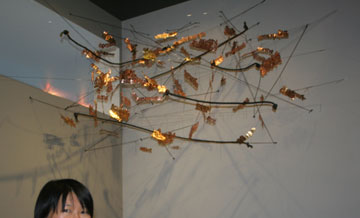
Cloud at MOCFA
Before. “Cloud” at the Museum of Craft and Folk Arts. 2006, copper, elastic, rope, string, approximately 7x7x5′. Cropped photo from a photo courtesy of MOCFA/David Perry Associates.
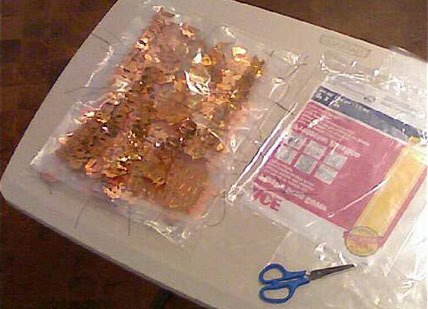
Cloud, de-installed and packed up
After. The copper text of Cloud, de-installed and packed up with hardware store plastic sheeting as interleaving.

Standard