Citizenship, Values

a happy day for you (if you’re the kind of person who likes civil liberties)

Gays and lesbians have a constitutional right to marry in California, the state Supreme Court said today in a historic ruling that could be repudiated by the voters in November.

In a 4-3 decision, the justices said the state’s ban on same-sex marriage violates the “fundamental constitutional right to form a family relationship.”

“State Supreme Court says same-sex couples have right to marry” SFGate.com, May 15, 2008

This issue may go to the state ballot in November. Hopefully, the voters of California, unlike those in 26 states that have banned same-sex marriage, will take a stand against discrimination. The way I see it, all you need is some historical perspective to understand that banning gay marriage in favor of domestic partnerships is painfully similar to “separate but equal” Jim Crow laws. Let’s not forget anti-miscegenation laws (most states explicitly barred interracial marriages well into the 20th century; Alabama’s anti-miscegenation law was not taken off the books until November 2000!). I wonder if any whites (the Voting Rights Act passed in 1965) voted to bar interracial marriages on the premise that interracial marriage threatened the “institution of marriage” — because they had the traditional view that marriage was a privilege that belonged to white people, just like some straight people are irrationally attached to the idea that the only marriage is hetero marriage.
Standard
Research, Travelogue

NYC Art

Some NYC highlights:

The kindness of friends and fellow travelers

The easy loquaciousness of a city of professional talkers

Brilliant people and their sincere enthusiasm to share industry insights

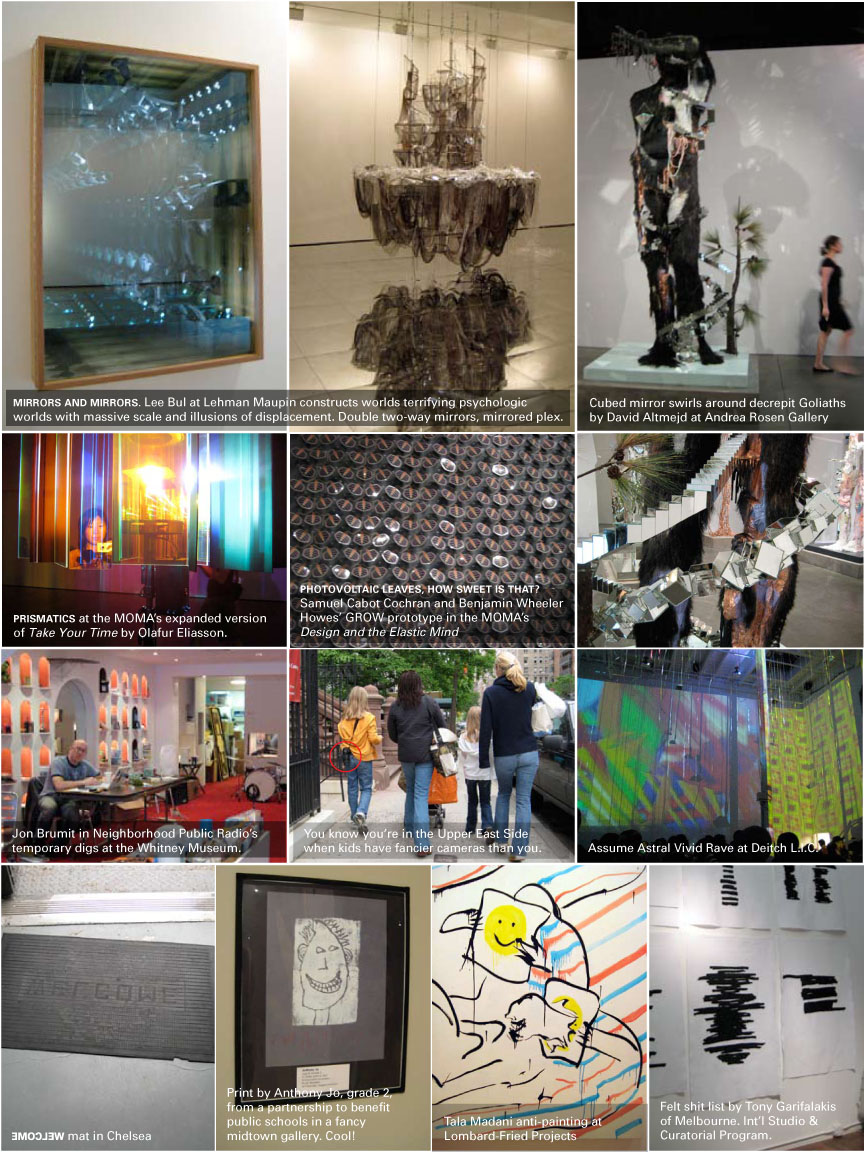
Surprising phosphorescent rubber sculptures by Jeanne Silverthorne at McKee Gallery.

The psychologically pregnant, tough and beautiful sculptures by Lee Bul at Lehmann Maupin Gallery

The strange giant figurative sculptures in unexpected media by David Altmejd at Andrea Rosen Gallery

More (yes, more!) Olafur Eliasson art at MOMA and PS1. Yes, the big rotating mirrored ceiling is impressive, but so are the kaleidoscope windows and color spectrum screenprint series.

Neighborhood Public Radio‘s quirky storefront broadcast studio and friendly faces at the Whitney Biennial

The videos at the Whitney Biennial:
Javier Tellez’ blind people and an elephant,
Omer Fast’s exploration of memory with a soldier’s narrative,
Mika Rottenberg’s chick/chicken coop installation/video, whose video/installation at the Tate Modern last fall was extremely enjoyable as well,
Spike Lee’s When the Levees Broke.
Also,
Ellen Harvey‘s Museum of Failure, which expresses her skepticism of art’s capacity in light and mirrors,
Heather Rowe’s Screen for the Rooms Behind,
photographs and shipped glass Fed Ex boxes by Walead Beshty

Vlatka Horvat’s temporary text-in-nature performances photographed and on display at Neuhoff Gallery

A delightful taste of sad-sack SF humor at Apex Art‘s Lots of Things Like This, a group show curated by Dave Eggers with Tucker Nichols and

Cao Guo-Qiang at the Guggenheim. Great use of the space. I loved the discreet installations in the wings, such as the shipwreck of china plates and cups, and the river constructed of yak skin with live snakes.

New York Magazine‘s fantastic graphic design

The International Studio and Curatorial Program‘s great new building in East Williamsburg, and esp. Satoshi Hashimoto for his futile video in which he buries himself in dirt.

Yoko Ono at Galerie Lelong
(A tangent: My mother loved the Beatles. She was introduced to their music by her Adult Education English instructor. She loved John Lennon’s voice, but she was also impressed that regardless of his wealth and fame, he married a Japanese woman. It was proof that anything is possible in America. Little did my mother know about Oko’s influence in Conceptual Art and Fluxus.)

Substraction, the surprising and humorous show of giant Ab Ex paintings at Deitch Projects.

Marco Breur & Arnold Helbling mail art with chromogenic paper at Von Lintel Gallery

Vintage Robert Colescott videos and mockumentary at Kravets Wheby

Some low-lights:

Overpriced food and coffee that tasted like coffee-flavored beverage.

Loads of corporate and secondary market galleries selling historic paintings by white men from the 20th century, as recent as the 1970s.

Standard
Art & Development

Striking a balance between playing outside of the rules and professionalism

I finally received a reimbursement cheque from an arts event I participated in last year. While the experience was fantastic, I would not wish the stress and financial strain resulting from my participation on anyone, much less artists of modest means. It’s wonderful when organisations take risks on emerging artists, but when the organisation’s programs exceed its capacity, the costs can begin to outweigh the benefits. Those costs can be financial, but far worse, psychological.

Standard
Art & Development, Values

all my base are belong to yours

sudden downturn

As much as I know I’m a producer of culture, in most quantifiable, economic measures, I’m a consumer: for the studio, I buy art materials. To promote my art, I buy office supplies, web hosting services, pay utilities, postage. I’m paying off my education (for which I am a consumer of loans). Even in the non-profit sector, I contribute with studio rent or donations (which is turned into capital at auctions). And even when I receive grants, the funds mostly circulate through me to art stores, hardware stores, printers, service providers, consultants, and to those previously mentioned lenders, and so on.

The Fed’s Stimulus Package is premised on the hopes that recipients will spend their rebates. Liquidity is good, as shown by the Moniac (the Monetary National Income Automatic Computer), a device designed by economist Bill Phillips and re-created by artist Michael Stevenson.

Liquidity is good. But let’s start with solvency. Most artists I know are working as teachers, designers, installers or baristas. I’m pretty sure artists would love to have the confidence to finance new projects, buy health insurance, maybe go on vacation!

Artists assume more risks than others, and often live with lower returns on their investments. But the choice is pretty obvious between keeping the monetary flow going on principle, and paying off credit card debt, chipping away at student loans, or re-stocking that rainy day fund.

One side effect—positive or negative, depending—is that the cost of participating in art opportunities that pay in “exposure” might finally start outweighing the benefits.

Standard
Art & Development

Schjeldahl on Eliasson: It’s grand, phenomenological. We love to hate it.

What are these works, besides fun? Perhaps not much, in themselves. They are choice instances of institutionally parasitic art that exists only because space-rich, audience-hungry museums and Kunsthallen must fill their schedules with something, and preferably not the inefficiently small and expensively insured objects that are traditional paintings and sculptures. I have been unhappy with the reign of such circusy manifestations, which are called into being less by anyone’s desire than as fulfillments of a job description. (Our jobs constrict us. Art should give us compensatory glimpses of freedom.) But there is a lyrical aura to any job that is done really well, and Eliasson routinely distills that aura into a Platonic essence of know-how and impeccable execution. The effect is generous and perhaps salubriously contagious. (Let’s all be better at what we do!) But the clincher, for me, is the negative virtue of Eliasson’s matter-of-factness, which more than refreshes in a type of art that commonly features strenuous myth and message. He refrains from burdening us with implications of mystical portent—a weak suit of intermittently impressive artist-shamans from Joseph Beuys to Matthew Barney—or, like hosts of the politically righteous, with exhortations to improve our moral hygiene. Eliasson isn’t entirely immune to social-therapeutic rhetoric—that would be asking a lot of a Scandinavian—as witness the nudgy title “Take Your Time.” (I will do as I please with my time, thanks.) But when he works, he is all honesty.

From “Uncluttered: An Olafur Eliasson retrospective,” by Peter Schjeldahl. New Yorker Magazine. April 28, 2008

Standard
Art & Development, Values

Professional Development for Artists

This past week, in addition to wrapping up some freelance graphic design projects, I’ve been busy with professional development courtesy of the Creative Capital Foundation In 2006, I was nominated by the wonderful people at the alternative art space, Intersection for the Arts, to participate in a Creative Capital Professional Development workshop, which covered everything from fine-tuning one’s self-promotion and grant-writing skills, to interpersonal communications skill building, to improving one’s attitude about money, to planning one’s life in the arts strategically. It did wonders for my attitude and professional skills — it even influenced my art (I decided to become an optimist!).

Creative Capital hasn’t offered the workshop locally since, but they partnered with Intersection again to offer a one-day communication workshop with Kirby Tepper. It fine-tuned my skills, and gave me new skills that I hope to carry out in the coming week.

I’m a Creative Capital enthusiast. They are building a model from the ground up — their trainers are successful artists and business world pros. I hope to reciprocate the support I’ve received from Intersection and Creative Capital one day.

It’s too bad there is such a need for professional development among artists, but few artists every have the opportunity to participate in trainings that are truly supportive. Sadly, cynicism, co-miseration and resignation to suffering for one’s art or the unfairness in the art world are dominant modes of discourse among artists. But what good does that do to anyone? While it helps to be realistic — having a life in the arts is challenging — it certainly doesn’t support artists or improve their success when one can’t imagine that having a life in the arts is compatible with success and happiness.

So I wanted to plug the Center for Cultural Innovation’s new book, The Business of Art: The Artist’s Guide to Profitable Self-Employment. I haven’t gotten my hands on it yet, but knowing CCI’s work is rooted in data gathered directly from practicing artists, I’m sure that it will be practical and useful.

Standard