Research

Podcast Reviews: Art school lectures

In the studio, I listen to a lot of podcasts, including lectures by contemporary artists, lit, conversations on astronomy, to public radio arts and culture shows. In the past few years a lot more interesting podcasts have popped up, so I thought I’d spread the good word and post reviews of notable podcasts here.

I’ve already mentioned the fantastic artist’s lecture by Kerry James Marshall at SFAI, as well as the really great presentation by Johanna Drucker at SVA.

SFAI’s podcast features world-class artists, but is rarely updated, and seems under produced (it’s just an audio recording of the lecture, but the levels aren’t balanced, and some of the Q&As should be cut or filled in). Likewise with CCA on iTunes U, except CCA’s recently hired some professional with a broadcast voice to conduct interviews. Though, with a podcast of first-year students seems more like an enrollment tactic, rather than intellectual endeavor.

SVA’s got a better-produced series of podcast lectures. As I mentioned, the Drucker lecture from the MFA Art Criticism and Writing department is great. I also tried listening to Barry Schwabsky present a paper on the ontology of painting — but had to stop due to a fatal flaw: the lecture was presented bilingually (English and French), but the levels were not balanced, and the translator was blasting my ears while I could barely hear Schwabsky. Too bad.

But SVA really excels with their Graphic Design lecture videos, including a Paul Rand series with notables like Milton Glaser, as well as a series presented by the design genius, Steven Heller. I haven’t got a portable player for videocasts, so I’m just scratching the surface of the design lectures, but they seem better produced. Learn more at the nicely designed web site, of course.

Standard
Values

Safe water = good

In keeping with my creed that the notion that a modern country like the U.S. can’t provide safe drinking water is absurd,* I applaud the effort to pressure Clorox, owner of the North American branch of Brita, to recycle those costly, carbon-filled filters. I gave up my Brita filter years ago, but at least the filtered water drinkers reduce the amount of bottles wasted.

Take Back the Filter: An Oaklander starts a campaign to urge Clorox to recycle used Brita water filters.
By Beth Terry, June 18, 2008, East Bay Express

I didn’t know whether to laugh or cry when I read this:

Clorox is making a bid for the green consumer at this time with its purchase of Burt’s Bees and its development of Green Works cleaning products.

Something about a wolf in sheep’s clothing. Or a wolf in a green jumpsuit.

*Karl Pilkington is right: We’re going backwards.

Standard
Research

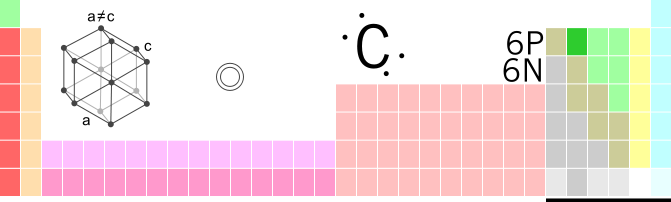
A point of reference: Carbon

carbon periodic chart, wiki commons
From the Wikipedia Commons.

Life is often represented as Light.
As in, “Then there was light.”
Or photographs of a dewy leaf bathed in sunlight. But it’s not the light that gives light, as much as the chlorophyll that transforms light into food.

Guess what?
Chlorophyll is comprised mostly of carbon atoms.

Carbon — literally — is the building block of life.
And it’s intrinsically tied to light: Carbon reflects light (as diamonds), creates light (and electricity, as the primary element in the hydrocarbons coal and petroleum), and absorbs light (charcoal, a result of the release of energy and light in a fire).

Standard
Art & Development

Physics dilettante

In continuing my projects around light as a stand-in for optimism or the immaterial qualities that the art experience is supposed to inspire, I’ve been trying to learn more about physics.

How Stuff Works’ article on fiber optics mentions a physics principle called Total Internal Reflection. What a wonderful phrase!

Total Internal ReflectionoitcelfeR lanretnI lotaT

Standard
Community, Research

White stuff I like, more or less

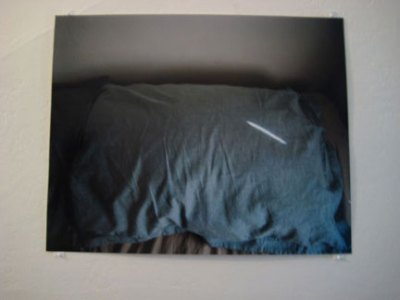
I have always liked Lindsey White‘s photos. Her new photos and videos make up a nice show at Partisan Gallery, somebody’s house on Guerrero. Endearingly earnest, like her previous portraits, but less quirky-cute, and more chance-magic (in the end, it’s just about personal taste: arty vs. Art). The new works are about light, and veer between optimism and the pathetic/mundane.


A bad pic of a great photo by Lindsey White, of a spear of light on a pillow. She shoots digital and 120mm, if you wanted to know.


A multi-channel video installation; each video is a single shot of a single thing. It functions like a sequence of photos in a book, only with slight movement and minimal audio. Great!

Also liked Richard T. Walker‘s two-channel video installation at Iceberger. More instruments, letters to nature, human projection onto the romantic ideals of nature. His English accent adds something; for no good reason, I assume that it suggests more of an awareness of the Romantic period than if he were American. Maybe my visit to Cumbria, the land of all those English Lake writers, has something to do with it.

It was a nice summer evening, and I enjoyed chatting with artists and meeting some guys showing with Little Tree Gallery, but I couldn’t shake my self-awareness of the New Mission, as youthful gallery-goers drank Pabst on the sidewalk for hours on end, just like during First Fridays in Oakland. What’s at stake is so different for different people, isn’t it? Earlier in the day, I found a kindred iconoclast willing to challenge hipsters’ endorsement of dingy ethnic restaurants in rough neighborhoods like Tu Lan and Shalimar. WTF? Thanks to the digital age, there is a source to explain this behavior: Stuff White People Like. See #91: San Francisco and #71: Being the only white person around.

Another thing White People like is critical theory (see #81: Graduate School). I must be White, because the podcast of Johanna Drucker‘s lecture at SVA blew my mind. The artist and author challenges Adorno’s 20th c. aesthetic theory and explains her notion called aesthesis, a specialized form of knowing (through art), characterized by knowing grounded in central experience, emergent experiences and co-dependent relationships. In contrast to Adorno’s assertion that art is autonomous, Drucker suggests that art is complicit and co-dependent; that it is in fact a form of commodity production, even if we don’t like to think of it so.

A tasty morsel:
She classifies low-brow pop paintings and drawings that reference comics or media as:

combinatoric mass culture kitsch production

And on the meat of the matter, for me:

To dispute Adorno’s assertion that because art is removed from the world of utilitarian objects, they are inherently resistant, Drucker says:

The notion of resistance [inherent to art] will die hard because it is the last link to the kind of utopian belief that … has a long history with modernism, and certainly gets reformulated again in mid-19th century with the coming of political philosophy…. The shift to political philosophy from ‘regular’ philosophy is that rather than understanding or describing the condition of knowledge or sensation or the mind, the political philosophy said the point is to change it. So the task of change — which again, the world is broken, we do need to fix it — … comes to be identified with the avant garde and … the role of art assumes a moral hierarchy and a moral high ground for the artist and the work of art. And that seems to me to be highly suspect. And that’s where I come back to complicity. We are not better than the world we inhabit….

The notion that difficulty, in and of itself, is a form of resistance that performs some sort of political efficacy—it’s just not true. It’s what I call magical politics. It’s like, where exactly does the transformation of power relations and political agency actually occur in those difficult works? It doesn’t….

I make difficult work. I write really obscure things. But I don’t imagine that they are making a transformation of the political structure. I do imagine, and I do believe that they transform the meme world. That’s what we do. We are meme makers. We transform. We reimagine. We remodel. We offer new models of cognition and new models of experience. And we produce that as an effect. We don’t produce that inherently in objects. It is an effect of what we do.

I had similar feelings of caution around the sense of artists having a moral high ground in the process of developing new work for Activist Imagination. So it’s great to hear Drucker put a historical framework around the conditions of art-viewing that we are subject to, and available for displacement if we choose.

Standard
Community

The Headlands: Not so bad, and Saturday: openings galore!?

golden gate bridge
A recent view from the Marin Headlands.

Marin can seem awful far from San Francisco or Oakland, but really, once you get up there, it’s totally worth it. So come over for Tuesday’s Artists’ Talk.

Tuesday, June 17 @ 7:30PM
Artist Talk: Headlands Graduate Fellows
Headlands Center for the Arts, Marin Headlands, CA

The Graduate Fellowship Awards were established to provide outstanding recent MFA graduates with free studio space for one year and a chance to segue from art school into the professional artist’s life during their time at Headlands.
Mariah Hess, MFA in Photography, UC, Davis
Ginelle Hustrulid, MFA in Film/Video Mills College
Julie Chang, MFA in Painting Stanford University
Joe McKay, MFA in Art Practice UC, Berkeley
David Gurman, MFA in Film/Video CCA
Emily McLeod, MFA in Photography SFSU
Vanessa Woods
Location + Directions

—–

And tomorrow, don’t miss:

Saturday, June 14, 2008, 4:00 PM
Rodney Ewing: Public Safety Artist’s Talk
Frey Norris Gallery, 456 Geary St, San Francisco

On Saturday, June 14th at 4:00 in the afternoon, Ewing will offer a slide presentation and gallery talk that will examine popular media discourse on issues around public safety (and the anxieties that fuel them and attempts to mitigate them) and how these intersect with his artwork and studio practice. This event is free and open to the general public.

Currently at Frey Norris Gallery: Rodney Ewing’s first exhibition with the gallery, Public Safety, is comprised of three thematic series that are displayed throughout our space: Disarm, Countermeasures and Meditations. Public Safety examines devices and methods ostensibly designed to protect citizens. Ewing re-structures them as tools that might provide an alternative kind of security, tools that subvert the original intentions of the represented objects’ creators. The redesigning of these instruments and re-application of these techniques appear as cable-hung and wall mounted images, light boxes and installations.

Saturday, June 14, 7-9 pm
Opening: Richard T. Walker
Iceberger Gallery, 3150 18th St. @ Treat, San Francisco

Iceberger is proud to present Sometimes I like you more than othertimes. a solo show by Richard T. Walker. Walker utilizes spoken dialogue, text and original music compositions to generate video and photographic works that explore complex relationships between language, the environment and the human condition.

Ongoing / May 22 – June 29, 2008
Exhibition: You Make Me Make You, Suzanne Husky
Triple Base Gallery, 3041 24th St, San Francisco

For her ambitious installation at Triple Base, Suzanne Husky has crafted a series of soft sculptures that include Chinese factory workers, Mexican laborers, “counter-mainstream hipsters”, and a series of inventive Berkeley “eco-heroes.” The work depicts extreme labor, oppression, community, superficiality, unmindful expending of resources, and white guilt. This show is sure to entertain if you like stories, using your imagination, and thinking critically about the world we live in today.

The Dinner Lecture Series event will take place on Friday, June 27th and features special guests Amy Franceschini and Michael Swaine of Futurefarmers.

SAT. JUNE 14TH, 7-10PM
OPENING: IF WE LET OURSELVES GO: NEW WORK BY LINDSEY WHITE
PARTISAN GALLERY, 112 GUERRERO (between Duboce and 14th)

Show: June 14th-July 12th
After opening, viewings by appointment:
415 272 7029

Standard
Research

Walker ramblings

I had the good fortune to visit the Walker Art Center last Fall, and it knocked my socks off.

The Walker is striking in how top-notch it is all around. The collection is incredible, with lots of contemporary projects. The building is huge, with lots of interesting spaces: some grand foyers, some interesting changes in elevation, a nice split-level gallery, not to mention the sprawling grounds. And of course, the Walker graphic design department kicks ass. (Check out their site.)

Lately I’ve been really feeling the interconnectedness among art, design and architecture. I’ve always been interested in design — in fact, it’s how I got into art in the first place — but until recently I’ve been sort of oblivious to architecture. But like seeing the crystal goblet of graphic design, I’m finally starting to really see the matrix of the built environment.

Cheers to the Walker for maintaining a high level of commitment to excellence in these overlapping spheres of inquiry.

I’m excited about two programs at the Walker this season. And guess what? They’re cross-disciplinary.

Art + Graphic Design :
Call for submissions for artist-designed political yard signs

Art + Music + Performance + Architecture + Video :
Meredith Monk and Ann Hamilton
A multi-media music-theater-performance work set against video of a tower Hamilton designed in Northern California.

[On another note, I’m fascinated by artist’s strategies for presentation. I watched Hamilton’s video clip on Spark, showing the construction of the massive tower and early collaborations with Monk. But the tower is on the Olivers’ private ranch. I wondered, who will see it? Then I get an email from the Walker; the architectural work in CA sparks a performance work, which sparks a video that gets parlayed into a theater-based work in MN. Brilliant! As a project-based artist (that is, making projects rather than ongoing bodies of work), I love how Hamilton took a sketch and used its momentum to build traction on multiple presentations of the work.]

Standard